
Pathophysiology Chapter 1 Questions And Verified Correct Answers Guaranteed Success/2024.
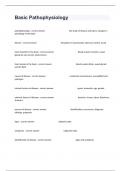
What is pathophysiology? - correct answer It is the study of abnormalities in physiologic functioning of living beings. It examines disturbances of normal mechanical, physical, and biochemical functions, either caused by a disease or resulting from a disease or abnormal syndrome or condition. Broken down, what two components make up pathophysiology? - correct answer Pathology (suffering) and physiology (nature) Pathology is the study and diagnoses of disease through examination of organs, tissues, cells, and bodily fluids. Physiology is the study of mechanical, physical, and biochemical functions of living organisms. What are the four interrelated topics in Pathophysiology? - correct answer Etiology, pathogenesis, clinical manifestations, and treatment implications. What is Etiology? - correct answer In it's most general definition, is the study of the causes or reasons for phenomena. A description of etiologic process includes the identification of those casual factors that, acting in concert, provoke a particular disease or injury. What does it mean if the cause of a phenomena is unknown? - correct answer This condition is said to be *idiopathic* What does it mean if the cause of a phenomena is the result of an unintended or unwanted medical treatment? - correct answer This condition is said to be *iatrogenic* What is a good example of most disorders being multifactorial (having several different etiologic factors contribute) - correct answer Coronary heart disease. It can be caused by genetics, diet, exposure to cigarette smoke, elevated blood pressure, and more. What is a risk factor? - correct answer When the link between an etiologic factor and development of a disease is less than certain, but the probability is increased when the factor is present. What are risk factor's important for? - correct answer *Disease prevention* and various levels of prevention provide focus for epidemiology. What is pathogenesis? - correct answer It refers to the development or evolution of a disease, from the initial stimulus to the ultimate expression of the manifestations of the disease. In summary, it is a description of how etiologic factors are thought to alter physiologic function and lead tot he development of clinical manifestations that are observed in a particular disorder or disease. What is the best example of a communication network in terms of such physiologic events that take place within pathogenesis? - correct answer The immune system and it's interactions with essentially every other cell in the body! What are clinical manifestations? - correct answer Manifestations of a disease that are observed are termed *signs of disease*. Such objective data may be gathered by clinical examination or by biochemical analysis, diagnostic imaging, and other laboratory tests. What are symptoms? - correct answer The subjective feelings of an abnormality in the body. By definition, symptoms are subjective and can only be reported by the affected individual to an observer. What is a sign? - correct answer Signs can be objectively observed. For example, nausea is a symptom and vomiting is a sign. What is a syndrome? - correct answer A syndrome is termed for a disorder when the etiology of a particular set of signs and symptoms has not yet been determined. What is a latent period or incubation period (in terms of infectious diseases) - correct answer The interval between exposure of a tissue to an injurious agent and the first appearance of signs and symptoms. What is the prodromal period or prodrome? - correct answer This refers to the appearance of the first signs and symptoms indicating the onset of a disease. They are often non-specific, such as headache, malaise, anorexia, and nausea. What is the manifest illness stage or the acute phase? - correct answer The disease reaches it's full intensity and signs and symptoms attain their greatest severity. What is the silent period or latent period? - correct answer Sometimes during the course of a disease, the signs and symptoms may become mild or even disappear for a time. What are some examples of a silent period occurring in disease? - correct answer Total-body irradiation syndrome and syphilis. What is a subclinical stage? - correct answer The patient functions normally, although the disease processes are well established. An example of this is chronic renal disease, a kidney and partially the other can be destroyed before any symptoms related to a decrease in renal functions are perceived. Explain the meaning of some diseases following a course of alternating exacerbations and remissions. - correct answer An exacerbation is a relatively sudden increase in the severity of a disease or any of its signs and symptoms. A remission is an abatement or decline in severity of the signs and symptoms of a disease. If a remission is permanent (longer than 5 years) the person is said to be cured. What is the convalescence stage? - correct answer The stage of recovery after a disease, injury, or surgical operation. What does it mean when a disease produces subsequent pathologic sequela? - correct answer Scarring! What are treatment implications? - correct answer An understanding of the etiology, pathogenesis, and clinical consequences of a particular disorder may suggest, or "imply", that certain treatments could be helpful. What are measures of how well a given test can discriminate between persons with and without a given condition? - correct answer Sensitivity and specificity What is sensitivity? - correct answer It is the probability that the test will be positive when applied to a person with the condition. (If a kit for testing a throat swab for the presence of streptococcal infection has a sensitivity of 80%, then 20% of a group of people with streptococcal infection would erroneously test negative for the condition (false negative rate). What is specificity? - correct answer It is the probability that a test will be negative when applied to a person who does not have a given condition. If the streptococcal throat swab kit has a specificity of 95%, then 5% of those tested who do not actually have the condition would erroneously test positive. (false positive rate). What are some individual factors that influence normality? - correct answer Age, gender, genetic a
Información del documento
- Subido en
- 5 de mayo de 2024
- Número de páginas
- 3
- Escrito en
- 2023/2024
- Tipo
- Examen
- Contiene
- Preguntas y respuestas

