With reference to the item and your own knowledge, explain the meaning of
the term norms. [5]
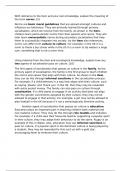
Norms are basic moral guidelines that are spread amongst cultures and
influence our behaviour. They are primarily learned through primary
socialisation, which we receive from the family. As shown in the item,
children learn particularistic norms from their parents and carers. They will
later learn universalistic norms during secondary socialisation that help
them to successfully integrate into society. As the item also references,
norms can differ from culture to culture. For example, in the UK it is a
norm to thank a bus driver while in the US it is a norm to tip waiters a large
sum, something that is not a norm here.
Using material from the item and sociological knowledge, explain how any
two agents of socialisation pass on culture. [10]
The first agent of socialisation that passes on culture is the family. As the
primary agent of socialisation, the family is the first group to teach children
the norms and values that align with their culture. As shown in the item,
they can do this through informal sanctions in the socialisation process.
For example, if a child behaves in a way that aligns with their culture, such
as saying ‘please’ and ‘thank you’ in the UK, then they may be rewarded
with extra pocket money. The family can also pass on culture through
canalisation. If a child wants to engage in an activity that does not align
with the gender conventions assigned by their culture, they may not be
allowed to engage in that activity. For example, a girl may not be allowed to
play football in the UK because it’s not a stereotypically feminine activity.
Another agent of socialisation that passes on culture is education.
Education plays an important part in teaching children both material and
non-material culture. They may do this through role models and imitation.
For example, if a child sees their favourite teacher supporting a popular sport
in their culture, they may adapt their behaviour to do the same. Rugby is an
example of this in Wales. Also, education may use informal sanctions to
pass on culture. If a popular sport in the dominant culture is being played by
a student, they may be rewarded for this such as with a gold star,
encouraging them to embrace their culture.
the term norms. [5]
Norms are basic moral guidelines that are spread amongst cultures and
influence our behaviour. They are primarily learned through primary
socialisation, which we receive from the family. As shown in the item,
children learn particularistic norms from their parents and carers. They will
later learn universalistic norms during secondary socialisation that help
them to successfully integrate into society. As the item also references,
norms can differ from culture to culture. For example, in the UK it is a
norm to thank a bus driver while in the US it is a norm to tip waiters a large
sum, something that is not a norm here.
Using material from the item and sociological knowledge, explain how any
two agents of socialisation pass on culture. [10]
The first agent of socialisation that passes on culture is the family. As the
primary agent of socialisation, the family is the first group to teach children
the norms and values that align with their culture. As shown in the item,
they can do this through informal sanctions in the socialisation process.
For example, if a child behaves in a way that aligns with their culture, such
as saying ‘please’ and ‘thank you’ in the UK, then they may be rewarded
with extra pocket money. The family can also pass on culture through
canalisation. If a child wants to engage in an activity that does not align
with the gender conventions assigned by their culture, they may not be
allowed to engage in that activity. For example, a girl may not be allowed to
play football in the UK because it’s not a stereotypically feminine activity.
Another agent of socialisation that passes on culture is education.
Education plays an important part in teaching children both material and
non-material culture. They may do this through role models and imitation.
For example, if a child sees their favourite teacher supporting a popular sport
in their culture, they may adapt their behaviour to do the same. Rugby is an
example of this in Wales. Also, education may use informal sanctions to
pass on culture. If a popular sport in the dominant culture is being played by
a student, they may be rewarded for this such as with a gold star,
encouraging them to embrace their culture.