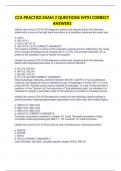
CCA PRACTICE EXAM 2 QUESTIONS WITH CORRECT ANSWERS|100% verified
CCA PRACTICE EXAM 2 QUESTIONS WITH CORRECT ANSWERS Identify the correct ICD-10-CM diagnosis code(s) and sequencing for the following: patient with a scar on the right hand secondary to a laceration sustained two years ago. a. L90.5 b. S61.411S c. L90.5, S61.411S d. S61.411S, L90.5 CORRECT ANSWER C The residual condition or nature of the sequela is sequenced first, followed by the cause of the sequela (Hazelwood and Venable 2014, 5, 181). The seventh character "S" us added to the laceration code to identify the sequela. Identify the correct ICD-10-CM diagnosis code(s) and sequencing for the following: patient with dysphasia secondary to a previous cerebral infarction. a. R13.10, I69.391 b. R47.02, I69.391 c. I69.391, R13.10 d. R13.10, I69.398 CORRECT ANSWER C Index Dysphagia, following, cerebral infarction I69.391. Add R13.10 as an additional code per "use additional code to identify the type of dysphagia, if known (R13.1-)" note under I69.391. Multiple codes may be needed for sequelae...in order to fully describe a condition. In the Tabular List, the instruction of "Use additional code" not indicates it is necessary to assign a secondary code to fully describe a condition or disease process. Identify the correct ICD-10-CM diagnosis code(s) for the following: patient suffered a partial traumatic metacarpophalangeal amputation of his right index and middle fingers. a. S68.011A, S68.012A b. S68.120A, S68.122A c. S68.011D, S68.012D d. S68.011S CORRECT ANSWER B Traumatic amputation classified in chapter 19. Index Traumatic amputation, finger (complete metacarpophalangeal) S68.11-. 7th character "A" initial encounter. Identify the correct ICD-10-PCS code for open thrombectomy, left brachial artery. a. R68.89 b. R79.89 c. R89.8 d. R97.2 CORRECT ANSWER D Index Elevated, elevation, prostate specific antigen (PSA), R97.20 Identify the correct ICD-10-CM diagnosis code(s) for a patient with near-syncope event and nausea. a. R55 b. R55, R11.0 c. R55, R11.2 d. R42, R11.0 CORRECT ANSWER B Near-syncope and nausea are both symptoms and therefore not integral to the other. Both conditions should be coded. Identify the correct ICD-10-CM diagnosis code(s) for a patient with an elevated glucose tolerance test. a. R73.9 b. R73.01 c. R73.01, R73.9 d. R73.02 CORRECT ANSWER D An oral glucose tolerance test helps determine whether a patient has prediabetes or diabetes. Index Elevated, elevation, glucose tolerance (oral) R73.02, which when verified in the Tabular, is a complete code. The Tabular should always be referenced to verify the code. Identify the correct ICD-10-CM diagnosis code(s) for a patient with pneumonia and persistent cough. a. R05, J40 b. J18.9, R05 c. J18.9 d. J18.1 CORRECT ANSWER C Pneumonia, unspecified, is assigned J18.9 in the Alphabetic Index. The persistent cough is a symptom of the pneumonia and should not be coded separately. Identify the correct ICD-10-CM diagnosis code(s) for a patient with seizures; epilepsy ruled out. a. R56.9 b. G40.901 c. R56.9, G40.909 d. G40.909 CORRECT ANSWER A Code signs and symptoms when a condition is ruled out, which means the condition has been proven not to exist. The code for seizures (R56.9) is assigned when a more specific diagnosis cannot be made even after all the bearing on the case have been investigated. Identify the correct ICD-10-CM diagnosis code for a male patient with stress urinary incontinence. a. N39.46 b. R32 c. N39.3 d. N39.498 CORRECT ANSWER C Urinary incontinence is a loss of urine without warning and may be associated with many conditions. ICD-10-CM classifies stress incontinence to N39.3 for both male and female types. Index Incontinence, stress (female) (male), N39.3. Subcategory N39.498 Other specified urinary incontinences is not correct because the type (stress) has a specific code. Identify the correct ICD-10-CM diagnosis code(s) for a patient hospitalized and treated for vancomycin-resistant sepsis requiring treatment with other special antibiotics. a. A49.01 b. A41.2, Z16.3 c. A41.9, Z16.21 d. Z16.3, A41.02 CORRECT ANSWER C Category Z16, Resistance to Antimicrobial Drugs, is used as additional code. Assign sepsis for principal as "code first the infection." Identify the punctuation mark that is used to supplement words or explanatory information that may or may not be present in the statement of a diagnosis in ICD-10-CM coding. The punctuation does not affect the code number assigned to the case and is considered a nonessential modifier. a. Parentheses () b. Square brackets [] c. Slanted brackets [] d. Braces { } CORRECT ANSWER A Parentheses enclose supplementary words or explanatory information that may or may not be present in the statement of a diagnosis or procedure. They do not affect the code number assigned in the case. Bronchiectasis (fusiform) (post infectious) (recurrent) is an example of a diagnosis statement with nonessential modifiers noted with parentheses
Información del documento
- Subido en
- 2 de mayo de 2024
- Número de páginas
- 25
- Escrito en
- 2023/2024
- Tipo
- Examen
- Contiene
- Preguntas y respuestas