Halogens
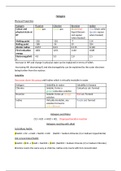
Physical Properties
Halogen Fluorine Chlorine Bromine Iodine
Colour and Yellow gas Green gas Brown-red Grey-black solid
physical state at liquid (brown- (purple vapour
RT red vapour when heated)
when heated)
Melting point -220 -101 -7 114
Boiling point -188 -34 59 184
Atomic radius 0.057 0.01 0.115 0.140
First ionisation 1681 1251 1140 1008
energy
Electronegativit 4.0 3.0 2.8 2.5
y
-Increase in MP and change in physical state can be explained in terms of VdWs
-Increasing AR, decreasing IE and electronegativity can be explained by the outer electrons
being further from the nucleus
Solubility
Decreases down the group until iodine which is virtually insoluble in water
Halogen Solubility in water Solubility in hexane
Chlorine Soluble, forms a Colourless sol. Formed
green/colourless solution
Bromine Soluble, forms an orange Red sol. Formed
solution
Iodine Virtually insoluble, any Purple sol. formed
solution formed is
yellow/brown
Halogens and Water
Cl2 + H20 → H0Cl + HCL Disproportionation reaction
Halogens reacting with alkali
Cold dilute NaOH:
2NaOH + Cl2 → NaCl + NaClO + H20 (NaClO = Sodium Chlorate (I) or Sodium Hypochlorite)
Hot concentrated NaOH
6NaOH + 3Cl2 → 5NaCl + NaClO3 + 3H20 (NaClO3 = Sodium Chorate (V) or Sodium Chlorate)
Bromine reacts the same way as chlorine, iodine only reacts with hot concentrated.
Physical Properties
Halogen Fluorine Chlorine Bromine Iodine
Colour and Yellow gas Green gas Brown-red Grey-black solid
physical state at liquid (brown- (purple vapour
RT red vapour when heated)
when heated)
Melting point -220 -101 -7 114
Boiling point -188 -34 59 184
Atomic radius 0.057 0.01 0.115 0.140
First ionisation 1681 1251 1140 1008
energy
Electronegativit 4.0 3.0 2.8 2.5
y
-Increase in MP and change in physical state can be explained in terms of VdWs
-Increasing AR, decreasing IE and electronegativity can be explained by the outer electrons
being further from the nucleus
Solubility
Decreases down the group until iodine which is virtually insoluble in water
Halogen Solubility in water Solubility in hexane
Chlorine Soluble, forms a Colourless sol. Formed
green/colourless solution
Bromine Soluble, forms an orange Red sol. Formed
solution
Iodine Virtually insoluble, any Purple sol. formed
solution formed is
yellow/brown
Halogens and Water
Cl2 + H20 → H0Cl + HCL Disproportionation reaction
Halogens reacting with alkali
Cold dilute NaOH:
2NaOH + Cl2 → NaCl + NaClO + H20 (NaClO = Sodium Chlorate (I) or Sodium Hypochlorite)
Hot concentrated NaOH
6NaOH + 3Cl2 → 5NaCl + NaClO3 + 3H20 (NaClO3 = Sodium Chorate (V) or Sodium Chlorate)
Bromine reacts the same way as chlorine, iodine only reacts with hot concentrated.