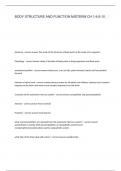
body structure and function midterm ch 1-4,6-10
Anatomy - correct answer The study of the structure of body parts or the study of an organism Physiology - correct answer study of function of body parts or living organisms and their parts anatomical position - correct answer body erect, arms at side, palms forward, hands and feet pointed forward function of spinal cord - correct answer primary center for all spinal cord reflexes; sensory tracts conduct impulses to the brain and motor tracts conduct impulses from the brain 2 systems of the autonomic nervous system - correct answer sympathetic and parasympathetic Anterior - correct answer front (ventral) Posterior - correct answer back (dorsal) what neurotransmitters are released from the autonomic Nervous system? - correct answer acetyicholine ( used by both parasympathetic an sympathetic systems) and norepinephrine(noradrenaline) used by sympathetic system what lobe of the brain deal with vision? - correct answer occipital lobe Proximal - correct answer near the point of attachment Distal - correct answer away from the point of attachment superficial - correct answer near the surface deep - correct answer away from the surface Anatomical Directions - correct answer superior, inferior, anterior, posterior, medial, lateral, proximal, distal, superficial, deep body planes - correct answer sagittal, frontal, transverse sagittal plane - correct answer divides body into left and right sides frontal plane - correct answer (coronal) Divides the body into front and back portions. transverse plane - correct answer divides the body into upper and lower portions 2 major body cavities - correct answer Dorsal cavity and ventral cavity dorsal cavities contain - correct answer cranial and spinal cavity ventral cavity - correct answer thoracic cavity and abdominopelvic cavity abdominopelvic regions - correct answer 9 regions right hypochondriac, epigastric, left hypochondriac, right lumbar, umbilical, left lumbar, right iliac (inguinal) hypogastric, left iliac (inguinal) Acid - correct answer Any subject that when dissolved in water contributes to an excess of of H- ion (values below 7) high H+ Base - correct answer A chemical that when dissolved in water reduces concentration of H+ in the whole solution (values above 7) low H+ active transport - correct answer requires ATP (like riding a bike up hill) ion pumps, phagocytosis, pinocytosis passive transport - correct answer requires no ATP (like riding a bike downhill) Diffusion, filtration, osmosis hypotonic solution - correct answer cell swells, can burst causing hemolysis isotonic solution - correct answer nothing happens hypertonic solution - correct answer cell shrinks called crenation 4 tissues of the body - correct answer epithelial, connective, muscular, nervous epithelial tissue - correct answer covers body surfaces and lines body cavities (protect us) connective tissue - correct answer connects joints, tissue, tendons, and structure. (most abundant tissue in the body because it is the supporting framework) muscle tissue - correct answer movement specialist of the body (3 kinds-skeletal, cardiac, smooth) nervous tissue - correct answer provides rapid communication between structures and control of functions Functions of the skeletal system - correct answer supports and gives shape to the body, protects internal organs, stores calcium, hematopoiesis, helps make movements possible (joints pulled by muscle) 4 types of bones - correct answer long (humerus), short (wrist), flat (frontal), irregular (vertebrae) vertebral column - correct answer Cervical (7), Thoracic (12), Lumbar (5), Sacrum (1), Coccyx (1) thorax - correct answer sternum( breast bone), thoracic (rib cage), 1-7 true ribs, 8-10 false ribs, 11-12 floating ribs different kinds of joints - correct answer synarthroses, amphiarthroses, diarthroses what happens to bone with age - correct answer the human skeleton reaches its mature state at 25. After 50 density of bone decreases slowly skeletal muscle - correct answer striated and voluntary with crosswise stripes or striations cardiac muscle - correct answer Involuntary muscle tissue found only in the heart with intercalated disk and striations Functions of the skin - correct answer protection, temperature, regulation, sense smooth muscle - correct answer Involuntary muscle found inside many internal organs of the body. also called visceral muscle with no striations Primary layers of skin - correct answer epidermis, dermis, hypodermis (subcutaneous tissue) Epidermis - correct answer outermost layer of skin Dermis - correct answer middle layer of skin; deeper of the 2. made up mostly of connective tissue and it allows the skin to stretch Hypodermis (subcutaneous tissue) - correct answer fatty layer located directly above muscle Joint Movements - correct answer Abduction, Adduction, rotation Circumduction, Flexion, Extension, Dorsiflexi
Información del documento
- Subido en
- 27 de abril de 2024
- Número de páginas
- 8
- Escrito en
- 2023/2024
- Tipo
- Examen
- Contiene
- Preguntas y respuestas