Med/Surg Final Exam
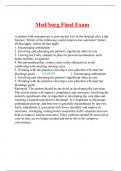
Med/Surg Final Exam A patient with osteoporosis is post-op day two in the hospital after a hip fracture. Which of the following would improve her outcomes? Select all that apply. Select all that apply. 1. Encouraging ambulation 2. Involving and educating the patient's significant other in care 3. Leaving the Foley catheter in place to prevent incontinence until better mobility is regained 4. Recommending that visitors come in the afternoon to avoid conflicting with morning nursing cares. 5. Working with the patient to develop a care plan that will meet her discharge goals - ANSWER 1. Encouraging ambulation 2. Involving and educating the patient's significant other in care 5. Working with the patient to develop a care plan that will meet her discharge goals Rationale: The patient should be involved in developing the care plan. This involvement will improve compliance and outcomes. Involving the patient's significant other is important in developing the care plan and ensuring a smooth transition to discharge. It is important to encourage ambulation post-op, and best rest is generally discontinued by day two. Early ambulation is associated with lower mortality and improved outcomes. Arranging visiting hours around the staff's schedule does not help to improve patient outcomes. Foley catheters should be removed as soon as they are no longer needed and never left in for caregiver convenience. The nurse is reviewing the x-ray of a patient with a fractured humerus. The x-ray shows one side of the bone is broken while the other side is bent. What type of fracture is this? 1. Compression fracture 2. Greenstick fracture 3. Impacted fracture 4. Oblique fracture - ANSWER 2. Greenstick fracture Rationale: A greenstick fracture is when one side of the bone is broken while the other side is only bent. These fractures most occur often in children. An impacted fracture is when a part of the bone is driven into another bone. A compression fracture is when the fractured bone is compressed by other bone tissue. An oblique fracture is when the fracture is diagonal to the bone's long axis. The nurse is assessing a patient in a Thomas splint traction, a device used to immobilize a hip fracture. The nurse should assess for complications as indicated by: 1. Pain at the site of a fracture 2. Redness on the skin that does not blanch when pressed 3. Tight bandages overlapping the length of the leg from ankle to groin 4. Warm toes 5. Weak posterior tibial pulse - ANSWER 2. Redness on the skin that does not blanch when pressed 5. Weak posterior tibial pulse Rationale: Weak posterior tibial pulses are a sign of poor perfusion and arterial compromise. This could be caused by tissue pressure from the traction devise. Redness that doesn't blanch with pressure is a sign of a developing pressure ulcer, a complication possible with the pressure of the bandage with a Thomas splint. A Thomas splint applies traction by use of bandages that overlap the length of the entire leg, applying the pressure evenly with weight at the bottom. This is an expected finding. Warm toes are a sign of good perfusion. Pain at the fracture site is an expected finding. The nurse is caring for a patient with a closed ulna fracture after the application of a cast. After the patient complains of severe pain, the nurse administers an analgesic and applies an ice pack. When the patient states that the medication provided no relief, the nurse should be alert to the possible of: 1. Anxiety 2. Arterial compromise 3. Infection 4. The short time frame since the ulna is fracture. - ANSWER 2. Arterial compromise. Rationale: Fracture pain is usually relieved by analgesics, elevation, cold packs, and rest. Pain that is not improved from these interventions is most likely due to impaired perfusion and ischemia. The nurse should assess for vascular compromise and then notify the physician immediately. Anxiety often increases pain, but failure to relieve pain from normal interventions is suspicious of vascular compromise. Infection and is accompanied pain do not develop immediately. An elderly woman with rheumatoid arthritis informs the nurse that most of her friends have osteoarthritis and asks what the difference is between the two diseases. The nurse should understand that: 1. Osteoarthritis pain generally occurs after periods of inactivity, while rheumatoid arthritis pain occurs after activity 2. Rheumatoid arthritis affects the larger joints, while osteoarthritis affect the smaller joints 3. Rheumatoid arthritis causes joints to be inflamed, red, and swollen while osteoarthritis does not generally cause swelling 4. Rheumatoid arthritis is most common in men, while osteoarthritis is most common in women - ANSWER 3. Rheumatoid
Escuela, estudio y materia
- Institución
- Med/Surg
- Grado
- Med/Surg
Información del documento
- Subido en
- 17 de abril de 2024
- Número de páginas
- 41
- Escrito en
- 2023/2024
- Tipo
- Examen
- Contiene
- Preguntas y respuestas
Temas
- medsurg final exam
- medsurg final exam
- medsurg final exam 2024
-
medsurg final exam a patient with osteoporosis i

Documento también disponible en un lote