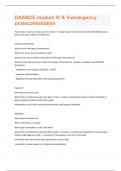
DAANCE module IV & V-emergency protocol/sedation Questions & Answers Already Passed!!
Flow meters- what are these used to monitor? - Answer-determines the ratio of the O2/N2O mixture as well as the rate at which it is delivered. Anesthesia Machines What are the two types of anesthesia? Where are each type of anesthesia used? What are the two machines used with the first type of anesthesia? What are two safety features of the second type of anesthesia? - Answer--Inhalation and N2O2/O2 Anesthesia - Inhalation at the hospital, N2O2/O2 in office - vaporizers and ventilators - Regulator-fail safe Mechanism and Scavenging System Vaporizer What does this device do? What kind of maintenance does this device have? - Answer-A device that converts liquid anesthetic to gases suitable for delivery with other gases. Maintenance and Checks: periodic maintenance and frequent calibrated Ventilator What does this device do? Why is this device so useful? What type of anesthesia is this used with? What kind of maintenance does this device have? - Answer--A machine that breathes for the pt using a bellows type apparatus with +/- pressure to move gases in and out of the lungs. -Eliminates the need to manually squeeze the reservoir bag. -Used with a closed system (i.e. Endotracheal Intubation)-The anesthetic system should have a high/low pressure alarm to indicate excessive pressure or a disconnect has occurred. Regulator-Fail Safe Mechanism What setting are these used? What level of O2 will these mechanisms be engaged at? What kind of maintenance does this mechanism require (5 things)? - Answer--Office based anesthesia. -Most anesthesia machines will stop delivering automatically when the O2 level is unsafe (20%). Maintenance and Checks: -Flow meters, reservoir bags and delivery tubes checked daily or patentcy and leaks. -Calibrate to manufacturer specs -A record should be kept during surgery. -Turn off O2 daily -Have back up O2 available (Sep. O2 tanks) Scavenging System What does this system do? Why do we use this system? - Answer--It reduces the level of noxious agents to an acceptable level by exhausting them outside the room. -Excess gases and vapors may be expelled in the operatory from leaks in the System or through pressure relief/pop off valves. Anesthetic Gases (color coded cylinders) Why do we color code gas tanks? Match the color to the gas (green, blue, gray, yellow, black, brown) Which gases are associated with 2000psi and 750psi? What maintenance is required for tanks? - Answer-- to minimize potential for incorrect connection to anesthesia systems. Oxygen- Green (2000psi) Nitrous Oxide- Blue (750 psi)Carbon Dioxide- Gray Compressed Air- Yellow Nitrogen- Black Helium- Brown -shut off after last pt. Airway Adjuncts -What is the first thing used in the case of airway obstruction? -What is the second step is obstruction continues? How is this placed? -What is the first type of airway placed if the initial 2 steps do not work? How is it placed, and is the patient awake or asleep? - What is the second type of airway placed? How is this placed and what is the benefit of this? Are patients awake or asleep? - Answer-1. Bag/Valve/Mask/Full Facemask 2. Tongue Traction Suture- 1 or 2 sutures can be placed through the dorsum of the tongue and grasped with a lg. hemostat. 3.Nasopharyngeal Airway- lubricated tube passed through the nares into the nasal cavity through the oropharynx to posterior of the tongue. Easily inserted and tolerated in awake patients. 4. Oropharyngeal Airway- not tolerated well by pts. It may be placed to position the tongue more anterior. Supraglottic Airways (2 types) What are the two types? describe - Answer-1. Laryngeal Mask Airway (LMA)- a device that consists of a plastic tube at the end of which is a small air inflated balloon that sits over the top of the larynx. 2. "I-Gel"- the balloon is filled w/gel rather than air does not req. inflation .Laryngeal Mask airway (LMA) What is the advantage of this? What can this airway help avoid having to place? Is the patient awake or asleep? Can is be used on a patient on a ventilator? What does this airway not protect against? - Answer--Primary Adv: it can be placed blindly w/o laryngoscope -it avoids tracheal intubation -Unconscious pt. -Can be used w/spontaneous respiration or artificial ventilation. ** It does NOT protect the airway from aspiration of regurgitated material I-Gel airway What are the advantages of this? Is the patient awake or asleep? - Answer-can be rapidly inserted, and less likely to dislodge that LMA during movement. *Unconscious pt Endotracheal Intubation What locations is this placed? Is visual placement necessary? Is the patient awake or asleep? If the tube is inserted and a gurgling sound is heard, what does this mean? - Answer--Placed nasally, orally or through the tracheostomy site. -No. May be placed blindly (w/o direct vision) or under direct vision (w/laryngoscope). *Unconscious pt. -The tube has been inserted too far and is in the stomach. Combitube When is this used?What does this device consist of? How do you know if it has been placed in the correct area? What kind of anesthetized patient is this placed in? - Answer--Generally reserved for significant emergencies -Consists of tracheal tube combined w/esophageal obturator Both cuffs are inflated: if chest rises=continue ventilation. If no rise= poss. in trachea. * ONLY in unconscous pt. Cricothyrotomy When is this technique used? Why? - Answer--An airway obstruction that persists after all conventional methods have failed, including Heimlich and intubation. -quickest, easiest, surgical airway EKG (electrocardiogram) What is this for? What is displayed on the monitor? What kind of maintenance is required? - Answer--A device used to display the electrical activity of the heart. -Waveforms used to evaluate condition and function of the heart muscle. -Maint & Cks: check batteries periodically; according to manufact. specs. Defibrillator (2 types) What are the two types? What is the difference between the two? What further types in the automatic defibrillator divided into? How do these deliver charges, and how is it measured? What is the maintenance of these? - Answer-- Full functioning and AED - Full Function has no adjustable DC power supply. AED automatically assess cardiac rhythm. -Semiautomatic asked the user to shock patient, fully automatic shocks by itself-Paddles or pads deliver charges to Pt. Countershock measured in Joules= watts x seconds **Expirations and shelf life- pads must be replaced BEFORE the exp. dates. *Test w/electrical source and w/o (batteries) Monitoring blood pressure What are these devices determining? What are the two types? What is the correct positioning of a bp cuff? What is the maintenance? - Answer--This device is used to determine the arterial pressure of patient. Types: Manual (Sphygmomanometer and stethoscope) Automatic machines -BP cuff should cover 2/3 the distance from the elbow to shoulder Maint. & Cks: Weekly visual and manual inspection for wears, tears and leaks. Respiratory Observation When should ventilation be monitored? What are three different ways ventilation can be monitored? Which one is an extremely late sign of hypoxemia? - Answer--Ventilation must be monitored throughout the procedure. 1. Chest rise- easiest way 2. Anesthesia Bag- rebreathing bag can be observed for inflating/deflating. 3.Color- Cyanosis= blue tinge to mucous membranes, skin and nail beds. * Cyanosis- Can give an indication about the respiratory status but is usually an extremely late sign of hypoxemia (insuff. O2 in blood). Pretracheal StethoscopeWhat type of observation is this used for? - Answer-*respiratory observation Signs of airway obstruction (7 things) - Answer-Choking Gagging Labored breathing Respiratory arrest Cardiac arrest Suprasternal notch retraction Rapid pulse initially then decreasing pulse Common airway obstructions
Escuela, estudio y materia
- Institución
- DAANCE module IV & V-emergency protocol/sedation
- Grado
- DAANCE module IV & V-emergency protocol/sedation
Información del documento
- Subido en
- 17 de abril de 2024
- Número de páginas
- 21
- Escrito en
- 2023/2024
- Tipo
- Examen
- Contiene
- Preguntas y respuestas
Temas
-
daance module iv v emergency protocolsedation

Documento también disponible en un lote