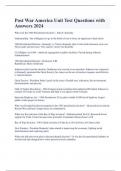
Post War America Unit Test Questions with Answers 2024
Post War America Unit Test Questions with Answers 2024 Who won the 1960 Presidential election? - John F. Kennedy brinkmanship - the willingness to go to the brink of war to force an opponent to back down 1960 Presidential Election - Kennedy vs. Nixon, Kennedy (due to televised charisma) won over Nixon (pale and nervous). Very narrow victory for Kennedy Civil Rights Act 1964 - outlawed segregation in public facilities- Passed during Johnson Administration 1964 Presidential Election - Democrat: LBJ Republican: Barry Goldwater Johnson easily won the election. Goldwater was viewed as an extremist. Johnson was connected to Kennedy, promoted the Great Society, his stance on the use of nuclear weapons, and effective tv advertisements. Great Society - President Johns's goals in the areas of health care, education, the environment, discrimination, and poverty Gulf of Tonkin Resolution - 1964 Congressional resolution that authorized President Johnson to commit US troops to south Vietnam and fight a war against north Vietnam Interstate Highway Act - 1956 Eisenhower 20 yr plan to build 41,000 mi of highway, largest public works project in history Why was Dwight Eisenhower popular in the 1952 presidential election? - He promised to end the Korean War and had a tough stance on communism. What was the outcome of the Bay of Pigs invasion? - Embarrassment for US. Increased Soviet support for Cuba. Castro became more powerful. Communist threat closer to US Bay of Pigs Invasion - 1961 failed invasion of Cuba by a CIA-led force of Cuban exiles New Frontier - President Kennedy's plan aimed at improving the economy, fighting racial discrimination and exploring space What role did television play in the presidential election? - It was the first presidential debates to be televised and changed how voters perceived each candidate. Flexible response - A policy, developed during the Kennedy administration, that involved preparing for a variety of military responses to international crises rather than focusing on the use of nuclear weapons. Cuban Missile Crisis - 1962 conflict between the US and the Soviet Union resulting from the Soviet installation of nuclear missiles in Cuba 38th parallel - Line that divided Korea - Soviet Union occupied the north and United States occupied the south, during the Cold War. McCarthyism - unscrupulously accusing people of disloyalty and being communist Joseph McCarthy - US Senator who was the chair of HUAC. Used reckless and unconstitutional practices to accuse people of being communist How did the Second Red Scare hinder the Civil Rights Movement? - Taking a stand against racism was seen as unpatriotic and a challenge to the traditional hierarchy of the United States. James Dean - was an American actor, well known as a pop culture icon J.D. Salinger - Famous novelist. Wrote The Catcher in the Rye Elvis Presley - Became a symbol of rock and roll and known as The King Jackson Pollock - American painter, famous for creating abstract paintings by dripping or pouring paint on a canvas in complex swirls and spatters. Jack Kerouac - One of the most famous beatniks. He wrote a novel On the Road which became a symbol for the Beat Generation. Cult of domesticity - idealized view of women & home; women, self-less caregiver for children, refuge for husbands Doomsday Clock - symbolized the inevitable destruction of life as a result of man-made technology Duck and Cover - Schoolchildren practiced crawling under their desks and putting their hands over their heads to protect themselves from an atomic bomb attack. Containment - The U.S. would utilize various strategies to prevent Soviet forces from spreading communism to other countries Truman Doctrine - The goal of the doctrine was to prevent capitalist nations from embracing communism and alleviate economic hardships that may make them vulnerable to Soviet influence. Atomic Anxiety - *"Duck - and - cover" Generation learned how to survive a nuclear attack* it was having fear of a nuclear attack; What was the relationship between the Soviet Union and the United States during World War II? - they allied against Nazi Germany during theterm-10 war Who met at the Yalta conference? - President Franklin Roosevelt of the United States, Prime Minister Winston Churchill of Great Britain, and Premier Joseph Stalin of the Soviet Union Potsdam Conference - the allied leaders agreed to meet over the summer at the Potsdam Conference in Germany to negotiate terms for the end of the war and continue the discussions that had begun at Yalta Capitalism - is based on private ownership and individual economic freedom. Most of the means of production, such as factories and businesses, are owned by private individuals and not by the government. Communism - is a system that seeks to create a classless society in which the major means of production, such as factories and businesses, are owned and controlled by the public Cold War - a political rivalry that includes public threats, competition, and propaganda among at least two nations without engaging in physical fighting. What was the Cold War fought over? - Political beliefs. The United States and the Soviet Union had differing beliefs about how postwar affairs should be handled, including Germany's political and economic future Iron Curtain - the political, military, and ideological barrier erected by the Soviet Union after World War II to seal off itself and its dependent eastern and central European allies from open contact with the West and other noncommunist areas What did Winston Churchill claim that the Soviet Union wanted? - Expansion of power Iron curtain - Symbolic divide in Europe between the communist and capitalist nations The Marshall Plan - US sponsored program to provide aid to rebuild western Europe. They believed it it would help fight against communist expansion Berlin Airlift - Joint effort by the US and Britian to fly food and supplies into W Berlin after the Soviet blocked off all ground routes into the city North Atlantic Treaty Organization (NATO) - Military alliance created in 1949 made up of 12 non-Communist countries including the United States that support each other if attacked and to protect against the spread of communism
Escuela, estudio y materia
- Institución
- Post War America
- Grado
- Post War America
Información del documento
- Subido en
- 16 de abril de 2024
- Número de páginas
- 9
- Escrito en
- 2023/2024
- Tipo
- Examen
- Contiene
- Preguntas y respuestas
Temas
-
post war america unit test questions with answers
-
who won the 1960 presidential election john f
-
civil rights act 1964 outlawed segregation in pu
-
great society president johnss goals in the are

Documento también disponible en un lote