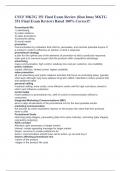
CSUF MKTG 351 Final Exam Review (Ron Imus MKTG 351 Final Exam Review) Rated 100% Correct!!
CSUF MKTG 351 Final Exam Review (Ron Imus MKTG 351 Final Exam Review) Rated 100% Correct!! Promotional Mix 1) advertising 2) public relations 3) sales promotions 4) personal selling 5) social media promotion Communication by marketers that informs, persuades, and reminds potential buyers of a product in order to influence an opinion or elicit a response promotional strategy a plan for the optimal use of the elements of promotion to elicit a particular response; main goal is to convince buyers that the products offer competitive advantage advertising mass communication, high control, relatively low cost per customer, low credibility public relations unpaid, effective, limited control, higher credibility sales promotion all non-advertising and public relations activities that focus on promoting sales; typically short-term although may have spillover long-term effect; intended to induce product trial and additional sales personal selling in-person selling, more costly; more effective; works well for high cost items; aimed to inform and influence customers social media recent addition to promotional mix, shift of control of communication efforts to consumers Integrated Marketing Communications (IMC) aims to align all elements of the promotional mix for the best possible results marketing communication the process by which marketers impress on the buyers the value that their products have to offer Promotional Goals informing (early stages), persuading (late intro/ early maturity), reminding (later stages), connecting (ongoing) AIDA concept Attention: gain awareness of target market Interest: create appealing message for target market Desire: convince to create preference for Action: communication should have call to action- go out and buy it factors affecting promotional mix -nature of the product -stages in the product life cycle -type of buying decision -push and pull strategies nature of the product mass media (advertising) will work well for mass produced, consumer products where personal selling will work better for customized, business products Stages of Product Life Cycle early stage: advertising/public relation for awareness and sales promotion to induce trial growth stage: advertising and public relations for establishing differential advantage, reduce sales promotion maturity stage: persuasive reminder advertising and sales promotion to increase sales decline stage: advertising reduced, personal selling efforts continue Type of Buying Decision simple/routine: require no deliberation, reminder advertising and sales promotion can be very effective complex/ high involvement: personal selling can work well Push and Pull Strategies Push: incentivize wholesalers or retailers to carry the product (ex. trade discounts) Pull: incentivizes end consumers directly advertising impersonal, one-way mass communication paid for by a marketer to increase sales in the long run advertising response function elongated S shaped figure- starts with too little to do much for sales, moves over to relatively high effectiveness where increase will lead to increase in sales, then to a saturation point where more advertisement won't do much Major Types of Advertising institutional and product institutional advertising Advertising that promotes organizational image as a whole; makes sense for parent brands and advocacy advertising advocacy advertising a form of advertising in which companies promote a positive image or try to overcome negative perceptions product advertising promotes individual products; three types: pioneer, competitive, and comparative advertising pioneer advertising early stages of product; explaining benefits of product class, not brands competitive advertising growth stage of product; new companies enter market; shift to focus on persuasion of individual brands comparative advertising explicit comparison made between brands; effective for smaller brands; more prominent in highly competitive markets; illegal in many countries advertising budget methods percentage of sales method fixed percentage of sales assigned to advertising budget; during downturn in sales this method would encourage reducing advertising when more might be needed competitive parity method advertising budget is set at a level comparable to other brands; questionable method bc each company has different standings and strategies DAGMAR approach Defining Advertising Goals for Measured Advertising Results; define goals advertising is supposed to accomplish and then calculate the number of impressions expected and the cost of accomplishing each impression steps to creating advertisements 1) identify product (attributes and) benefits 2) develop advertising appeals (fun, fear, convenience, savings, health, environment, etc.) 3) executing the message by moving consumers through the AIDA process (through slice of life, testimonials, humor, science, etc.) 4) evaluation of the campaign unique selling proposition (USP) something that is special about the brand and emphasized on an ongoing basis; advertising appeal becomes USP Media Decisions in Advertising media type, media mix, and media schedule (collectively called media planning) Media Types - newspapers: cheap, geographically selective - magazines: long ad life, high pass-along rates, good reproduction, and highly targeted - radio: cheap and highly localized - television: high cost, high impact, wide coverage - internet: newer, highly customizable, can monitor effectiveness in real time - outdoor media media mix emphasis placed on media outlets used, and the budget allocated to each efficacy of media mix - cost: cost per contact (cost per thousand(CPM)) - reach: how many people does the medium have access to (gross rating points (GRP)) - frequency: number of times an individual is exposed to an advertisement - audience selectivity: ability to reach target market - noise level: interference from everything else Media Scheduling setting the timing and sequence for a series of advertisements Continuous Media Scheduling ads are run at steady pace throughout the campaign; ideal for mature products Flighted Media Scheduling ads run heavily in short bursts w no ads between bursts; ideal for raising attention above noise level Pulsing Media Scheduling advertising combines continuous with flighted scheduling; continuous at a lower amplitude w higher bursts
Escuela, estudio y materia
- Institución
- CSUF MKTG 351
- Grado
- CSUF MKTG 351
Información del documento
- Subido en
- 16 de abril de 2024
- Número de páginas
- 10
- Escrito en
- 2023/2024
- Tipo
- Examen
- Contiene
- Preguntas y respuestas
Temas
-
csuf mktg 351 final exam review ron imus mktg 351

Documento también disponible en un lote