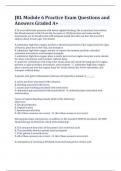
JBL Module 6 Practice Exam Questions and Answers Graded A+
JBL Module 6 Practice Exam Questions and Answers Graded A+ A 26-year-old female presents with heavy vaginal bleeding. She is conscious, but restless. Her blood pressure is 84/54 mm Hg, her pulse is 120 beats/min and weak, and her respirations are 22 breaths/min with adequate depth. She tells you that she inserted a tampon about 2 hours ago. You should: A. administer high-flow oxygen, perform a detailed assessment of her vaginal area for signs of trauma, place her on her side, and transport. B. administer high-flow oxygen, ask her to remove the tampon, perform a detailed secondary assessment, and transport promptly. C. administer high-flow oxygen, place a sterile pad over her vagina, keep her warm, elevate her lower extremities, and transport without delay. D. assist her ventilations with a bag-valve mask, place one sterile dressing into her vagina, perform a rapid secondary assessment, and transport. - C. administer high-flow oxygen, place a sterile pad over her vagina, keep her warm, elevate her lower extremities, and transport without delay. A patient with pelvic inflammatory disease will typically complain of _________. A. aches and fever associated with urination B. bleeding associated with stress C. nausea and vomiting associated with intercourse D. abdominal pain associated with menstruation - D. abdominal pain associated with menstruation Causes of vaginal bleeding include which of the following? Select one: A. Ectopic pregnancy B. Vaginal trauma C. Spontaneous abortion D. All of these answers are correct. - D. All of these answers are correct. During gynecologic emergencies, in addition to the standard SAMPLE questions, the EMT should attempt to determine which of the following? A. The amount of time since of the patent's last menstrual cycle B. The possibility that the patient may be pregnant C. If the patient is sexually active D. All of these answers are correct. - D. All of these answers are correct. In anticipation of receiving a fertilized ovum, the lining of the uterine wall: A. becomes engorged with blood. B. thins and begins to separate. C. diverts blood flow to the vagina. D. sheds and is expelled externally. - A. becomes engorged with blood. In cases of sexual assault, it is important to ensure that you do which of the following? Select one: A. Immediately write down your observations of the scene before assessing the patient. B. Call for a female EMT or ALS care provider. C. Discuss with law enforcement any suspicions that you may have about the perpetrator. D. All of these answers are correct. - D. All of these answers are correct. In contrast to bleeding caused by external trauma to the vagina, bleeding caused by conditions such as polyps or cancer: A. can be controlled in the field. B. often presents with acute pain. C. is typically not as severe. D. may be relatively painless. - D. may be relatively painless. It is common for young females who experience their first menstrual period to: A. lose up to 500 mL of blood within the first 24 hours. B. become so emotionally distraught that they contemplate suicide. C. have a false positive home pregnancy test result. D. experience abdominal cramping, which may be misinterpreted. - D. experience abdominal cramping, which may be misinterpreted. Law enforcement personnel request your assistance to assess a 31-year-old female who was sexually assaulted. When you arrive at the scene, you find the patient sitting on a curb outside her apartment. She is conscious, alert, and crying. When you ask her what happened, she tells you that she does not want to be treated or transported to the hospital. She further tells you that all she wants to do is clean up. You should: A. provide emotional support and visually assess her for obvious trauma. B. perform a limited hands-on assessment to detect life-threatening injuries. C. advise her that she cannot clean herself up because this will destroy evidence. D. ask her if there is anyone you can contact, such as a friend or relative. - A. provide emotional support and visually assess her for obvious trauma. Patient complaints of pain during intercourse, lower abdominal discomfort, and nausea may be indicative of which of the following? A. Chlamydia B. Bacterial vaginosis C. Gonorrhea D. Pelvic inflammatory disease - D. Pelvic inflammatory disease Some women experience ___________ during ovulation. A. hypotension B. severe bleeding C. slight cramping D. severe abdominal pain - C. slight cramping The __________ and _________ are folds of tissue that surround the urethral and vaginal openings. A. perineum; anus B. fallopian tubes; uterus C. vagina; cervix D. labia majora; labia minora - D. labia majora; labia minora The _____________ connect(s) each ovary with the uterus. A. fallopian tubes B. egg C. cervix D. abdomen - A. fallopian tubes The EMT should ensure that vaginal bleeding is _________. A. severe enough to warrant transport B. not caused by traumatic injury C. taken seriously and the patient is transported for gynecologic evaluation D. controlled directly by the patient - C. taken seriously and the patient is transported for gynecologic evaluation The physical examination of a sexual assault victim should be: A. deferred until the patient can be evaluated by a physician. B. limited to a brief survey for life-threatening injuries. C. as detailed as possible so all injuries can be documented. D. performed in the presence of at least two police officers. - B. limited to a brief survey for life-threatening injuries. When caring for a female patient who has been sexually assaulted, you should: A. place any bloodstained clothing or other articles in separate paper bags. B. ask the patient for a concise, detailed report of what happened to her. C. allow law enforcement to take her statement before you begin treatment. D. advise her that she will not be allowed to shower or change her clothes. - A. place any bloodstained clothing or other articles in separate paper bags Which of the following conditions would MOST likely lead to pelvic inflammatory disease if left untreated? A. Ovarian cysts B. Chlamydia C. Ectopic pregnancy D. Genital herpes - B. Chlamydia Which of the following drugs is commonly referred to as "roofies"? A. MDMA B. Rohypnol C. GHB D. Ketamine - B. Rohypnol Which of the following infections, when left untreated, may lead to infection of the blood and brain? A. Pelvic inflammatory disease B. Chlamydia C. Bacterial vaginosis D. Gonorrhea - D. Gonorrhea While the ages can vary, women typically experience menstruation from approximately _________ to ____________ years of age. A. 10; 70 B. 11; 50 C. 10; 40 D. 20; 60 - B. 11; 50 A 26-year-old female who is 34 weeks pregnant is experiencing a seizure. Her husband tells you that her blood pressure has been high and that she had been complaining of a headache for the past few days. You should: A. place her on her side, administer high-flow oxygen, and transport. B. insert an oral airway and ventilate her with a bag-valve mask. C. administer oral glucose for presumed hypoglycemia and transport. D. elevate her legs to improve brain perfusion and keep her warm. - A. place her on her side, administer high-flow oxygen, and transport. A history of pelvic inflammatory disease or tubal ligations increases a woman's risk for: A. gestational diabetes. B. an ectopic pregnancy. C. placenta previa. D. preeclampsia. - B. an ectopic pregnancy. A mother who is pregnant with her first baby is typically in the first stage of labor for approximately: A. 16 hours. B. 10 hours. C. 4 hours. D. 8 hours. - A. 16 hours. A nuchal cord is defined as an umbilical cord that: A. has separated from the placenta. B. is lacerated due to a traumatic delivery. C. has abnormally developed blood vessels. D. is wrapped around the baby's neck. - D. is wrapped around the baby's neck. A pregnant trauma patient may lose a significant amount of blood before showing signs of shock because: A. pregnant patients have an overall increase in blood volume. B. pregnancy causes vasodilation and a lower blood pressure. C. blood is shunted to the uterus and fetus during major trauma. D. pregnant patients can dramatically increase their heart rate. - A. pregnant patients have an overall increase in blood volume
Escuela, estudio y materia
- Institución
- JBL
- Grado
- JBL
Información del documento
- Subido en
- 16 de abril de 2024
- Número de páginas
- 27
- Escrito en
- 2023/2024
- Tipo
- Examen
- Contiene
- Preguntas y respuestas
Temas
- a ectopic pregnancy
-
jbl module 6 practice exam questions and answers g
-
a 26 year old female presents with heavy vaginal b
-
a patient with pelvic inflammatory disease will ty
-
during gynecologic emergenc

Documento también disponible en un lote