Certified Lactation Counselor Test Questions with Correct Solutions, A+
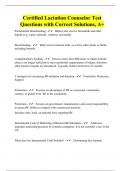
Predominant Breastfeeding - Babies who receive breastmilk and other liquids (e.g. water, minerals, vitamins, oral meds). Breastfeeding - Baby receives human milk, as well as other foods or fluids, including formula. Complementary Feeding - Process starts when BM alone or infant formula alone is no longer sufficient to meet nutritional requirements of infants, therefore other foods or liquids are introduced. Typically child is between 6-23 months 3 strategies for increasing BF initiation and duration - Promotion, Protection, Support Promotion - Focuses on advantages of BF on a personal, community, country, or global level. BF to the community. Protection - Focuses on government, manufacturer, and social responsibility to assure BF ability to compete with commercial interests. Includes state, local, an national laws regarding BF. International Code of Marketing of Breast-milk Subsitutes - Addresses improper marketing practices by formula companies. It is not currently a law in the US. What does the International Code Prohibit? - Distributing free formula Giving coupons for formula What did the AAP resolution state in regards to the International Code? - No distributing formula, discharge bags, industry written handouts. Support - Focuses on interaction of helpers with family, as well as program development and implementation. 10 steps to successful BF - 1. Written BF policy. Skin to Skin immediately after birth. 2. Train healthcare staff 3. Inform pregnant women about benefits and management of BF 4. Help all mothers initiate BF within 1 hour after birth 5. Show mother's how to BF and maintain lactation 6. Exclusive breast milk only 7. Practice rooming in 24 hours a day 8. Encourage BF on demand 9. No artificial teats or pacifiers 10. Establishment of BF support groups Healthcare staff responsibility for working with lactating mothers include what? - 1. Training 2. Minimum of 20 hours of training 3. 3 hours of competency verification What are the indications for providing supplementation other than breast milk? - 1. Medical condition 2. Parents request after being informed of consequences Protocol for calculating Baby's daily needs - Baby's weight x 2.5 (2.7 or 3.0 if Baby needs to catch up weight) = daily ounces. PCP decides what the multiplier is!!! What should be assessed 3-5 days after birth by PCP? - Hydration (elimination patterns) Body weight (no more than 7% loss) Observe Feeding Maternal or infant issues What is a CLC? - Nationally recognized designation awarded by the ALPP. Practice parameters are designated by professional scope of practice. How many stools per day should a breast fed newborn have? - 4, some yellow by day 4. When should a baby be back to birth weight? - 12-14 days post birth How much weight should a baby gain daily? - Approximately 1 ounce Why do women supplement with formula when there is no medical need? - 1. Lack of preparation for what the newborn period would be like. 2. Lack of timely interventions Alveoli - Small glands in the breast that produce milk At-Breast Supplementer - a device that allows a supplement to be given while a baby is actively nursing at the breast, ex: Supplement Nursing System Atopy - hypersensitive or allergic state involving an inherited predisposition What is the BFHI Baby Friendly Hospital Initiative - Initiative by UNICEF and WHO (1991) to support breastfeeding in hospitals and maternity centers. "The 10 Steps". Unicef. Baby-Friendly Hospital Initiative. Available online: Bilirubin - an orange-yellow pigment formed in the liver by the breakdown of hemoglobin and excreted in bile. CCK (cholecystokinin) - Hormone that regulates the emptying of the gallbladder and secretion of enzymes by the pancreas.
Información del documento
- Subido en
- 15 de abril de 2024
- Número de páginas
- 64
- Escrito en
- 2023/2024
- Tipo
- Examen
- Contiene
- Preguntas y respuestas