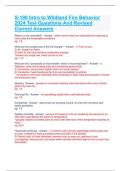
S-190 Intro to Wildland Fire Behavior 2024 Test Questions And Revised Correct Answers
S-190 Intro to Wildland Fire Behavior 2024 Test Questions And Revised Correct Answers When is a fire controlled? - Answer - when control lines can reasonably be expected to hold under the forseesable conditions pg. 1.9 What are the components of the fire triangle? - Answer - 1) Fuel: to burn 2) Air: oxygen for flame 3) Heat: to start and continue combustion process. *remove any single one, there can be no fire* pg. 1.10 What are the 3 processes of heat transfer, which is most important? - Answer - 1) Radiation: dries surrounding fuels and sometimes ignites them 2) Convection: occurs when lighter warm air moves upward 3) Conduction: heat transferred by from one fuel particle to another * convection is the most important while conduction is least important because of woods low conduction rate* Spotting - Answer - process of convection starting new fires beyond the zone of direct ignition by main fire pg. 1.6 Running Fire - Answer - fire spreading rapidly with a well defined head pg. 1.6 Smoldering - Answer - also known as "punking around" is a fire with out flame and barely spreading pg. 1.6 Relative Humidity - Answer - amount of moisture in the air divided by the amount of air held when saturated at the same air temperature *typically reaches its lowest point at mid to late afternoon (when temperature reaches its max)** pg. 2b.8 Horizontal Continuity - Answer - 1) Uniform fuels: all fuels distributed continuously over an area. (network of fuels providing continuous path of fire spread) 2) Patchy fuels: all fuels ditributed unevenly over an area (ex: patches of rock outcroppings, bare ground, and areas where another dominant type of fuel is much less flammable) pg. 2b.8-9 Canyons (2 types) - Answer - 1)Narrow Canyons: fire in a steep narrow canyon can easily spread to fuels on the adjacent side by radiation and spotting. 2) Box canyon: Fires starting near the base of box canyons may react similarly to fire in a wood burning stove or fireplace pg. 2a.5 What has the greatest effect on fire spread? - Answer - wind pg. 2c.15 Vertical Arrangement - Answer - 1) Gr-ound Fuels: all combustible material lying beneath the surface (ex: deep duff, tree roots, rotten buried material, other organic material) 2) Surface Fuels: all combustible materials lying on or immediately above the ground (ex: needles, leaves, duff, grass, stumps ect.) 3)Ladder Fuels: combustible materials that aid the spread of fire from the surface little, shrubs, and other moderate height vegetation 4) Aerial Fuels: All green and dead materials located in the upper canopy (ex: tree branches, crowns, snags ect.) pg. 2b.9-10 6 Basic Fuel Types - Answer - 1) Grass 2) Grass-Shrub 3) Shrub 4) Timber- Understory 5) Timber Litter 6) Slash- Blowdown pg. 2b.3 Barrier (2 types) - Answer - Any obstruction to the spread of fire 1) Natural Barriers: rocks, rivers, lakes, slides. 2) Man-Made Barries: roads, highways, reservoirs, fireline constructed by fire resources pg. 2a.7 Indicator of increased fire behavior - Answer - Unstable Atmosphere: encourages upward motion of air. pg. 2c.13 what wind indication is a sign of increased fire behavior - Answer - Dust Devils and Fire whirls are clear signs of increased fire behavior. pg. 2c.28 what weather factor leads to increased fire behavior - Answer - Battling or Shifting (Foehn) winds lead to increased fire behavior. pg. 2c.25 As relative humidity increases, temperature _______. - Answer - decreases pg. 2c.6 what are the hazards of a thunderstorm? - Answer - Hazards Include: Change in wind speed and direction (downdraft winds), rising heat, and dangerous lightning pg.2c.26 What fuel type reacts the fastest? - Answer - Grass: burns the hottest and fastest pg. 2b.4 What are the hazards of a narrow canyon - Answer - Wind eddies and strong up-slope air movement, spreading fuels to adjacent sides by radiation and spotting pg. 2a.5 parts of a fire - Answer - point of origin, head, flank, rear, perimeter, fingers, pockets, island, spot fire point of origin - Answer - the start the precise location where a competent ignition source came into contact with the material first ignited and sustained combustion occurred usually rear & upwind head of a fire - Answer - the side of fire having the fastest rate of speed most intensity downwind flank of a fire - Answer - the part of a fire's perimeter that is roughly parallel to the main direction of spread lower flame, greatest variability where most fire is fought
Escuela, estudio y materia
- Institución
- S-190
- Grado
- S-190
Información del documento
- Subido en
- 14 de abril de 2024
- Número de páginas
- 15
- Escrito en
- 2023/2024
- Tipo
- Examen
- Contiene
- Preguntas y respuestas
Temas
- s 190
- s 190 intro
-
s 190 intro to wildland fire
-
s 190 intro to wildland fire behavior
-
test questions and revised correct answers

Documento también disponible en un lote