NASM-BCS Glossary
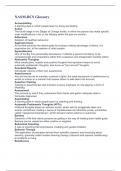
NASM-BCS Glossary Accomodating A learning style in which people learn by doing and feeling. Action The fourth stage in the Stages of Change model, in which the person has made specific overt modifications in his or her lifestyle within the past six months. Adherence Adoption of healthier behaviors. Aggressiveness An act that achieves the desire goals by hurting or taking advantage of others; it is expressive but, at the expense of other people. Agreeableness One of the Big Five personality dimensions; it reflects a person's tendency to be compassionate and cooperative rather than suspicious and antagonistic towards others. Alternative Thoughts More constructive, hopeful and positive thoughts that represent means to avoid automatic problematic thoughts; also know as "turn-around" thoughts. Anecdotal Reports Individuals' reports of their own experiences. Assertiveness Any act that serves to maintain a person's rights; the open expression of preferences by words or actions in a manner that causes others to take them into account. Assertive Training Training in assertiveness that includes a heavy emphasis on role playing; a form of Modeling. Assessment The process by which they understand their clients and gather adequate data to formulate diagnoses. Assimilating A learning style in which people learn by watching and thinking. Automatic Problematic Thoughts (APTs) Irrational thoughts based on extreme words, which tend to exaggerate ideas and events, sometimes creating a sense of hopelessness and absolute words, sometimes called "categorical imperatives", which demand certain actions or outcomes. Barriers Elements of life that clients perceive as getting in the way of meeting their health goals. Barriers can be viewed as either positive or negative. Behavioral Coaching A type of coaching that emphasizes modeling and guided imitation. Behavior Therapy The application of principles derived from scientific research and theorizing about learning, generally called modern learning therapy (classical and operant conditioning) to problems in living. Beneficence Striving to benefit those with whom the professional works; one of the APA Ethics Codes General Principles. Big Five Five broad dimensions of personality that describe people's general tendencies to behave in predictable ways: openness to experiences, conscientiousness, extraversion, agreeableness, and neuroticism Bio-informational theory A theory based on the assumption that an image is a functionally organized set of propositions stored in the brain; it holds that a description of an image consists of two main types of statements: response and stimulus propositions. Body mass index (BMI) A standard measure of weight divided by height. Case studies Studies in which the researcher closely observes, monitors, and records an individual's behavior over a period of time. Classical conditioning Learning through associations between a neutral environmental stimulus (a conditioned stimulus) and a naturally occurring stimulus (the unconditioned stimulus). Coaching In a helping profession, the connection between two individuals, in which the coach, primarily through asking questions, encourages the client to make the changes the client desires in his or her life Cognitive-behavioral therapy (CBT) A group of psychological treatments based on science that focus on how people's thoughts, emotions, and behaviors affect one another. Cognitive distortions Viewpoints that highlight the information that supports a schema and minimize the information that contradicts it. Cognitive restructuring See Rational emotive therapy. Collective efficacy A social approach to self-efficacy in which only groups of people can achieve tasks, not just the individual. Compliance Following the fitness or wellness professional's suggestions. Conditioned response A response to a conditioned stimulus that is learned via a repeated pairing between conditioned and unconditioned stimuli. Conditioned stimulus A neutral stimulus that, after becoming associated with an unconditioned stimulus, eventually comes to trigger (via a learning process) a specific response Conscientiousness One of the Big Five personality dimensions; it reflects a person's perseverance in the face of challenges, and ability to complete tasks in disciplined and well organized ways Contemplation The second stage in the Stages of Change model, in which the person is intending to change in the next six months. Contingency contracting The use of explicit agreements specifying expectations, plans, and/or contingencies for the behavior(s) to be changed. Converging A learning style in which people learn by doing and thinking. Cued relaxation A way of including relaxation in everyday life by using cues to remind oneself to take a brief relaxation break. Culture A group of people who identify with a particular set of behaviors, attitudes, common purpose or need, similar background, and values. Diagnosis The determination of an illness or injury, to be made by a licensed professional. Diverging A learning style in which people learn by feeling and watching Electromyography (EMG) The process of evaluating and recording of the electrical activity of the muscles. Ethics The rules of behavior based on which types of behaviors are considered good or bad, and right or wrong Ethnicity A means of identifying a group of people who have similar social or cultural backgrounds, sharing the same language, traditions, religious preferences, and personal values Exercise self-efficacy A person's belief in his or her ability to perform a specific exercise. Experimental studies Studies where imagery is usually manipulated and compared against a control group. External imagery Imagery performed from the perspective of a spectator or outside observer External locus of control A person's belief that he or she has no control over the situation surrounding the individual, but rather that outside forces control the situation. Extraversion
Información del documento
- Subido en
- 9 de abril de 2024
- Número de páginas
- 10
- Escrito en
- 2023/2024
- Tipo
- Examen
- Contiene
- Preguntas y respuestas