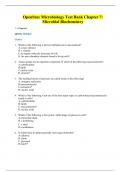
OpenStax Microbiology Test Bank Chapter 7: Microbial Biochemistry
OpenStax Microbiology Test Bank Chapter 7: Microbial Biochemistry * = Correct answer Multiple Choice 1. Which of the following is the best definition of a macronutrient? A.a trace element B. a vitamin C. an organic molecule necessary for life D. the most abundant elements found in living cells* 2. Amino groups are an important component of which of the following macromolecules? A.carbohydrates B.lipids C.nucleic acids D. proteins* 3. The building blocks of polymers are called which of the following? A. inorganic molecules B.macromolecules C.monomers* D. nucleic acids 4. Which of the following is not one of the four major types of carbon-based macromolecules found in cells? A. carbohydrates B. lipids C. macronutrients* D. nucleic acids 5. Which of the following is the typical, stable shape of glucose in cells? A.a branched chain B. a doublering C. a ring* D.a tetrahedron 6. In which form do plants generally store sugar molecules? A.cellulose B. chitin C. glycogen D.starch* 7. 8. Which term specifically describes fatty acids that do not have any double bonds, triple bonds, or rings? A. esterified B. polyunsaturated C. saturated* D.unsaturated 9. Which of the following best describes the difference between steroids and sterols? A. Steroids are the most common type of sterol. B. Steroids contain rings, whereas sterols do not. C. Sterols are a type of steroid with an OH group.* D. Sterols are present in prokaryotes and steroids are not. 10. Which best describes oligopeptides? A. a molecule consisting of two amino acids B. long chains of amino acids C. polymers of about 20 amino acids* D. polymers of about 50 amino acids 11. Which of the following is not a lipid? A. a fatty acid B. a glyceraldehyde* C. a wax D. an isoprenoid E. 12. How many single covalent bonds can oxygen form? A.one B.two* C.three D.four 13. Which of the following molecules is an organic molecule? A.CO2 B. CaCO3 C. CH3OH* D. H2O 14. Which of the following is the best example of a micronutrient? A.carbon B. nitrogen C.phosphorus D. potassium* 15. Which of the following best describes glucose, fructose, and galactose? A.achiral B. enantiomers C. stereoisomers D.structural isomers* 16. Why does it matter which enantiomer of a molecule is used for a medication? A.Enantiomers can have different pharmacologic effects and only one may be effective.* B. It is usually easier to prepare one enantiomer than mixtures of both. C. The D form is typically more effective than the L form. D. The L form is typically more effective than the D form. 17. Which of the following shows a ketone? A. a carboxylic acid B. anester C. an internal carbonyl group* D. an internal ether 18. Which of the following types of bonds joins monosaccharides together to form a polysaccharide? A. glycosidic bonds* B. hydrogen bonds C. peptide bonds D.phosphodiester bonds 19. Which of the following best describes the molecule lactose? A.disaccharide* B.monosaccharide C.polysaccharide D. trisaccharide 20. Which of the following is an important component of insect exoskeletons? A.cellulose B. chitin* C. glycogen D. starch 21. Which describes the hydrocarbon tails in the plasma membrane? A.amphipathic B. hydrophilic C.hydrophobic* D.polar 22. In a protein, which type of chemical linkage joins the amino acids? A. disulfide linkages B. glycosidic linkages or bonds C. hydrogen bonds D. peptide bonds* 23. Which is a common type of secondary structure of proteins? A. the α helix* B. the β helix C. the Δ helix D. the ω helix 24. Disulfide bridges are most important inwhich of the following? A.primary structure of proteins B. secondary structure of proteins C. structure of carbohydrates D. tertiary structure of proteins* 25. Which enantiomers rotate plane polarized light in a clockwise direction? A.+ or d* B. + or l C. – or d D. – or l 26. C6H12O6is an example of which type of molecule? A. amino acid B. fatty acid C. monosaccharide* D. nucleotide 27. The phospholipid molecules in the plasma membrane are which of the following? A.amphipathic* B.hydrophilic only C.hydrophobic only D.in the shape of micelles 28. Amylose is a component of which of the following? A. cellulose B. disaccharides C. nucleotides C.starch* 29. Chitin is a polymer of which of the following? A. amylase and amylopectin B. glycosaminoglycan B. N-acetyl glucosamine* C. N-acetyl muramic acid 30. Dextromethorphan and levomethorphan are best described as which of the following? A. achiral B. biologically identical C.enantiomers* D.structural isomers 31. Which type of molecule is CH3(CH2)14COOH? A. amino acid B. fatty acid* C. monosaccharide D. nucleotide 32. A triglyceride contains which subcomponents? A. a glycerol and two fatty acids B. a glycerol and two sugars C. a glycerol and three fatty acids* D. a glycerol and three sugars 33. The phospholipids of the plasma membrane contain which subcomponents? A. a wax, a glycerol, and a phosphate group B. two fatty acids, a glycerol, and a phosphate group* C. three fatty acids, a glycerol, and a phosphate group D. four sphingolipids and a phosphate group 34. Which monomers make up lipids? A.amino acids B.fatty acids C. lipids do not consist of monomers* D.monosaccharides 35. Which are the components found in starch? A. amylose and amylopectin* B. amylose and glycogen C. cellulose and glycogen D.glucosamine and muramic acid
Escuela, estudio y materia
- Institución
- OpenStax Microbiology
- Grado
- OpenStax Microbiology
Información del documento
- Subido en
- 8 de abril de 2024
- Número de páginas
- 15
- Escrito en
- 2023/2024
- Tipo
- Examen
- Contiene
- Preguntas y respuestas
Temas
-
openstax microbiology test bank chapter 7 microbi

Documento también disponible en un lote