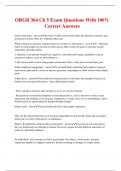
ORGB 364 Ch 5 Exam Questions With 100% Correct Answers
ORGB 364 Ch 5 Exam Questions With 100% Correct Answers define motivation - answerthe forces within a person that affect the direction, intensity, and persistence of their effort for voluntary behaviour. What is direction, intensity, and persistence as it relates to motivation? - answer1. Direction refers to what people are focused on achieving; in other words, the goal or outcome toward which they steer their effort. 2. Intensity is the amount of physical, cognitive, and emotional energy expanded at a given moment to achieve a task or other objective. 3. Persistence refers to how long people sustain their effort as they move toward their goal. define employee engagement - answeris an individual's emotional and cognitive (logical) motivation, particularly a focused, intense, persistent, and purposive effort toward work-related goals. define drives - answerare hardwired characteristics of the brain that attempt to keep us in balance by correcting deficiencies. Also called primary needs. · Drives produce emotions that energize us to act on our environment. · Research has consistently identified several human drives, such as the drive to have social interaction and bonding, to develop our competence, to make sense of our surroundings, and to defend ourselves against physical and psychological harm. define needs - answerare goal-directed forces that people experience. They are the motivational forces of emotions channelled toward specific goals and associated behaviours to correct deficiencies or imbalances. What is the difference between drives and needs? - answerEveryone has the same drives; they are hardwired in us through evolution. However, people develop different intensities of needs in a particular situation. the individual's self-concept (as well as personality and values), social norms, and past experience amplify or suppress emotions, thereby resulting in stronger or weaker needs. define four-drive theory - answerThis theory states that emotions are the source of human motivation and that these emotions are generated through four drives. What are the 4 drives in four-drive theory? - answer1. Drive to acquire. This is the drive to seek, take, control, and retain objects and personal experiences. It produces various needs, including achievement, competence, status, and self-esteem. The drive to acquire also motivates competition. 2. Drive to bond. This drive produces the need to belonging and affiliation. It explains why our self-concept is partly defined by associations with social groups. The drive to bond motivates people to cooperate and, consequently, is essential for organizations and societies. 3. Drive to comprehend. We are inherently curious and need to make sense of our environment and ourselves. When observing something that is inconsistent with or beyond our current knowledge, we experience a tension that motivates us to close that information gap. The drive to comprehend motivates curiosity as well as the broader need to reach our knowledge potential. 4. Drive to defend. This is the drive to protect ourselves physically, psychologically, and socially. Probably the first drive to develop in human beings, it creates a fight-or-flight response when we are confronted with threats to our physical safety, our possessions, our self-concept, our values, and the well-being of people around us. What are Maslow's hierarchy of needs? - answer· Physiological (need for food, air, water, shelter, etc.) · Safety (need for security and stability) ·Belongingness/love (need for interaction with and affection from others), · Esteem (need for self-esteem and social esteem/status), and · Self-actualization (need for self-fulfilment, realization of one's potential). Define intrinsic motivation - answermotivation that occurs when people are fulfilling their needs for competence and autonomy by engaging in the activity itself, rather than from an externally controlled outcome of that activity. Intrinsically motivated employees apply their talents toward a meaningful task and experience progress or success in that task.
Escuela, estudio y materia
- Institución
- ORGB 364
- Grado
- ORGB 364
Información del documento
- Subido en
- 6 de abril de 2024
- Número de páginas
- 7
- Escrito en
- 2023/2024
- Tipo
- Examen
- Contiene
- Preguntas y respuestas
Temas
-
orgb 364 ch 5 exam questions with 100 correct ans

Documento también disponible en un lote