ORGB 364 - FINAL EXAM TERMS
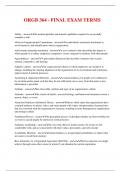
ORGB 364 - FINAL EXAM TERMS Ability - answerthe natural aptitudes and learned capabilities required to successfully complete a task Affective Organizational Commitment - answeran individual's emotional attachment to, involvement in, and identification with an organization achievement-nurturing orientation - answera cross-cultural value describing the degree to which people in a culture emphasize competitive versus cooperative relations with other people Agreeableness - answerA personality dimension that describes someone who is good natured, cooperative, and trusting. Adaptive culture - answeran organizational culture in which employees are receptive to change, including the ongoing alignment of the organization to its environment and continuous improvement of internal processes Anchoring & Adjustment Heuristic - answera natural tendency for people to be influenced by an initial anchor point such that they do not sufficiently move away from that point as new information is provided Artifacts - answerthe observable symbols and signs of an organization's culture Attitudes - answerthe cluster of beliefs, assessed feelings, and behavioral intentions toward a person, object, or event Attraction-Selection-Attribution Theory - answertheory which states that organizations have a natural tendency to attract, select, and retain people with values and personality characteristics that are consistent with the organization's character, resulting in more homogeneous organization and stronger culture Attribution Process - answerthe perceptual process of deciding whether an observed behavior or event is caused largely by internal or external factors Authentic Leadership - answerthe view that effective leaders need to be aware of, feel comfortable with, and act consistently with their values, personality, and self-concept Availability Heuristic - answernatural tendency to assign higher probabilities to objects that are easier to recall from memory Best Alternative to a Negotiated Agreement (BATNA) - answerthe best outcome you might achieve through some other course of action if you abandon the current negotiation Bicultural Audit - answera process of diagnosing cultural relations between companies and determining the extent to which cultural clashes will likely occur Bounded Rationality - answerthe view that people are bounded in their decision-making capabilities, including access to limited information, limited information processing, and tendency toward satisficing rather than maximizing when making choices Brainstorming - answera freewheeling, face-to-face meeting where team members aren't allowed to criticize but are encouraged to speak freely, generate as many ideas as possible, and build on the ideas of others Brainwriting - answera variation of brainstorming whereby participants write (rather than speak about) and share their ideas Brooks's Law - answerthe principle that adding more people to a late software project only makes it later Categorical Thinking - answerorganizing people and objects into preconceived categories that are stored in our long-term memory Ceremonies - answerplanned displays of organizational culture, conducted specifically for the benefit of an audience Cognitive Dissonance - answeremotional experience caused by a perception that our beliefs, feelings, and behaviour are incongruent with each other Collectivism - answera cross-cultural value describing the degree to which people in a culture emphasize duty to groups to which they belong and to group harmony Communication - answerthe process by which information is transmitted and understood between two or more people Confirmation Bias - answerthe process of screening out information that is contrary to our values and assumptions and to more readily accept confirming information Conflict - answerprocess in which one party perceives that its interests are being opposed or negatively affected by another party Conscientiousness - answera personality dimension describing people who are organized, dependable, goal-focused, thorough, disciplined, methodical, and industrious Contact Hypothesis - answera theory stating that the more we interact with someone, the less prejudiced or perceptually biased we will be against that person Continuance Commitment - answeran individual's calculative attachment to an organization Corporate Social Responsibility (CSR) - answerorganizational activities intended to benefit society and the environment beyond the firm's immediate financial interests or legal obligations
Escuela, estudio y materia
- Institución
- ORGB 364
- Grado
- ORGB 364
Información del documento
- Subido en
- 6 de abril de 2024
- Número de páginas
- 14
- Escrito en
- 2023/2024
- Tipo
- Examen
- Contiene
- Preguntas y respuestas
Temas
-
orgb 364 final exam terms

Documento también disponible en un lote