Criminology Exam #1 (Ch. 1-4) Questions With Correct Answers.
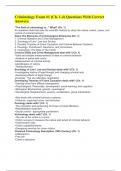
Criminology Exam #1 (Ch. 1-4) Questions With Correct Answers. "The field of criminology is..." What? (Ch. 1) An academic field that uses the scientific method to study the nature, extent, cause, and control of criminal behavior Name The Elements of Criminological Enterprise (Ch. 1) 1. Criminal Statistics and Crime Management 2. Sociology of Law / Law and Society 3. Develop Theories of Crime Causation and Criminal Behavior Systems 4. Penology: Punishment, Sanctions, and Corrections 5. Victimology: The Role of The Victim Criminal Stats and Crime Management deal with? (Ch. 1) -Valid and reliable measurements of data on criminal behavior -Analysis of police and courts -Measurement of criminal activity -Identification of victims -Testing theories Sociology of Law / Law and Society deals with? (Ch. 1) -Investigating history of legal thought and changing criminal acts -Assessing effects of legal change -Example : The sex offenders registration Developing Theories of Crime Causation deals with? (Ch. 1) -Viewing crime from different standpoints: Psychological: Personality, development, social learning, and cognition Biological: Biochemical, genetic, neurological Sociological: Neighborhood, poverty, socialization, group interactions -Also deals with criminal behavior systems: Violence, organized crime, and terrorism Penology deals with? (Ch. 1) -The correction and sentencing of known criminal offenders: Rehabilitation treatment Social control - appropriate punishment Victimology deals with? (Ch. 1) -The role of the victim in a crime Victim surveys to measure the nature and extent of criminal behavior Victimization risks Victim culpability/blame Designing services for crime victims Classical Criminology Description (18th Century) (Ch. 1) -Utilitarianism -Free will -Crime is attractive -Crime can be controlled through fear/punishment -Punishment works better when swift/severe Positivist Criminology Description (19th Century) (Ch. 1) -The scientific method -Logic -Empirical verification - things must be proved -Value-free - no outside influence by observers or biases Positivist Criminology: What physical aspects were studied during this period? Who was the "father of criminology?" What was the Biosocial Theory? (Ch. 1) -Physiognomists and Phrenologists Facial features and head lumps -Cesare Lombroso -Focuses on the interaction between biological and social factors as related to crime Sociological Criminology Description (19th Century) (Ch. 1) -Crime as a social phenomenon -Reflects other social and economic conditions -Functional, conflict, and symbolic means Developmental Criminology Description (20th Century) (Ch. 1) -Sheldon and Eleanor Glueck -Developmental theory: Views criminality as a dynamic process influenced by: Biological Social Physiological elements Contemporary Criminology Description/Theories (21st Century) (Ch. 1) -Rational Choice Theory -Trait Theory -Social Structure Theory -Social Process Theory -Critical Theory -Developmental Theory Deviance - And when is it a crime? (Ch. 1) -Deviance - Any action that violates a social norm (either positively or negatively) (assault vs winning a Nobel Prize) -Deviant acts become crimes when it is deemed socially harmful or dangerous - when it is specifically defined, prohibited, and punished under criminal law Define Crime (Ch. 1) A violation of societal rules of behaviors as interpreted/expressed by the criminal law, which reflects public opinion... etc. Individuals who violate these rules are subject to sanctions by state authority, social stigma, and loss of status What is the consensus view? - Concept of Crime (Ch. 1) The belief that the majority of citizens in a society share common values and agree on what behaviors should be defined as criminal What is the conflict view? - Concept of Crime (Ch. 1) The belief that criminal behavior is defined by those in power and criminality is defined in such a way as to protect their power What is the interactionist view? - Concept of Crime (Ch. 1) The belief that those with social power are able to impose their values on society as a whole; and these values then define criminal behavior; consensus through conflict Contemporary criminal law is divided into what two categories? What are the parameters for each? (Ch. 1) Felonies (serious offenses - murder, rape, burglary) Misdemeanors (minor crimes - unarmed assault, larceny, disturbing the peace) What are the purposes/goals of contemporary criminal law? (Ch. 1) -Enforcing social control -Discouraging revenge -Expressing public opinion -Teaching moral values -Deterring criminal behavior -Punishing wrongdoing -Creating equity -Maintaining social order What are some of the ethical issues for criminologists? (Ch. 1) -What to study: Conflicts of interest -Whom to study: Offender and victims -How to study: Criminologists as criminals themselves What are the four primary sources of crime data? (Ch. 2) -Uniform Crime Report (UCR) -National Incident-Based Reporting System (NIBRS) -National Crime Victimization Survey (NCVS) -Self Report Surveys Uniform Crime Reports (UCR) are broken up into how many parts based on crimes? What are some crimes included in these parts? (Ch. 2) -Technically three parts: Part I(a) : Violent Crimes (homicide, rape, robbery, aggravated assault) Part I(b): Property Crimes (burglary, larceny theft, motor vehicle theft, arson) Part II: All others (sex crimes, drug offenses, vandalism, etc) The validity and limitations of Uniform Crime Reports (UCR)? (Ch. 2) -Only reports known crimes -Only the most serious crimes are reported -Fails to differentiate between attempted and completed crimes -Many crimes not reported by the UCR What is the status of the National Incident-Based Reporting System? (Ch. 2)
Información del documento
- Subido en
- 5 de abril de 2024
- Número de páginas
- 7
- Escrito en
- 2023/2024
- Tipo
- Examen
- Contiene
- Preguntas y respuestas