Chemistry: Final Exam Review 2023 with complete solution
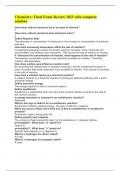
Chemistry: Final Exam Review 2023 with complete solution How many valence electrons are in an atom of chlorine? 7 How many valence electrons does aluminum have? 3 Define Reaction Rate The decrease in concentration of reactants or the increase in concentration of products with time. How does increasing temperature affect the rate of reaction? Increasing temperature causes the kinetic energy to increase. Thus, molecules are moving faster and colliding more frequently. This causes the rate of reaction to incrase. If I decrease the concentration of reactant, what happens to the rate of reaction? Decreasing concentration leads to less reactants available for collision. Therefore, reaction rate decreases. How does surface area influence reaction rate? By increasing the surface area of reactant molecules, we are increasing the space or point of contact that these molecules have available to interact. This causes an increase in the rate of reaction. How does a catalyst speed up a chemical reaction? A catalyst speeds up a chemical reaction by finding an alternate pathway with a lower activation energy. Define activation energy. The energy required to start a chemical reaction. Define equilibrium. Equilibrium is established when the rate of the forward reaction is equal to the rate of the reverse reaction. Is energy absorbed or released in an endothermic reaction? Absorbed. What is the sign of delta H for an exothermic reaction? Exothermic reactions release energy. The sign of delta H is negative. When you touch a flask and it feels hot, is this an endothermic or exothermic process? Exothermic; heat is being given off. Define specific heat capacity. The amount of heat required to raise 1g of a substance to 1 degrees Celsius. q=mc(delta)T ; What does "q" stand for? Heat (kJ) q=mc(delta)T ; What does "c" stand for? Specific heat capacity (J / g degrees C) What is a hydrogen ion donor called? An acid. What is a hydrogen ion acceptor called? A base.
Información del documento
- Subido en
- 5 de abril de 2024
- Número de páginas
- 4
- Escrito en
- 2023/2024
- Tipo
- Examen
- Contiene
- Preguntas y respuestas