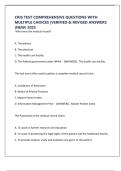
Test Bank - Maternal-Child Nursing (5th Edition by McKinney) Chapter 10
Test Bank - Maternal-Child Nursing (5th Edition by McKinney) Chapter 10 Chapter 10: Hereditary and Environmental Influences on Development MULTIPLE CHOICE 1. How can a woman avoid exposing her fetus to teratogens? a. Update her immunizations during the first trimester of her pregnancy. b. Use saunas and hot tubs during the winter months only. c. Use only class A drugs during her pregnancy. d. Use alcoholic beverages only in the first and third trimesters of pregnancy. ANS: C Feedback A Immunizations, such as rubella, are contraindicated in pregnancy. B Maternal hyperthermia is an important teratogen. C In well-controlled studies, clNasUs RASdINruGgTsBh.aCvOeMno demonstrated fetal risk. D Alcohol is an environmental substance known to be teratogenic. PTS: 1 DIF: Cognitive Level: Application REF: p. 194 OBJ: Nursing Process: Planning MSC: Client Needs: Health Promotion and Maintenance 2. The karyotype of a person is 47, XY, +21. This person is a a. Normal male b. Male with Down syndrome c. Normal female d. Female with Turner syndrome ANS: B Feedback A A normal male has 46 chromosomes. B This person is male because his sex chromosomes are XY. He has one extra copy of chromosome 21 (for a total of 47 instead of 46), resulting in Down syndrome. C A normal female has 46 chromosomes and XX for the sex chromosomes. D A female with Turner syndrome has 45 chromosomes; the sex chromosomes have just one X. PTS: 1 DIF: Cognitive Level: Comprehension REF: p. 191 OBJ: Nursing Process: Assessment MSC: Client Needs: Physiologic Integrity 3. People who have two copies of the same abnormal autosomal dominant gene will usually be a. More severely affected by the disorder than will people with one copy of the gene b. Infertile and unable to transmit the gene c. Carriers of the trait but not affected with the disorder d. Mildly affected with the disorder ANS: A Feedback NURSINGTB.COM A People who have two copies of an abnormal gene are usually more severely affected by the disorder because they have no normal gene to maintain normal function. B Infertility may or may not be caused by chromosomal defects. C A carrier of a trait has one recessive gene. D Those mildly affected with the disorder will have only one copy of the abnormal gene. PTS: 1 DIF: Cognitive Level: Comprehension REF: p. 191 OBJ: Nursing Process: Assessment MSC: Client Needs: Physiologic Integrity 4. A baby is born with blood type AB. The father is type A, and the mother is type B. The father asks why the baby has a blood type different from those of his parents. The nurses answer should be based on the knowledge that a. Both A and B blood types are dominant. b. The baby has a mutation of the parents blood types. c. Type A is recessive and links more easily with type B. d. Types A and B are recessive when linked together. ANS: A Feedback A Types A and B are equally dominant, and the baby can thus inherit one from each parent. B The infant has inherited both blood types from the parents; it is not a mutation. C Both types A and B are equally dominant. D Both types A and B are dominant. PTS: 1 DIF: Cognitive Level: Comprehension REF: p. 190 OBJ: Nursing Process: Implementation MSC: Client Needs: Physiologic Integrity 5. Which statement is true of multifactorial disorders? a. They may not be evident until lateNr iUnRliSfIeN. GTB.COM b. They are usually present and detectable at birth. c. The disorders are characterized by multiple defects. d. Secondary defects are rarely associated with multifactorial disease. ANS: B Feedback A They are usually detectable at birth. B Multifactorial disorders result from an interaction between a persons genetic susceptibility and environmental conditions that favor development of the defect. They are characteristically present and detectable at birth. C They are usually single isolated defects, although the primary defect may cause secondary defects. D Secondary defects can occur with multifactorial disorders. PTS: 1 DIF: Cognitive Level: Comprehension REF: p. 193 | Box 10-1 OBJ: Nursing Process: Assessment MSC: Client Needs: Health Promotion and Maintenance 6. Both members of an expectant couple are carriers for phenylketonuria (PKU), an autosomal recessive disorder. In counseling them about the risk to their unborn child, the nurse should tell them that a. The child has a 25% chance of being affected. b. The child will be a carrier, like the parents. c. The child has a 50% chance of being affected. d. One of four of their children will be affected. ANS: A Feedback A Each child born to a couple who carries an autosomal recessive trait has a 25% chance of having the disorder, because the child receives either a normal or an abnormal gene from each parent. B If one member of the coupleNhUasRtShIeNaGuTtoBs.oCmOaMl recessive disorder, all of their children will be carriers. If both parents are carriers, each child has a 50% chance of being a carrier. C The child has a 25% chance of being affected and a 50% chance of being a carrier. D Each child has the identical odds of being affected. Because both parents are carriers, each child has a 25% chance of being affected, a 50% change of being a carrier, and a 25% change of not having the gene transmitted. PTS: 1 DIF: Cognitive Level: Comprehension REF: pp. 190-191 | Box 10-1 OBJ: Nursing Process: Implementation MSC: Client Needs: Health Promotion and Maintenance 7. Which statement should a counselor make when telling a couple about the prenatal diagnosis of genetic disorders? a. Diagnosis can be obtained promptly through most hospital laboratories. b. Common disorders can quickly be diagnosed through blood tests. c. A comprehensive evaluation will result in an accurate diagnosis. d. Diagnosis may be slow and could be inconclusive.
Escuela, estudio y materia
- Institución
- Maternal-Child Nursing
- Grado
- Maternal-Child Nursing
Información del documento
- Subido en
- 4 de abril de 2024
- Número de páginas
- 12
- Escrito en
- 2023/2024
- Tipo
- Examen
- Contiene
- Preguntas y respuestas
Temas
-
test bank maternal child nursing 5th edition by