

Summary Bio-informatics and genome technology
1. Genome analysis
▪ G1:Genome complexity & genome mapping
o Genome structure, organization and complexity
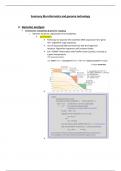
• Cot filtration:
➢ Technique to separate the repetitive DNA sequences from ‘gene-
rich’ single/low-copy sequences.
➢ Use of denatured DNA and look how fast the fragments
renature. Repetitive sequences will renature faster.
➢ Cot = [DNA]*renaturation time*buffer factor [cation], viscosity at
a given temperature
➢
ine cs
imo ecu are n or er reac on
concentra on of sing estran e DNA ini a concentra on
t concetra on of the t o sing estran s
for renatura on of enature DNA
nega ves i gna sthe s i ng es tra n e DNA i s i s s a pea ri ng
therefore t
integra on from the ini a va ues t gives
t
an
t
is the frac on sing estran e DNA s present i e A va ue et een
hen ha f of the DNA has renature an the formu a ecomes
t or t
n this manner the va ue of can e erive e perimenta from the reassocia oncurve
This va ue epen s on the ca on concentra on temperature fragment si e etc
➢
,o Genome mapping
• Restriction fragment length polymorphisms (RFLP)
➢ Loss of cleavage site by mutation leading to length variation in
microsatellite repeats
➢ Use of a probe in southern blotting with DNA from parents for
detection of the affected offspring
➢ Briefly, purified DNA from a biological sample is digested with
restriction enzymes, the resulting DNA fragments are separated
by using electrophoresis, which allows smaller fragments to move
faster than larger fragments. The DNA fragments are transferred
out of the gel or matrix onto a solid membrane, which is then
exposed to a DNA probe labeled with a radioactive, fluorescent,
or chemical tag. The tag allows any DNA fragments containing
complementary sequences with the DNA probe sequence to be
visualized within the Southern blot.
• Sequence tags
➢ Short unique sequence marker will amplify a single locus and
produce a single band after PCR
• Amplified fragment length polymorphisms (AFLP)
Amp i e ragment ength o morphism A
TTAA
AATT
➢
➢ Na het isoleren van het DNA uit het staal wordt het DNA in stukjes
geknipt met restrictie-enzymen. Tegelijkertijd worden stukjes
kunstmatig gesynthetiseerd DNA (adapters) aan deze
knipplaatsen geligeerd. Voor de daaropvolgende PCR worden
primers toegevoegd die de adaptersequentie herkennen. De DNA-
fragmenten worden samen met de adapters vermenigvuldigd in
de PCR. Men kan het aantal geamplificeerde restrictiefragmenten
regelen door aan de primers één of meerdere extra nucleotiden
toe te voegen. Voor eenvoudige genomen zoals die van fagen
worden primers zonder overhang gebruikt, zodat alle verkregen
restrictiefragmenten geamplificeerd worden. Uiteindelijk kan de
detectie van de geamplificeerde fragmenten gebeuren door
capillair-elektroforese.
,• Randomly amplified polymorphic DNA (RAPD)
➢ Markers are DNA fragments from PCR amplification of random
segments of the genomic DNA by using a single primer of
arbitrary nucleotide sequence.
➢ No fragments are made if primers annea e too far apart or if 3’
ends of primers are not facing each other.
➢ Limitations: nearly all RAPD markers are dominant
• Single nucleotide polymorphisms SN ’s
➢ Single-bp positions at which different sequence alternatives
(alleles) exist in a population
➢ Potentially suitable markers for multifactorial disorders using
LINKAGE DISEQUILIBRIUM MAPPING
iochemica reac on un er ing SN genot ping
D SAT N N AS D
pro es comp ementar to the SN s varia ons
SN posi on centra ocate ithin the pro e
n perfect matche pro es are sta e
rimer annea s to the SN a acent region
omp ementar to the SN at the 3 en
n matching primers i e ten using DNA
primer annea s a acent to the SN
DNA e ten san the incorporate nuc eo e is i en e
➢
pro es an a 3 a acent pro e annea
on matching pro es i e oine a igase
pairs of a e e speci c pro es ith an unre ate ac
nuc eo e is comp ement
isp acement the inva er
the resu ng structure is c eave a A en onuc ease N
is re ease et eenmatch mismatch
simp e restric on en onuc ease ase varia on
➢
, ▪ G2: Cloning & screening of large DNA fragments
o Introduction
• In between analysis of individual genes and analysis of entire genomes:
gene clusters, genomic regions, operons …
• Use of standard E.coli strains or S. cerevisiae
➢ Yeast has limited sensitivity towards antibiotics such as
geneticine neom cine … therefore au otrofic mar ers are often
used: a strain is mutated in a biosynthetic gene and therefore
requires a supply/supplement to survive until a plasmid with the
complement gene is inserted e.g. HIS3*
o Different cloning vectors (!!!)
• Plasmids
➢ = circular, double-stranded DNA molecules that exist in bacteria
and in the nuclei of some eukaryotic cells. They can replicate
independently of the host cell. The size of plasmids ranges from a
few kb to near 100 kb
➢ Containing Ori, selection marker, regulatory elements and MCS
- Ori: defines host range, copy number and incompatibility
- Selection marker: ampici ine Kanam cine…
- Regulatory elements: crucial elements in expression vectors
for recombinant protein production. E.g. inducible promotor.
- Multiple Cloning site: a short segment of DNA with multiple
recognition sites for restriction endonucleases which are not
present elsewhere on the plasmid.
• Cosmids
➢ = type of hybrid plasmid that contains a cos sequence (DNA
sequence derived from bacteriophage lambda) . As such, the
vector can be packaged into a phage head which in turn allows
foreign DNA to be transferred into / between cells by
transduction.
ineari a on using restric on en mes 3 oncatenate using DNA igase
ut foreign DNA to generate compa e en s pac aging infec on
Avoi se f iga on
Avoi insert chimers
ep ica ng se ecta e p asmi no p aques
1. Genome analysis
▪ G1:Genome complexity & genome mapping
o Genome structure, organization and complexity
• Cot filtration:
➢ Technique to separate the repetitive DNA sequences from ‘gene-
rich’ single/low-copy sequences.
➢ Use of denatured DNA and look how fast the fragments
renature. Repetitive sequences will renature faster.
➢ Cot = [DNA]*renaturation time*buffer factor [cation], viscosity at
a given temperature
➢
ine cs
imo ecu are n or er reac on
concentra on of sing estran e DNA ini a concentra on
t concetra on of the t o sing estran s
for renatura on of enature DNA
nega ves i gna sthe s i ng es tra n e DNA i s i s s a pea ri ng
therefore t
integra on from the ini a va ues t gives
t
an
t
is the frac on sing estran e DNA s present i e A va ue et een
hen ha f of the DNA has renature an the formu a ecomes
t or t
n this manner the va ue of can e erive e perimenta from the reassocia oncurve
This va ue epen s on the ca on concentra on temperature fragment si e etc
➢
,o Genome mapping
• Restriction fragment length polymorphisms (RFLP)
➢ Loss of cleavage site by mutation leading to length variation in
microsatellite repeats
➢ Use of a probe in southern blotting with DNA from parents for
detection of the affected offspring
➢ Briefly, purified DNA from a biological sample is digested with
restriction enzymes, the resulting DNA fragments are separated
by using electrophoresis, which allows smaller fragments to move
faster than larger fragments. The DNA fragments are transferred
out of the gel or matrix onto a solid membrane, which is then
exposed to a DNA probe labeled with a radioactive, fluorescent,
or chemical tag. The tag allows any DNA fragments containing
complementary sequences with the DNA probe sequence to be
visualized within the Southern blot.
• Sequence tags
➢ Short unique sequence marker will amplify a single locus and
produce a single band after PCR
• Amplified fragment length polymorphisms (AFLP)
Amp i e ragment ength o morphism A
TTAA
AATT
➢
➢ Na het isoleren van het DNA uit het staal wordt het DNA in stukjes
geknipt met restrictie-enzymen. Tegelijkertijd worden stukjes
kunstmatig gesynthetiseerd DNA (adapters) aan deze
knipplaatsen geligeerd. Voor de daaropvolgende PCR worden
primers toegevoegd die de adaptersequentie herkennen. De DNA-
fragmenten worden samen met de adapters vermenigvuldigd in
de PCR. Men kan het aantal geamplificeerde restrictiefragmenten
regelen door aan de primers één of meerdere extra nucleotiden
toe te voegen. Voor eenvoudige genomen zoals die van fagen
worden primers zonder overhang gebruikt, zodat alle verkregen
restrictiefragmenten geamplificeerd worden. Uiteindelijk kan de
detectie van de geamplificeerde fragmenten gebeuren door
capillair-elektroforese.
,• Randomly amplified polymorphic DNA (RAPD)
➢ Markers are DNA fragments from PCR amplification of random
segments of the genomic DNA by using a single primer of
arbitrary nucleotide sequence.
➢ No fragments are made if primers annea e too far apart or if 3’
ends of primers are not facing each other.
➢ Limitations: nearly all RAPD markers are dominant
• Single nucleotide polymorphisms SN ’s
➢ Single-bp positions at which different sequence alternatives
(alleles) exist in a population
➢ Potentially suitable markers for multifactorial disorders using
LINKAGE DISEQUILIBRIUM MAPPING
iochemica reac on un er ing SN genot ping
D SAT N N AS D
pro es comp ementar to the SN s varia ons
SN posi on centra ocate ithin the pro e
n perfect matche pro es are sta e
rimer annea s to the SN a acent region
omp ementar to the SN at the 3 en
n matching primers i e ten using DNA
primer annea s a acent to the SN
DNA e ten san the incorporate nuc eo e is i en e
➢
pro es an a 3 a acent pro e annea
on matching pro es i e oine a igase
pairs of a e e speci c pro es ith an unre ate ac
nuc eo e is comp ement
isp acement the inva er
the resu ng structure is c eave a A en onuc ease N
is re ease et eenmatch mismatch
simp e restric on en onuc ease ase varia on
➢
, ▪ G2: Cloning & screening of large DNA fragments
o Introduction
• In between analysis of individual genes and analysis of entire genomes:
gene clusters, genomic regions, operons …
• Use of standard E.coli strains or S. cerevisiae
➢ Yeast has limited sensitivity towards antibiotics such as
geneticine neom cine … therefore au otrofic mar ers are often
used: a strain is mutated in a biosynthetic gene and therefore
requires a supply/supplement to survive until a plasmid with the
complement gene is inserted e.g. HIS3*
o Different cloning vectors (!!!)
• Plasmids
➢ = circular, double-stranded DNA molecules that exist in bacteria
and in the nuclei of some eukaryotic cells. They can replicate
independently of the host cell. The size of plasmids ranges from a
few kb to near 100 kb
➢ Containing Ori, selection marker, regulatory elements and MCS
- Ori: defines host range, copy number and incompatibility
- Selection marker: ampici ine Kanam cine…
- Regulatory elements: crucial elements in expression vectors
for recombinant protein production. E.g. inducible promotor.
- Multiple Cloning site: a short segment of DNA with multiple
recognition sites for restriction endonucleases which are not
present elsewhere on the plasmid.
• Cosmids
➢ = type of hybrid plasmid that contains a cos sequence (DNA
sequence derived from bacteriophage lambda) . As such, the
vector can be packaged into a phage head which in turn allows
foreign DNA to be transferred into / between cells by
transduction.
ineari a on using restric on en mes 3 oncatenate using DNA igase
ut foreign DNA to generate compa e en s pac aging infec on
Avoi se f iga on
Avoi insert chimers
ep ica ng se ecta e p asmi no p aques


