CCTC real final exam
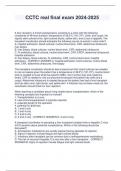
CCTC real final exam A liver recipient, 2-month postoperative, presents to a clinic with the following complaints of 48-hour duration: temperature of 38.5°C (101.3°F), chills, and cough. He reports dark-colored urine, light-colored stools, yellow skin, and a loss of appetite. The transplant coordinator should anticipate the following course of events in what order? A. hospital admission, blood cultures, routine blood work, CXR, abdominal ultrasound, liver biopsy B. liver biopsy, blood cultures, routine blood work, CXR, abdominal ultrasound C. IV antibiotics, blood cultures, routine blood work, CXR, ERCP, abdominal ultrasound, hospital admission D. liver biopsy, blood cultures, IV antibiotics, CXR, routine blood work, hospital admission - CORRECT ANSWER-A. hospital admission, blood cultures, routine blood work, CXR, abdominal ultrasound, liver biopsy The transplant coordinator should do less invasive test first: blood cultures are needed to rule out sepsis given the patient has a temperature of 38.5°C (101.3°F), routine blood work is needed to know what the patient's WBC, liver function test, and creatinine levels. CXR is needed to rule out pneumonia because the patient has chills and a cough. Abdominal ultrasound is needed because the patient has had a liver transplant and has dark urine, light stools, and yellow skin. If infection has not been ruled out, the coordinator should check for liver rejection. When teaching a candidate about living-related donor transplantation, which of the following concepts are important to include? 1. Transplantation is a cure. 2. Less immunosuppression is typically required. 3. expected length of the operation 4. potential for graft loss A. 1 and 2 only B. 1 and 4 only C. 2 and 3 only D. 3 and 4 only - CORRECT ANSWER-D. 3 and 4 only A transplant coordinator is educating a liver transplant recipient who is hepatitic C virus (HCV)-positive about potential complications. Which of the following should be discussed? A. Antirejection medications are usually lowered during episodes of rejection. B. Signs of rejection include fatigue and light colored stools. C. Infections after transplant can be common due to antihypertensive medications. D. The risk of recurrent hepatitis C is very low after a liver transplant. - CORRECT ANSWER-B. Signs of rejection include fatigue and light colored stools. Antirejection medications are increased, not lowered during episodes of rejection. Infections are common due to antirejection medications, not antihypertensive medications. The recipient is still HCV-positive even after the liver transplantation and treatment may be necessary
Escuela, estudio y materia
- Institución
- CCTC
- Grado
- CCTC
Información del documento
- Subido en
- 28 de marzo de 2024
- Número de páginas
- 14
- Escrito en
- 2023/2024
- Tipo
- Examen
- Contiene
- Preguntas y respuestas
Temas
- cctc real final exam
-
a liver recipient 2 month postoperative presents
-
a heart transplant recipient is being prepared for
-
in the absence of any specific abnormalities micr

Documento también disponible en un lote