NASM CES Final Exam Review 2024 Questions and Answers
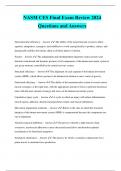
NASM CES Final Exam Review 2024 Questions and Answers Neuromuscular efficiency - Answer ️️ -The ability of the neuromuscular system to allow agonists, antagonists, synergists, and stablilzers to work synergistically to produce, reduce, and dynamically stabilize the kinetic chain in all three planes of motion. Posture - Answer ️️ -The independent and interdependent alignment (static posture) and function (transitional and dynamic posture) of all components of the human movement system at any given moment; controlled by the central nervous system. Structural efficiency - Answer ️️ -The alignment of each segment of the human movement system (HMS), which allows posture to be balanced in relation to one's center of gravity. Functional efficiency - Answer ️️ -The ability of the neuromuscular system to recruit correct muscle synergies, at the right time, with the appropriate amount of force to perform functional tasks with the least amount of energy and stress on the human movement system. Cumulative injury cycle - Answer ️️ -A cycle in which an injury will induce inflammation, muscle spasm, adhesion, altered neuromusclular control, and muscle imbalances. Movement impairment syndrome - Answer ️️ -Refers to the state in which the structural integrity of the human movement system (HMS) is compromised because the components are out of alignment. Altered reciprocal inhibition - Answer ️️ -The process whereby a tight muscle (short, overactive, myofascial adhesions) causes decreased neural drive and therefore optimal recruitment of its functional antagonist. Synergistic dominance - Answer ️️ -The process by which a synergist compenstates for a prime mover to maintain force production. Lower extremity movement impairment syndrome - Answer ️️ -Usually characterized by excessive foot pronation (flat feet), increased knee valgus (tibia externally rotated and femur internally rotated and adducted or knock-kneed), and increased movement at the lumbo-pelvic- hip-complex (extension or flexion) during functional movements. Upper extremity movement impairment syndrome - Answer ️️ -Usually characterized as having rounded shoulders and a forward head posture or improper scapulothoracic or glenohumeral kinematics during functional movements. Lengthening Techniques - Answer ️️ -2nd phase in the Corrective Exercise Continuum is to lengthen those overactive or tight neuromyofascial tissues. Lengthening - Answer ️️ -refers to the elongation of mechanically shortened muscle and connective tissuenecessary to increase range of motion (ROM) at the tissue and joint. 2 most common methods of stretching: - Answer ️️ -Static stretching Neuromuscular stretching Static stretching - Answer ️️ -Combines low force with long duration using autogenic inhibition. This form of stretching allows for relaxation and concomitant elongation of muscle. To perform static stretching, the stretch is held at the first point of tension or resistance barrier for 30 seconds. Performed solo Neuromuscular stretching - Answer ️️ -commonly called proprioceptive neuromuscular facilitation,or PNF involves taking the muscle to its end ROM (point of joint compensation), actively contracting the muscle to be stretched for 7 -15 seconds, then passively moving the joint to a new end ROM and holding this position for 20-30 seconds. Recurrent inhibition - Answer ️️ -A feedback circuit that can decrease the excitability of motor neurons via the interneuron called the Renshaw cell. Stretch reflex - Answer ️️ -A muscle contraction in response to stretching within the muscle. Static stretching is characterized by: - Answer ️️ -The elongation of neuromyofascial tissue to an end-range and statically holding that position fora period of time. Maximal control of structural alignment Minimal acceleration into and out of the elongated (stretch) position. Neuromuscular stretching is (NMS) characterized by: - Answer ️️ -Taking the muscle to its end ROM (point of joint compensation) Active contraction of the muscle to be stretched Passively (or actively) moving to a new end ROM Statically holding new position for 20-30 seconds and repeating 3 times. Neuromuscular stretching - Answer ️️ -Is a technique that involves a process of isometrically contracting a desired muscle in a lengthened position to induce a relazation response on the tissue, allowing it to further elongate. Requires the assistance of another person. Autogenic inhibition - Answer ️️ -The process when neural impulses that sense tension are greater than the impulses that cause muscles to contract, providing an inhibitory effect to the muscle spindles What is the origin of the Anterior Tibialis? - Answer ️️ -The lateral condyle and proximal two thirds f the lateral surface of the tibia What is the origin of the Posterior Tibilais ? - Answer ️️ -Proximal two thirds surface of the tibia and fibula What is the origin of the Soleus? - Answer ️️ -Posterior surface of the fibular head and proximal one third of its shaft and the posterior side of the tibia What is the origin of the Gastrocnemius? - Answer ️️ -Posterior aspect of the lateral and medial femoral condyles What is the origin of Peroneus Longus? - Answer ️️ -Lateral condyle of the tibia, head and proximal two thirds of the lateral surface of the fibula What is the origin of the long head of Biceps Femoris? - Answer ️️ -Ischial tuberosity of the pelvis and part of the sacrotuberous ligament What is the origin of the short head of Biceps Femoris? - Answer ️️ -Lower one third of the posterior aspect of the femur What is the origin of Semimembranosus? - Answer ️️ -Ischial tuberosity of the pelvis What is the origin of Semitendinosus? - Answer ️️ -Ischial tuberosity of the pelvis and part of the sacrotuberous ligament What is the origin of Vastus Lateralis? - Answer ️️ -Anterior and inferior border of the greater trochanter, lateral region of the gluteal tuberosity, lateral lip of the linea aspera of the femur What is the origin of Vastus Medialis? - Answer ️️ -Lower region of the intertrochanteric line, medial lip of the linea aspera, proximal medial supracondylar line of the femur What is the origin of Vastus Intermedius? - Answer ️️ -Anterior-lateral regions of the upper two thirds of the femur What is the origin of Rectus femoris? - Answer ️️ -Anterior-inferior illiac spine of the pelvis What is the origin of Adductor longus ? - Answer ️️ -Anterior surface of the inferior pubic ramus of the pelvis What is the origin of the anterior fibers of Adductor magnus? - Answer ️️ -Ischial ramus of the pelvis What is the origin of the posterior fibers of Adductor magnus? - Answer ️️ -Ischial tuberosity of the pelvis What is the origin of Adductor brevis? - Answer ️️ -Anterior surface of the inferior pubic ramus of the pelvis What is the origin of Gracilis? - Answer ️️ -Anterior aspect of the lower body of the pubis What is the origin of Pectineus? - Answer ️️ -Pectineal line on the superior pubic ramus of the pelvis What is the origin of the anterior fibers of Gluteus medius? - Answer ️️ -Outer surface of the ilium What is the origin of the posterior fibers of gluteus medius? - Answer ️️ -Outer surface of the ilium What is the origin of Gluteus maximus? - Answer ️️ -Outer ilium, posterior side of the sacrum, coccyx, and sacrotuberous ligament, and the posterior sacroiliac ligament What is the origin of Gluteus minimus? - Answer ️️ -Ilium, between the anterior and inferior gluteal line What is the origin of Tensor Fascia Late? - Answer ️️ -Outer surface of the illiac crest just posterior to the anterior-superior iliac spine of the pelvis What is the origin of Psoas? - Answer ️️ -Transverse processes and lateral bodies of the last thoracic and all lumbar vertebrae, including the intervertebral disc What is the origin of Sartorius? - Answer ️️ -Anterior-superior iliac spine of the pelvis which of the following best describes how plantar fasciitits has affected the population? - Answer ️️ -more than one million ambulatory care visits per year are attributed to plantar fasciiti
Escuela, estudio y materia
- Institución
- NASM CES
- Grado
- NASM CES
Información del documento
- Subido en
- 22 de marzo de 2024
- Número de páginas
- 67
- Escrito en
- 2023/2024
- Tipo
- Examen
- Contiene
- Preguntas y respuestas
Temas
-
nasm ces final exam review 2024 questions and answ

Documento también disponible en un lote