

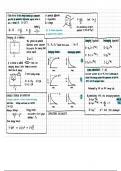
capacitance is the charge stored by a capacitor ✓ = potential difference
per volt of potential difference applied across it. (= capacitance A
C. = EOA CNA Caf
unit = farad, F (F = CV-1) Q = charge d
symbolz d
Ecoon=stPañtm "(8"!"85×1%-1? ing
Q = CV C- Q
v. ♀ Tip: to increase capacitance
of capacitor add a dielectric
Charging of a capacitor
+ The greater the potential Charging Equations: Discharging Equations:
V difference across capacitor Vo, Qo, Io = Initial max value i. V0 = E
the greater the charge that Q = Qo (Y-éᵗ/RC) Q = éᵗ're
can be stored. Charging Graphs: discharging graphs:
✓ = ECT - e- "RC) V-Ee-"RC
c
Q
QαV
If a resistor is added R
then the ÷ ¾
⟂-Io (t-e- "RC) I - I, e-t/RC
charging process takes longer as resistors
resist flow of charge. time time TIME CONSTANT: T = RC
R
E- emf: supply voltage the time constant for an RC circuit is the time it
Vo: E
t takes the charge across the capacitor to fall to
V
o
v i
E - Vc + Vr if V=IR : e 37% of it's original value.
E = Vct IR
t time time discharged by 371. so 631. charge left.
E
ENERGY STORED BY CAPACITOR if By substituting t-RC into discharging equations:
l
a charged capacitor is a store of electrical energy. É Q = ◦ e- "RC same fo
work done: voltage-work done per coulomb = Qoe-RC/RC - RC = -1 V. Q,
W= V RC
time time
Average Voltage: Energy stored = =Q e-t e- 1 = 0.37 = 371. discharged
= V10 = ½ V area under a Q-V graph CAPACITORS IN CIRCUITS:
gradient = %
Total Energy stored :
U =½QV or U=½CV² or = ½
♀
per volt of potential difference applied across it. (= capacitance A
C. = EOA CNA Caf
unit = farad, F (F = CV-1) Q = charge d
symbolz d
Ecoon=stPañtm "(8"!"85×1%-1? ing
Q = CV C- Q
v. ♀ Tip: to increase capacitance
of capacitor add a dielectric
Charging of a capacitor
+ The greater the potential Charging Equations: Discharging Equations:
V difference across capacitor Vo, Qo, Io = Initial max value i. V0 = E
the greater the charge that Q = Qo (Y-éᵗ/RC) Q = éᵗ're
can be stored. Charging Graphs: discharging graphs:
✓ = ECT - e- "RC) V-Ee-"RC
c
Q
QαV
If a resistor is added R
then the ÷ ¾
⟂-Io (t-e- "RC) I - I, e-t/RC
charging process takes longer as resistors
resist flow of charge. time time TIME CONSTANT: T = RC
R
E- emf: supply voltage the time constant for an RC circuit is the time it
Vo: E
t takes the charge across the capacitor to fall to
V
o
v i
E - Vc + Vr if V=IR : e 37% of it's original value.
E = Vct IR
t time time discharged by 371. so 631. charge left.
E
ENERGY STORED BY CAPACITOR if By substituting t-RC into discharging equations:
l
a charged capacitor is a store of electrical energy. É Q = ◦ e- "RC same fo
work done: voltage-work done per coulomb = Qoe-RC/RC - RC = -1 V. Q,
W= V RC
time time
Average Voltage: Energy stored = =Q e-t e- 1 = 0.37 = 371. discharged
= V10 = ½ V area under a Q-V graph CAPACITORS IN CIRCUITS:
gradient = %
Total Energy stored :
U =½QV or U=½CV² or = ½
♀

