

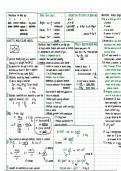
Assumtions For Ideal Gas: Ideal Gas Laws EQUATION OF STATE OF IDEAL GAS \
Questions: kinetic physic
R A V E PV αT 1) Eq. of an ideal gas PV=nR
Rapid + no forces of volume of a Only collide Boyles: p α f • constant PV ✗ NT p = pressure
Random attraction molecule is Elastically temperature • PV = KNT or N=NAn SO PV- KNANT V = volume
smaller than Charles: VαT • constant • PV - NRT ↑ n = no. of moles
volume of gas. pressure constant R= NA-K R = constant: 8.31 5m01-1k"
Pressure: P&T • constant T = temperature
KINETIC MOLECULAR MODEL volume 2) An ideal gas is a gas which
Question: Heat is supplied to an ideal gas MOLES + RELATIVE MOLAR MASS gas molecules don't interact
&
L
of fixed volume. Explain what causes an increase relative molar mass = Mr other. The molecules are th
in temperature and pressure of gas. molar mass = Mm → mass permole perfectly spheres.
Increase in temperature due to: Mm = Mr (kg) 3) TαV when pressure is c
① particle moving freely at a constant • molecules move rapid and randomly. 1000 increasing temp, increases
velocity in a straight line (NTL) • increases amount of collisions when heated 4) If volume is constant P&
② As particle hits the wall it exerts a force • causes an increase in kinetic energy number of moles = n → As T increases KE increa
and molecule bounces back in opposite • No work done as volume is constant. number of molecules = N so more collisions betwee
direction at the same speed. (N 3L) • T α U (internal energy) To find no. of moles : n = N occur as particles move
③ Collisions traced by change in momentum Newtons laws of motion: NA higher speed. Particles e
C- ) due to change in direction. • momentum of molecules increases To find mass of 1 molecule: greater force which wou
= -Mvx-(Mbc) (final-initial) • Force on molecules = rate of change in n = MN = total mass increase rate of change in
Δp = -2MVx f = - MVC momentum MNA molar mass ... pressure increases.
i = MVx • Force on wall is equal and opposite to 5) Avogadros constant is t
④ distance travelled for a molecule is twice the force on molecules there are in one mole of
length of container (2L) s- • Greater forces during collisions G) Assumptions Of Ideal
if tig = ¾ d:L: Increase in Pressure: Atoms move rapidly + ran
• molecules collide with walls exerting No force of attraction bet
force on walls Elastic collisions only
⑤ NIL = -= Ma (Ap) • pressure increases with temperature volume of a molecule is
- = -2mvx if t - 2¥ • P = force/area of a gas. Volume of cont
- force exerted • Pressure increases due to Time of each collision
→ F= -2m¥ = - MV²x on molecule lots of collisions. 7) PV NmI²
2L L + = force exerted
Vx on wall pV=KNT andPV = NME 8) Crms = root mean squa
3 R=KNA means the ✓ of the
Force exerted on wall and molecule creates a pressure. KAT = NME of the speeds of the
⑥ D= # F- = -MV²X A =L ✗ L - 12 'N' cancels 3 9) n- N/NA or n = mass
C mol
V-velocity
p, -mV²x mV" :. D= -mV²x K ME = 3kt-ME
C P = ° (3 average KE
L2
13 = volume KV-volume KE=½mV² so ✗ ½ = 3- KT mÉ
✗ NA
7 consider all molecules for total pressure: KE of one mole = ⅔"RN↑ R- NA-K
Questions: kinetic physic
R A V E PV αT 1) Eq. of an ideal gas PV=nR
Rapid + no forces of volume of a Only collide Boyles: p α f • constant PV ✗ NT p = pressure
Random attraction molecule is Elastically temperature • PV = KNT or N=NAn SO PV- KNANT V = volume
smaller than Charles: VαT • constant • PV - NRT ↑ n = no. of moles
volume of gas. pressure constant R= NA-K R = constant: 8.31 5m01-1k"
Pressure: P&T • constant T = temperature
KINETIC MOLECULAR MODEL volume 2) An ideal gas is a gas which
Question: Heat is supplied to an ideal gas MOLES + RELATIVE MOLAR MASS gas molecules don't interact
&
L
of fixed volume. Explain what causes an increase relative molar mass = Mr other. The molecules are th
in temperature and pressure of gas. molar mass = Mm → mass permole perfectly spheres.
Increase in temperature due to: Mm = Mr (kg) 3) TαV when pressure is c
① particle moving freely at a constant • molecules move rapid and randomly. 1000 increasing temp, increases
velocity in a straight line (NTL) • increases amount of collisions when heated 4) If volume is constant P&
② As particle hits the wall it exerts a force • causes an increase in kinetic energy number of moles = n → As T increases KE increa
and molecule bounces back in opposite • No work done as volume is constant. number of molecules = N so more collisions betwee
direction at the same speed. (N 3L) • T α U (internal energy) To find no. of moles : n = N occur as particles move
③ Collisions traced by change in momentum Newtons laws of motion: NA higher speed. Particles e
C- ) due to change in direction. • momentum of molecules increases To find mass of 1 molecule: greater force which wou
= -Mvx-(Mbc) (final-initial) • Force on molecules = rate of change in n = MN = total mass increase rate of change in
Δp = -2MVx f = - MVC momentum MNA molar mass ... pressure increases.
i = MVx • Force on wall is equal and opposite to 5) Avogadros constant is t
④ distance travelled for a molecule is twice the force on molecules there are in one mole of
length of container (2L) s- • Greater forces during collisions G) Assumptions Of Ideal
if tig = ¾ d:L: Increase in Pressure: Atoms move rapidly + ran
• molecules collide with walls exerting No force of attraction bet
force on walls Elastic collisions only
⑤ NIL = -= Ma (Ap) • pressure increases with temperature volume of a molecule is
- = -2mvx if t - 2¥ • P = force/area of a gas. Volume of cont
- force exerted • Pressure increases due to Time of each collision
→ F= -2m¥ = - MV²x on molecule lots of collisions. 7) PV NmI²
2L L + = force exerted
Vx on wall pV=KNT andPV = NME 8) Crms = root mean squa
3 R=KNA means the ✓ of the
Force exerted on wall and molecule creates a pressure. KAT = NME of the speeds of the
⑥ D= # F- = -MV²X A =L ✗ L - 12 'N' cancels 3 9) n- N/NA or n = mass
C mol
V-velocity
p, -mV²x mV" :. D= -mV²x K ME = 3kt-ME
C P = ° (3 average KE
L2
13 = volume KV-volume KE=½mV² so ✗ ½ = 3- KT mÉ
✗ NA
7 consider all molecules for total pressure: KE of one mole = ⅔"RN↑ R- NA-K


