Revenue Management Quality Solution Graded A
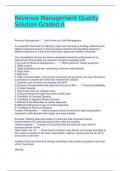
Revenue Management Quality Solution Graded A Revenue Management - Also Known as Yield Management An essential instrument for matching supply and demand by dividing customers into different segments based on their purchase intentions and allocating capacity to different segments in a way that maximizes a particular's facility's revenues. The constellation of tools and actions dedicated toward the achievement of an optimal level of the hotels net revenues and gross operating profit 7 key point of Revenue Management - 1. Right customer- market segments 2. Right product 3. Right distribution channel- accessing customers (web,directly) 4. Right Price 5.Right time 6. Right Communication- how product and prices are perceived, the way information is provided on website and value they receive from product 7. Optimal Level of hotel's net revenue and GOP 9 Economic Fundamentals that determine the use of RM - 1. Product Perishability 2. Limited Capacity 3. High Fixed and Low Variable Costs 4. Unequal Demand through day/ week/ month year 5. Possibility of Forecast Demand 6. Possibility to Segment Market Demand 7.Different Price Elasticities of market segments 8.Different Willingness to pay of market segments 9. Possibility of Advanced Booking Product Perishability - Hotel's product cannot be stored for later consumption/ important to shift demand btwn higher and lower periods Example: Offering alternative dates to customers that have been denied accommodation for particular period when hotel was booked. Limited Capacity - Number of Customers that the hotel can serve within a particular period of time High Fixed/ Low VC - Fixed Costs are those costs that do not change according to the number of guests in the hotel- depreciation, salaries--Fixed Costs are 60- 80 % of all costs in the hotel Variable Costs are those that change according to the number of guests in the hotel- HVAC, food costs MRMC PVC Unequal Demand Day/ Week/ Month/ Year - Tourism Demand- uncertain and subject to seasonal variations depending on the product of the hotel and its location Possibility to Forecast Demand - Decisions of Rev Manager are based on forecasts of tourism demand Possibility to Segment Market Demand - Applying revenue management techniques such as- Price Discrimination Assuming Demand is not homogeneous, so that the hotel may apply a differentiated marketing strategy and prepare different marketing mixes for the different target segments Different Price Elasticity of Market Segmennts - Price elasticity of demand- reaction of demand to changes in price Tourism Demand does not have a uniform elasticity- varies by market segment and market conditions Provides a basis for hotels to charge different market segments different prices Different Willingness to Pay of market segments - Willingness to pay is the highest price a customer is willing to pay for a product The price of the product is above a customer's willingness to pay- no purchase The price of the product is lower- creates a consumer surplus for buy, loss in rev for company Possibility for Advanced booking - Allows the hotel a long time window in which they can sell remaining rooms Provides the hotel with opportunity to use time as segmentation criteria Price Elasticity - Reaction to demand because of change in price ED-1= demand is elastic and quantity demanded changes more than the change in price, Total Revenue decreases ED= -1 Unit Elasticity, quantity demanded changes in exact same proportion of price, Total Revenue stays the same ED= 0 demand is perfectly inelastic so it is irresponsive to changes in price ED= Infinity, demand is perfectly elastic and small changes to price cause demand to drop to 0 ED-1 demand is inelastic and quantity demanded changes less due to change in price, Total Revenue Increases Calculate Elasticity of Demand - ((D1- D2)/ (D1+D2)/2)/(R1- R2)/(R1+R2)/2)) Recommendation for Hotel base on Elasticity Calculation - X= 1, Perfect Room rate X1, higher rate generating less rooms sales (less quantity demanded) and revenue- hotel should reduce rate X1, generate more revenue when we increase the rate, hotel should keep the rate high Revenue Management System - The set of Structural, procedural and HR elements dedicated toward the achievement of hotel revenue management's objectives Structural elements of the Rev Man. System - 1. Hotel revenue centers 2. Data and Information 3. RM tools 4. Rm software Hotel revenue center - determine the potential sources of revenue for the hotel (rooms, F&B, function rooms) and the capacity of hotel to use pricing as revenue generation tool Data and Information - Requires data about different metrics- ADR RevPar GOPPAR requires information about a hotels future bookings, sale of additional services in other revenue centers, competitor's rate/ strategies RM software - Gives hotel strategic advantage over those that use intuitive decisions Provides Forecasts based on the organizational models embedded in it Pricing Tools - Techniques that directly influence a hotel's prices- price discrimination, rate fences Non- Pricing Tools - do not directly influence pricing, relate to inventory control- capacity management, overbooking controls, length of stay controls Combined RM tools - Include Distribution Channel Management and Optimal Room Allocation- influence both the price of the hotel service and amount of rooms available at each rate Selection of Revenue Management team - in many hotel companies Revenue Management is the responsibility of one person. RM activities performed by general manager, front office manager or marketing manager. Small Properties- No RM team/ manager Mid Size Marketer- Marketing manager who deals with RM Upscale/ Large Hotels- Separate Revenue Manager Larger Chains- Revenue Management Center- disadvantage because they dont own/ manage them Environmental Impacts on the Revenue Management Sytem - 1. Micro environment 2. Macro environment 3. Internal Micro environment - Includes the actors from a hotels external environment who's actions can be influenced through a hotel's marketing mix (customers, competitors, distributors) Macro environment - Includes factors from the external environment which it cannot influence, but should try and adapt to PESTEL- Macro environment - Political, Economical, Social, Technological, Environmental, and Legislative dimensions that impact the revenue management system of a hotel through impact on tourism demand
Escuela, estudio y materia
- Institución
- Revenue Management
- Grado
- Revenue Management
Información del documento
- Subido en
- 19 de marzo de 2024
- Número de páginas
- 8
- Escrito en
- 2023/2024
- Tipo
- Examen
- Contiene
- Preguntas y respuestas
Temas
-
revenue management quality solution graded a r

Documento también disponible en un lote