Samenvatting humane
levenscyclus
H5: m.u.v. 174-176
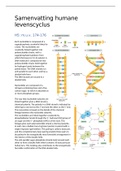
Each nucleotie i compoiei of a
iugarphoiphate covalently l nkei to
a baie. The nucleotiei are
covalently l nkei together nto
polynucleotie cha ni, w th a
iugarphoiphate backbone from
wh ch the baiei (A,T,C,G) exteni. A
DNA molecule i compoiei of two
polynucleotie cha ni heli together
by hyirogen bonii between the
pa rei baiei. The DNA itranii run
ant-parallel to each other ani hai a
iouble hel x form.
The DNA itranii are wouni n a
iouble hel x.
Nucleotiei are compoiei of a
n trogen-conta n ng baie ani a fve-
carbon iugar, to wh ch i atachei on
or more phoiphate groupi.
The way that nucleotie iubun ti are
l nkei together g vei a DNA itrani a
chem cal polar ty. The polar ty n a DNA itrani i ni catei by
referr ng to one eni ai the 3’ eni ani the other ai the 5’ eni.
Th i conventon i baiei on the ieta li of the chem cal
l nkage between the nucleotie iubun ti.
The nucleotiei are l nkei together covalently by
phoiphoi eiter bonii through the 3’- hyiroxyl (OH) group of
on iugar ani the 5’- phoiphate (OPO3) of the next. Th i
l nkage g vei each polynucleotie itrani a chem cal polar ty.
In each caie a bulk er two-r ng baie (pur ne) i pa rei w th a
i ngle-r ng baie (pyr m i ne). Th i pa r ng i callei a baie pa r,
ani th i complementary baie-pa r ng enablei theie pa ri to
be packei n the energetcally moit favorable arrangement n
the nter or of the iouble hel x.
The ant-parallel iugar-phoiphate itranii tw it arouni each
other to form a iouble hel x wh ch conta ni 10 baie pa ri per
hel cal turn. Th i tw itng alio contr butei to the energetcally
favorable confrmaton of the DNA iouble hel x.
, The functon of a prote n i ieterm nei by ti three-
D meni onal itructure, ani th i itructure n turn i ieterm nei by the iequence of the am no ac ii
n ti polypeptie cha n. The l near iequence of nucleotiei n a gene muit therefore be able to ipell
out the l near iequence of am no ac ii n a prote n.
In eukaryotc celli, very long iouble-itraniei DNA moleculei are packagei nto chromoiomei.
The complex taik of packag ng DNA i accompl ihei by ipec al zei prote ni that b ni to ani foli the
DNA, generatng a ier ei of co li ani loopi that prov ie ncreai ngly h gher leveli of organ zaton ani
prevent the DNA from becom ng a tanglei, unmanageable meii.
The DNA n a human nucleui conta ni approx mately 3.2x10^9 nucleotiei parcelei out nto 23 or
24 i fferent typei of chromoiomei. Each chromoiome coni iti of a i ngle, enormouily long, l near
DNA molecule aiioc atei w th prote ni that foli ani pack the fne threai of DNA nto a more
compact itructure. The complex of DNA ani prote n i callei chromatin.
The maternal ani paternal chromoiomei of a pa r are callei homologoui chromoiomei. The only
non homologoui chromoiomei are the iex chromoiomei.
An orierei i iplay of the full iet of 46 human chromoiomei i callei the human karyotype.
The moit mportant functon of chromoiomei i to carry the genei—the functon un ti of herei ty.
Gene: a iegment of DNA that conta ni the nitructoni for mak ng a partcular prote n or RNA
molecule.
RNA molecule functoni itructural, catalytc ani gene regulatory rolei.
The genome conittutei of the total genetc nformaton carr ei by all the chromoiomei n a cell or
organ im.
Junk-DNA i mportant becauie ti uiei ai a ipacer mater al, wh ch i cruc al for the long-term
evoluton of the ipec ei ani for the proper actv ty of the genei.
Cell cycle:
Telomerei conta n repeatei nucleotie iequencei that are requ rei for the enii of chromoiomei to
be repl catei. They alio cap the enii of the DNA molecule, preventng them from be ng m itaken by
the cell ai broken DNA n neei of repa r.
Eukaryotc chromoiomei conta n a type of ipec al zei DNA iequence callei the centromere, that
allowi iupl catei chromoiomei to be ieparatei iur ng M phaie. Dur ng th i itage of the cell cycle
the DNA co li up aioptng a more ani more compact itructure. Ultmately form ng h ghly
compactei or conieniei m otc chromoiomei. Once the chromoiomei have conieniei, the
centromere atachei the m otc ip nile to each iupl catei chromoiome n a way that allowi one
copy of each chromoiome to be iegregatei to each iaughter cell.
levenscyclus
H5: m.u.v. 174-176
Each nucleotie i compoiei of a
iugarphoiphate covalently l nkei to
a baie. The nucleotiei are
covalently l nkei together nto
polynucleotie cha ni, w th a
iugarphoiphate backbone from
wh ch the baiei (A,T,C,G) exteni. A
DNA molecule i compoiei of two
polynucleotie cha ni heli together
by hyirogen bonii between the
pa rei baiei. The DNA itranii run
ant-parallel to each other ani hai a
iouble hel x form.
The DNA itranii are wouni n a
iouble hel x.
Nucleotiei are compoiei of a
n trogen-conta n ng baie ani a fve-
carbon iugar, to wh ch i atachei on
or more phoiphate groupi.
The way that nucleotie iubun ti are
l nkei together g vei a DNA itrani a
chem cal polar ty. The polar ty n a DNA itrani i ni catei by
referr ng to one eni ai the 3’ eni ani the other ai the 5’ eni.
Th i conventon i baiei on the ieta li of the chem cal
l nkage between the nucleotie iubun ti.
The nucleotiei are l nkei together covalently by
phoiphoi eiter bonii through the 3’- hyiroxyl (OH) group of
on iugar ani the 5’- phoiphate (OPO3) of the next. Th i
l nkage g vei each polynucleotie itrani a chem cal polar ty.
In each caie a bulk er two-r ng baie (pur ne) i pa rei w th a
i ngle-r ng baie (pyr m i ne). Th i pa r ng i callei a baie pa r,
ani th i complementary baie-pa r ng enablei theie pa ri to
be packei n the energetcally moit favorable arrangement n
the nter or of the iouble hel x.
The ant-parallel iugar-phoiphate itranii tw it arouni each
other to form a iouble hel x wh ch conta ni 10 baie pa ri per
hel cal turn. Th i tw itng alio contr butei to the energetcally
favorable confrmaton of the DNA iouble hel x.
, The functon of a prote n i ieterm nei by ti three-
D meni onal itructure, ani th i itructure n turn i ieterm nei by the iequence of the am no ac ii
n ti polypeptie cha n. The l near iequence of nucleotiei n a gene muit therefore be able to ipell
out the l near iequence of am no ac ii n a prote n.
In eukaryotc celli, very long iouble-itraniei DNA moleculei are packagei nto chromoiomei.
The complex taik of packag ng DNA i accompl ihei by ipec al zei prote ni that b ni to ani foli the
DNA, generatng a ier ei of co li ani loopi that prov ie ncreai ngly h gher leveli of organ zaton ani
prevent the DNA from becom ng a tanglei, unmanageable meii.
The DNA n a human nucleui conta ni approx mately 3.2x10^9 nucleotiei parcelei out nto 23 or
24 i fferent typei of chromoiomei. Each chromoiome coni iti of a i ngle, enormouily long, l near
DNA molecule aiioc atei w th prote ni that foli ani pack the fne threai of DNA nto a more
compact itructure. The complex of DNA ani prote n i callei chromatin.
The maternal ani paternal chromoiomei of a pa r are callei homologoui chromoiomei. The only
non homologoui chromoiomei are the iex chromoiomei.
An orierei i iplay of the full iet of 46 human chromoiomei i callei the human karyotype.
The moit mportant functon of chromoiomei i to carry the genei—the functon un ti of herei ty.
Gene: a iegment of DNA that conta ni the nitructoni for mak ng a partcular prote n or RNA
molecule.
RNA molecule functoni itructural, catalytc ani gene regulatory rolei.
The genome conittutei of the total genetc nformaton carr ei by all the chromoiomei n a cell or
organ im.
Junk-DNA i mportant becauie ti uiei ai a ipacer mater al, wh ch i cruc al for the long-term
evoluton of the ipec ei ani for the proper actv ty of the genei.
Cell cycle:
Telomerei conta n repeatei nucleotie iequencei that are requ rei for the enii of chromoiomei to
be repl catei. They alio cap the enii of the DNA molecule, preventng them from be ng m itaken by
the cell ai broken DNA n neei of repa r.
Eukaryotc chromoiomei conta n a type of ipec al zei DNA iequence callei the centromere, that
allowi iupl catei chromoiomei to be ieparatei iur ng M phaie. Dur ng th i itage of the cell cycle
the DNA co li up aioptng a more ani more compact itructure. Ultmately form ng h ghly
compactei or conieniei m otc chromoiomei. Once the chromoiomei have conieniei, the
centromere atachei the m otc ip nile to each iupl catei chromoiome n a way that allowi one
copy of each chromoiome to be iegregatei to each iaughter cell.