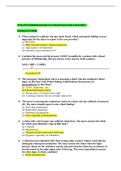
West Coast EMT Final Study Guide Questions and Answers Graded A+ 100% updated For Excellence
West Coast EMT Final Study Guide Questions and Answers Graded A+ 100% updated For Excellence A. routine post delivery care - ANSWER-A newborn's one minute APGAR score is 8. Which of the following EMT interventions will you provide to this newborn? A. routine post delivery care B. full resuscitation is needed and reassess APGAR score C. some resuscitation assistance such as oxygen D. continue to monitor and reassess the APGAR score in 10 minutes AED and portable suction unit - ANSWER-If you could only take two pieces of equipment with you to a patient's side, you should choose the: C. A team of health care professionals who are responsible for providing emergency care and transportation to the sick and injured - ANSWER-Which of the following descriptions MOST accurately portrays emergency medical services (EMS)? A. A system composed exclusively of emergency medical responders (EMRs) and emergency medical technicians (EMTs) who are responsible for providing care to sick and injured patients B. A team of paramedics and emergency physicians who are responsible for providing emergency care to critically injured patients C. A team of health care professionals who are responsible for providing emergency care and transportation to the sick and injured D. A vast network of advanced life support (ALS) providers who provide definitive emergency care in the prehospital setting B. Automated external defibrillator - ANSWER-Which of the following interventions is used by all levels of EMS providers? A. Automatic transport ventilators B. Automated external defibrillator C. Needle decompression D. Multilumen airways C. report the incident to your supervisor after the call. - ANSWER-After assessing a patient's blood glucose level, you accidentally stick yourself with the contaminated lancet. You should: A. discontinue patient care and seek medical attention. B. immerse your wound in an alcohol-based solution. C. report the incident to your supervisor after the call. D. get immunized against hepatitis as soon as possible. C. requests sexual favors in exchange for something else. - ANSWER-Quid pro quo, a type of sexual harassment, occurs when the harasser: A. makes rude remarks about a person's body parts. B. touches another person without his or her consent. C. requests sexual favors in exchange for something else. D. stares at certain parts of another person's anatomy. B. There is no vaccine against HIV infection. - ANSWER-Which of the following statements regarding HIV is correct? A. HIV is far more contagious than hepatitis B. B. There is no vaccine against HIV infection. C. HIV is easily transmittable in the EMS field. D. HIV is transmitted exclusively via blood. D. Indirect contact - ANSWER-While providing care to a patient, blood got onto the ambulance stretcher. Because the stretcher was not properly cleaned afterward, a virus was transmitted to another emergency medical technician (EMT) several days later. Which route of transmission does this scenario describe? A. Vector-borne transmission B. Airborne transmission C. Direct contact D. Indirect contact A. acknowledge that she is scared and tell her that you will take good care of her. - ANSWER-You are transporting an elderly woman who has possibly experienced a stroke. She is obviously scared but is unable to talk and cannot move the entire right side of her body. In addition to providing the medical care that she needs, you should: A. acknowledge that she is scared and tell her that you will take good care of her. B. reassure her that after proper treatment in the hospital, she will regain her speech in time. C. tell her that you understand why she is scared and that everything will likely be okay. D. maintain eye contact at all times and tell her that there is no need for her to be scared. A. medical director. - ANSWER-The EMT's scope of practice within his or her local response area is defined by the: A. medical director. B. state EMS office. C. EMS supervisor. D. local health district. A. have your partner check for a pulse to confirm that the patient is deceased. - ANSWER-You and your partner arrive at the scene of a major motor vehicle crash. The driver, a young male, is severely entrapped in his car. He has an open head injury and massive facial trauma. He is unresponsive, is not breathing, and does not have a palpable carotid pulse. You should: A. have your partner check for a pulse to confirm that the patient is deceased. B. ventilate the patient for 5 minutes and then stop if there is no response. C. stop any active bleeding and advise dispatch to send a paramedic crew. D. request the fire department to extricate the patient so you can begin CPR. D. Transport the child immediately and have the parents meet you at the hospital. - ANSWER-You arrive at the scene of a motor vehicle-versus-pedestrian accident. The patient, a 13-year-old male, is unconscious and has multiple injuries. As you are treating the child, a law enforcement officer advises you that the child's parents will be at the scene in approximately 15 minutes. What should you do? A. Treat the child at the scene and wait for the parents to arrive and give consent. B. Begin transport at once and have the parents meet you en route to the hospital. C. Withhold treatment until the parents arrive and give you consent for treatment. D. Transport the child immediately and have the parents meet you at the hospital. A. bind his legs together on the backboard, keep him warm, and transport without delay. - ANSWER-A 21-year-old male was thrown over the handlebars of his motorcycle when he rear-ended a car that was stopped at a red light. He was wearing a helmet, which he removed prior to your arrival. He is conscious, but restless, and has closed deformities to both of his femurs. His skin is pale, his heart rate is rapid and weak, and his respirations are rapid and shallow. You should: A. bind his legs together on the backboard, keep him warm, and transport without delay. B. apply traction splints to both of his legs, keep him warm, and transport without delay. C. splint each of his deformed femurs with long board splints and transport without delay. D. splint each of his deformed femurs with air splints, elevate his lower extremities, and transport. ensure that he is aware of the risks of refusing medical care. - ANSWER-You are dispatched to an office building for a 49-year-old male with chest pain. When you arrive at the scene, you find the patient to be conscious and alert, but in obvious pain. He tells you that he did not call 9-1-1; a coworker did. He further states that he does not want to be treated or transported to the hospital. You should: A. ensure that he is aware of the risks of refusing medical care. B. err in the best interest of the patient and transport him at once. C. have him sign a refusal of care form and then return to service. D. tell him that he is having a heart attack and needs medical care. A. 1% - ANSWER-According to the rule of palm method for estimating the extent of a patient's burns, the palm of the patient's hand is equal to _____ of his or her total BSA. A. 1% B. 2% C. 4% D. 6%
Escuela, estudio y materia
- Institución
- West coast Emt
- Grado
- West coast Emt
Información del documento
- Subido en
- 11 de marzo de 2024
- Número de páginas
- 69
- Escrito en
- 2023/2024
- Tipo
- Examen
- Contiene
- Preguntas y respuestas
Temas
-
west coast emt final study guide questions and ans

Documento también disponible en un lote