RELG 2650 MIDTERM Exam with 100% Verified and Updated Solutions
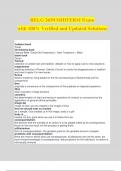
RELG 2650 MIDTERM Exam with 100% Verified and Updated Solutions Judiasm book Torah Christianity book Hebrew Bible (Torah/Old Testament) + New Testament = Bible Islam book Quran Talmud collection of Jewish law and tradition, debate on how to apply Law to new situations magisterium teaching authority of Roman Catholic Church to clarify the disagreements in tradition and how to apply it to new issues Sunna Islamic model for living based on the life and teachings of Muhammad and his companions Ijma originally a consensus of the companions of the prophets on disputed questions Qiya Islam casuistry of legal scholars casuistry the determination of right and wrong in questions of conduct or conscience by the application of general ethical principles Imago dei image of God, we are created in the image of God how we should treat our bodies as a temple, God created us in His image, body is a gift body is ___ neutral not evil, good when we use it to follow the Law consequentialism the doctrine that the morality of an action is to be judged solely by its consequences, focus on the end result not the process in getting there utilitarianism form of consequentialism, the greatest good for the greatest amount of people problems with consequentialism there are more to ethics than just consequences, all pleasures are not the same, we have limited knowledge of consequences, little protection for the individual, no action is intrinsically immoral deontology approach to ethics that judges the morality of an action based on the action's adherence to rules, focused on process or action NOT the outcome, "duty" norms the building blocks for ethics, something that is followed by society normative the rule or norm in a community non-normative "breaking" an unspoken social rule principle of utility when you maximize the good, used in utilitarianism/consequentialism intrinsic good something that is internally good, morally good Immanuel Kant major Enlightenment thinker, moral freedom could be achieved only by living in society and obeying its laws, deontological Kantian the belief that people should be treated as ends and never as means to the ends of others kingdom of ends you should treat no one as merely a means to an ends. Human beings are ends in themselves categorical imperative an ethical guideline developed by Immanuel Kant under which an action is evaluated in terms of what would happen if everybody else in the same situation acted the same way. universal maxim the categorical imperative, requires that any moral decision you make must be acceptable for everyone else to do too autonomy individual choice and control over own life, capacity to make free, informed decisions heteronomy the belief that one is entirely dependent on others for happiness and meaning autonomy deontology will is only affected by your duty, your universalizable maxim virtue theory ethical theory that emphasizes an individual's character rather than following a set of rules Tuskegee syphilis experiment 400 black men were infected with syphili
Escuela, estudio y materia
- Institución
- RELG 2650
- Grado
- RELG 2650
Información del documento
- Subido en
- 4 de marzo de 2024
- Número de páginas
- 7
- Escrito en
- 2023/2024
- Tipo
- Examen
- Contiene
- Preguntas y respuestas
Temas
-
relg 2650 midterm exam with 100 verified and upda

Documento también disponible en un lote