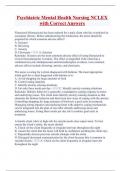
Psychiatric Mental Health Nursing NCLEX with Correct Answers
Flumazenil (Romazicon) has been ordered for a male client who has overdosed on oxazepam (Serax). Before administering the medication, the nurse should be prepared for which common adverse effect? A. Seizures B. Shivering C. Anxiety D. Chest pain - A. Seizures Rationale: Seizures are the most common adverse effect of using flumazenil to reverse benzodiazepine overdose. The effect is magnified if the client has a combined tricyclic antidepressant and benzodiazepine overdose. Less common adverse effects include shivering, anxiety, and chest pain. The nurse is caring for a client diagnosed with bulimia. The most appropriate initial goal for a client diagnosed with bulimia is to: A. Avoid shopping for large amounts of food B. Control eating impulses C. Identify anxiety-causing situations D. Eat only three meals per day - C. Identify anxiety-causing situations Rationale: Bulimic behavior is generally a maladaptive coping response to stress and underlying issues. The client must identify anxiety-causing situation as that stimulate the bulimic behavior and then learn new ways of coping with the anxiety. Controlling shopping for large amounts of food isn't a goal early in treatment. Managing eating impulses and replacing them with adaptive coping mechanisms can be integrated into the plan of care after initially addressing stress and underlying issues. Eating three meals per day isn't a realistic goal early in treatment. A female client who's at high risk for suicide needs close supervision. To best ensure the client's safety, the nurse should: A. Check on the client frequently at irregular intervals throughout the night B. Assure the client that the nurse will hold in confidence anything the client says C. Repeatedly discuss previous suicide attempts with the client D. Disregard decreased communication by the client because this is common in suicidal clients - A. Check on the client frequently at irregular intervals throughout the night Rationale: Checking the client frequently but at irregular intervals prevents the client from predicting when observation will take place and altering behavior in a misleading way at these times. Option B may encourage the client to try to manipulate the nurse's or seek attention for having a secret suicide plan. Option C may reinforce a suicidal idea. Decreased communication is a sign of withdrawal that may indicate the client has decided to commit suicide; the nurse shouldn't disregard it. Which of the following drugs should the nurse prepare to administer to a client with a toxic acetaminophen (Tylenol) level? A. Deferoxamine mesylate B. Succimer (Chemet) C. Flumazenil (Romazicon) D. Acetylcysteine (Mucomyst) - D. Acetylcysteine (Mucomyth) Rationale: The antidote for acetaminophen toxicity is acetylcysteine. It enhances conversion of toxic metabolites to nontoxic metabolites. Deferoxamine meslyate is the antidote for iron intoxication. Succimer is an antidote for lead poisoning. Flumazenil reverses the sedative effects of benzodiazepines. A male client is admitted to the substance abuse unit for alcohol detoxification. Which of the following medications is the nurse likely to administer to reduce the symptoms of alcohol withdrawal? A. Naloxone (Narcan) B. Haloperidol (Haldol) C. Magnesium sulfate D. Chlordiazepoxide (Librium) - D. Clordiazepoxide (Librium) Rationale: Chlordiazepoxide (Librium) and other tranquilizers help reduce the symptoms of alcohol withdrawal. Haloperidol (Haldol) may be given to treat clients with psychosis, severe agitation, or delirium. Naloxone (Narcan) is administered for narcotic overdose. Magnesium sulfate and other anticonvulsant medications are only administer to treat seizures if they occur during the withdrawal. During postprandial monitor, a female client with bulimia nervosa tells the nurse, "You can sit with me, but you're just wasting your time. After you sat with me yesterday, I was still able to purge. Today, my goal is to do it twice." What is the nurse's BEST responses? A. "I trust you not to purge." B. "How are you purging and when do you do it?" C. "Don't worry. I won't allow you to purge today." D. "I know it's important for you to feel in control, but I’ll monitor you for 90 minutes after you eat." - D. "I know it's important for you to feel in control, but I’ll monitor you for 90 minutes after you eat." Rationale: This response acknowledges that the clients is testing limits and that the nurse is setting them by performing postprandial monitoring to prevent self-induced eyes is. Clients with bulimia nervosa need to feel in control of the diet because they feel they lack control over all other aspects of their lives. Because their therapeutic relationships with caregivers are less important than their need to purge, they don't fear betraying the nurse's trust by engaging in the activity. They commonly plot purging and rarely share their secrets about it. An authoritarian or challenging response may trigger a power struggle between the nurse and client.
Escuela, estudio y materia
- Institución
- Psychiatric nursing
- Grado
- Psychiatric nursing
Información del documento
- Subido en
- 2 de marzo de 2024
- Número de páginas
- 20
- Escrito en
- 2023/2024
- Tipo
- Examen
- Contiene
- Preguntas y respuestas
Temas
-
psychiatric mental health nursing exam
-
psychiatric mental health nursing answers

Documento también disponible en un lote