Cells And Immunity
Week 5
Mike Fry
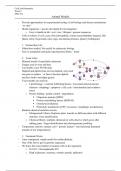
Animal Models
- Provide opportunities for experimental testing of cell biology and disease mechanisms
“in vitro”
- Model organisms = species developed for investigations
o Easy to handle in lab / cost / size / lifespan / genome sequences
- Cells in culture; E-coli, yeast, flies [drosophila], worms [caeriorhabditis elegans], fish
[danio rerio], frogs/toads, mice, pigs, non-human primates, plants [Arabidopsis]
1. Escherichia Coli;
- Oldest/best studied. Not useful for eukaryotic biology
- Easy to manipulate and quick reproduction [20min – hour]
2. Yeast Cells;
- Minimal model of unicellular eukaryote
- Fungus used in wine and beer
- Can double every 90-100 mins
- Haploid and diploid [can exist as haploid- only need
one gene to replace – or fuse to become diploid
and have both a and alpha genes]
- Yeast models are used for;
o Lipid biology / vesicular trafficking/fusion / lysosomal and peroxisome
function / autophagy / apoptosis / cell cycle / mitochondria and oxidative
stress
o Protein folding / quality control / degradation.
Chaperone proteins [HSPs]
Protein remodelling factors [HSP104]
Osmolytes [trehalose]
Proteolytic machineries [UPS / lysosome / autophagic mechanisms]
- Random chemical mutation screens
o Mutagenized Culture; Replicate plate, transfer to different plates with different
nutrients. Gene identification
o Chemical library; multiple chemicals in wells observe which grow after
adding genes. Target identification and chemogenomic profiling.
- Temperature sensitive mutant; cool = protein, heated = non functional [maintain
mutants at low temperatures]
3. Nematode Worm
- 1mm, transparent, simple model for multicellularity
- One of the first to get its genome sequenced
- We know the exact number of somatic cells in the organisms
o M 1031 // Hermaphrodite 959
o High in pharynx, neurones, somatic gonads, epidermis
, Cells And Immunity
Week 5
Mike Fry
- Large number, easy to feed, 14hr embryonic development. Less food = Dauer larvae
[hibernation]
- Connectome; map of interactions of nerve cells [electron microscopy] more in head
ganglia / dorsal and ventral chord / tail ganglion
4. Drosophila [melanogaster]
- Easy to breed, small size, 1000’s experiments
- Whole life cycle 7-10 days
- Developmental model for multicellular organisms [hox genes discovered in it]
5. Zebrafish [Dario Rerio]
- New emerging model 15-20 years, developmental biology
- Transparent embryos, develop outside the mothers body
- Withstand high doses of mutagens [create more mutants]
- Cells can regenerate
- Small but need warm water – costly
- Functional genomics;
o Large scale mutagenesis [cloning]
o Reverse genetics [germline transgenesis/somatic/ site directed mutagenesis]
o Expression profiling [microarray / proteomes]
o Bioinformatics [comparative / homology / conservation / in silico cloning]
- Applications;
o Biomedicine [phenotypic disease models / highly throughout screening]
o Aquatic biomedicine [immunity / phenotypic disease models]
o Aqua biotech [bioreactors / aquaculture]
o Eco toxicogenomic [bio monitor fish]
6. Mouse [mus musculus]
- Largest similarity to humans
- Common ancestor 80MYA, similar genome structure / organisation / similar number
of genes
- Amenable to genetic manipulation
- Gene editing tools CRISPR/Cas9 and similar [pigs resemble humans] methodologies
for increased fidelity [ethics]
Principal of 3 R’s;
1. Replacement;
- Methods which avoid or replace animals [organoids – using organ tissue //
controversial when considering brain tissues]
2. Reduction;
- Minimise number of animals / experiments [statistics not meaningful]
Week 5
Mike Fry
Animal Models
- Provide opportunities for experimental testing of cell biology and disease mechanisms
“in vitro”
- Model organisms = species developed for investigations
o Easy to handle in lab / cost / size / lifespan / genome sequences
- Cells in culture; E-coli, yeast, flies [drosophila], worms [caeriorhabditis elegans], fish
[danio rerio], frogs/toads, mice, pigs, non-human primates, plants [Arabidopsis]
1. Escherichia Coli;
- Oldest/best studied. Not useful for eukaryotic biology
- Easy to manipulate and quick reproduction [20min – hour]
2. Yeast Cells;
- Minimal model of unicellular eukaryote
- Fungus used in wine and beer
- Can double every 90-100 mins
- Haploid and diploid [can exist as haploid- only need
one gene to replace – or fuse to become diploid
and have both a and alpha genes]
- Yeast models are used for;
o Lipid biology / vesicular trafficking/fusion / lysosomal and peroxisome
function / autophagy / apoptosis / cell cycle / mitochondria and oxidative
stress
o Protein folding / quality control / degradation.
Chaperone proteins [HSPs]
Protein remodelling factors [HSP104]
Osmolytes [trehalose]
Proteolytic machineries [UPS / lysosome / autophagic mechanisms]
- Random chemical mutation screens
o Mutagenized Culture; Replicate plate, transfer to different plates with different
nutrients. Gene identification
o Chemical library; multiple chemicals in wells observe which grow after
adding genes. Target identification and chemogenomic profiling.
- Temperature sensitive mutant; cool = protein, heated = non functional [maintain
mutants at low temperatures]
3. Nematode Worm
- 1mm, transparent, simple model for multicellularity
- One of the first to get its genome sequenced
- We know the exact number of somatic cells in the organisms
o M 1031 // Hermaphrodite 959
o High in pharynx, neurones, somatic gonads, epidermis
, Cells And Immunity
Week 5
Mike Fry
- Large number, easy to feed, 14hr embryonic development. Less food = Dauer larvae
[hibernation]
- Connectome; map of interactions of nerve cells [electron microscopy] more in head
ganglia / dorsal and ventral chord / tail ganglion
4. Drosophila [melanogaster]
- Easy to breed, small size, 1000’s experiments
- Whole life cycle 7-10 days
- Developmental model for multicellular organisms [hox genes discovered in it]
5. Zebrafish [Dario Rerio]
- New emerging model 15-20 years, developmental biology
- Transparent embryos, develop outside the mothers body
- Withstand high doses of mutagens [create more mutants]
- Cells can regenerate
- Small but need warm water – costly
- Functional genomics;
o Large scale mutagenesis [cloning]
o Reverse genetics [germline transgenesis/somatic/ site directed mutagenesis]
o Expression profiling [microarray / proteomes]
o Bioinformatics [comparative / homology / conservation / in silico cloning]
- Applications;
o Biomedicine [phenotypic disease models / highly throughout screening]
o Aquatic biomedicine [immunity / phenotypic disease models]
o Aqua biotech [bioreactors / aquaculture]
o Eco toxicogenomic [bio monitor fish]
6. Mouse [mus musculus]
- Largest similarity to humans
- Common ancestor 80MYA, similar genome structure / organisation / similar number
of genes
- Amenable to genetic manipulation
- Gene editing tools CRISPR/Cas9 and similar [pigs resemble humans] methodologies
for increased fidelity [ethics]
Principal of 3 R’s;
1. Replacement;
- Methods which avoid or replace animals [organoids – using organ tissue //
controversial when considering brain tissues]
2. Reduction;
- Minimise number of animals / experiments [statistics not meaningful]