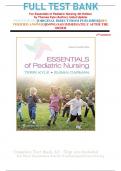
FULL TEST BANK For Essentials of Pediatric Nursing 4th Edition by Theresa Kyle (Author), latest Update
27. The mother of a 1-month-old infant tells the nurse she worries that her baby will get meningitis like her oldest son did when he was an infant. The nurse should base her response on which statement? a. Meningitis rarely occurs during infancy. b. Often a genetic predisposition to meningitis is found. c. Vaccination to prevent all types of meningitis is now available. d. Vaccination to prevent Haemophilus influenzae type B meningitis has decreased the frequency of this disease in children. ANSWERS:D H. influenzae type B meningitis has been virtually eradicated in areas of the world where the vaccine is administered routinely. Bacterial meningitis remains a serious illness in children. It is significant because of the residual damage caused by undiagnosed and untreated or inadequately treated cases. The leading causes of neonatal meningitis are the group B streptococci and Escherichia coli organisms. Meningitis is an extension of a variety of bacterial infections. No genetic predisposition exists. Vaccinations are not available for all of the potential causative organisms. PTS: 1 DIF: Cognitive Level: Apply REF: 950 UPPER: Integrated Process: Teaching/Learning MSC: Area of Client Needs: Physiologic Integrity: Reduction of Risk Potential 28. The vector reservoir for agents causing viral encephalitis in the United States is: a. tarantula spiders. b. mosquitoes. c. carnivorous wild animals. d. domestic and wild animals. ANSWERS:B Viral encephalitis, not attributable to a childhood viral disease, is usually transmitted by mosquitoes. The vector reservoir for most agents pathogenic for humans and detected in the United States are mosquitoes and ticks; therefore, most cases of encephalitis appear during the hot summer months. Tarantula spiders, carnivorous wild animals, and domestic and wild animals are not reservoirs for the agents that cause viral encephalitis. PTS: 1 DIF: Cognitive Level: Understand REF: 954 UPPER: Integrated Process: Nursing Process: Planning MSC: Area of Client Needs: Physiologic Integrity: Reduction of Risk Potential 29. Which is beneficial in reducing the risk of Reye syndrome? a. Immunization against the disease b. Medical attention for all head injuries c. Prompt treatment of bacterial meningitis d. Avoidance of aspirin to treat fever associated with influenza ANSWERS:D Although the etiology of Reye syndrome is obscure, most cases follow a common viral illness, either varicella or influenza. A potential association exists between aspirin therapy and the development of Reye syndrome, so use of aspirin is avoided. No immunization currently exists for Reye syndrome. Reye syndrome is not correlated with head injuries or bacterial meningitis. PTS: 1 DIF: Cognitive Level: Understand REF: 956 UPPER: Integrated Process: Nursing Process: Planning MSC: Area of Client Needs: Physiologic Integrity: Reduction of Risk Potential 30. When taking the history of a child hospitalized with Reye syndrome, the nurse should not be surprised that a week ago the child had recovered from: a. measles. b. varicella. c. meningitis. d. hepatitis. ANSWERS:B Most cases of Reye syndrome follow a common viral illness such as varicella or influenza. Measles, meningitis, and hepatitis are not associated with Reye syndrome. PTS: 1 DIF: Cognitive Level: Understand REF: 956 UPPER: Integrated Process: Nursing Process: Planning MSC: Area of Client Needs: Physiologic Integrity: Physiologic Adaptation 31. When caring for the child with Reye syndrome, the priority nursing intervention should be to: a. monitor intake and output. b. prevent skin breakdown. c. observe for petechiae. d. do range-of-motion exercises. ANSWERS:A Accurate and frequent monitoring of intake and output is essential for adjusting fluid volumes to prevent both dehydration and cerebral edema. Preventing skin breakdown, observing for petechiae, and doing range-of-motion exercises are important interventions in the care of a critically ill or comatose child. Careful monitoring of intake and output is a priority. PTS: 1 DIF: Cognitive Level: Apply REF: 956 UPPER: Integrated Process: Nursing Process: Implementation MSC: Area of Client Needs: Physiologic Integrity: Physiologic Adaptation 32. A young childs parents call the nurse after their child was bitten by a raccoon in the woods. The nurses recommendation should be based on which statement? a. Child should be hospitalized for close observation. b. No treatment is necessary if thorough wound cleaning is done. c. Antirabies prophylaxis must be initiated. d. Antirabies prophylaxis must be initiated if clinical manifestations appear. ANSWERS:C Current therapy for a rabid animal bite consists of a thorough cleansing of the wound and passive immunization with human rabies immune globulin (HRIG) as soon as possible. Hospitalization is not necessary. The wound cleansing, passive immunization, and immune globulin administration can be done as an outpatient. The child needs to receive both HRIG and rabies vaccine. PTS: 1 DIF: Cognitive Level: Apply REF: 955 UPPER: Integrated Process: Teaching/Learning MSC: Area of Client Needs: Physiologic Integrity: Physiologic Adaptation 33. A child is brought to the emergency department after experiencing a seizure at school. There is no previous history of seizures. The father tells the nurse that he cannot believe the child has epilepsy. The nurses best response is: a. Epilepsy is easily treated. b. Very few children have actual epilepsy. c. The seizure may or may not mean that your child has epilepsy. d. Your child has had only one convulsion; it probably wont happen again. ANSWERS:C Seizures are the indispensable characteristic of epilepsy; however, not every seizure is epileptic. Epilepsy is a chronic seizure disorder with recurrent and unprovoked seizures. The treatment of epilepsy involves a thorough assessment to determine the type of seizure the child is having and the cause, followed by individualized therapy to allow the child to have as normal a life as possible. The nurse should not make generalized comments regarding the incidence of epilepsy until further assessment is made. PTS: 1 DIF: Cognitive Level: Apply REF: 956 UPPER: Integrated Process: Teaching/Learning MSC: Area of Client Needs: Physiologic Integrity: Physiologic Adaptation 34. Which type of seizure involves both hemispheres of the brain? a. Focal b. Partial c. Generalized d. Acquired ANSWERS
Información del documento
- Subido en
- 23 de febrero de 2024
- Número de páginas
- 393
- Escrito en
- 2023/2024
- Tipo
- Examen
- Contiene
- Preguntas y respuestas