
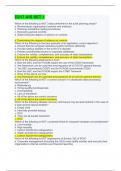
D217 Ais Set 1
D217 AIS SET 1 Which of the following is NOT a task performed in the audit planning phase? a. Reviewing an organization's policies and practices b. Planning substantive testing procedures c. Reviewing general controls d. Determining the degree of reliance on controls d. Determining the degree of reliance on controls Which of the following is the best example of an application control objective? a. Ensure that the computer operating system functions efficiently b. Provide backup facilities in the event of a disaster c. Prevent unauthorized access to corporate databases d. Ensure the validity, completeness, and accuracy of sales transactions d. Ensure the validity, completeness, and accuracy of sales transactions Which of the following statements is true? a. Both the SEC and the PCAOB require the use of the COSO framework b. Any framework can be used that encompasses all of COCO's general themes. c. The SEC recommends COBIT and the PCAOB recommends COSO d. Both the SEC and the PCAOB require the COBIT framwork e. None of the above are true b. Any framework can be used that encompasses all of COCO's general themes. Which of the following is NOT a control concern in a distributed data processing environment? a. Redundancy b. Hiring qualified professionals c. Incompatibility d. Lack of standards e. All of the above are control concerns e. All of the above are control concerns Which of the following disaster recovery techniques may be least optimal in the case of a wide spread natural disaster? a. Empty shell b. Internally provided backup c. ROC d. They are all equally beneficial c. ROC Which of the following is NOT a potential threat to computer hardware and peripherals? a. Low humidity b. High humidity c. Carbon dioxide fire extinguishers d. Water sprinkler fire extinguishers c. Carbon dioxide fire extinguishers Which of the following is NOT requirement of Section 302 of SOX? a. Corporate management (including the CEO) must certify monthly and annually their organization's internal controls over financial reporting b. Auditors must interview management regarding significant changes in the design or operation of internal control that occurred since the last audit c. Auditors must determine whether changes in internal control have materially affected, or are likely to materially affect, internal control over financial reporting. d. Management must disclose any material changes in the company's internal controls that have occurred during the most recent fiscal quarter. e. All of the above are requirements a. Corporate management (including the CEO) must certify monthly and annually their organization's internal controls over financial reporting Which of the following is NOT a requirement in management's report on the effectiveness of internal controls over financial reporting? a. Describe the flow of transactions in sufficient detail to points at which misstatement could arise b. An evaluation of entity-wide controls that correspond to the COSO framework c. A statement that the organization's internal auditors have issued an attestation report on management's assessment of the company's internal controls d. An explicit written conclusion as the effectiveness of internal control over financial reporting e. All of the above are requirements c. A statement that the organization's internal auditors have issued an attestation report on management's assessment of the company's internal controls Which of the following is associated with the unique characteristics of an industry? a. Inherent risk b. Detection risk c. Control risk d. None of the above a. Inherent risk Which of the following is not true about the SSAE 16 report? a. It is a third-party attestation report b. It replaced Statement on Auditing Standards No. (SAS 70) c. The service provider prepares a separate SSAE 16 report tailored to the needs of each of its client firms, which the client auditors rely upon d. When using the carve-out method, service provider management would exclude the sub-service organization's relevant controls e. All of the above are true c. The service provider prepares a separate SSAE 16 report tailored to the needs of each of its client firms, which the client auditors rely upon When someone disguises the source of Internet messages to make appear that it is coming from a different source, this is called: a. Deep packet inspection b. Message packet switching c. Dual-homed signaling d. IP screening e. None of the above e. None of the above A program that attaches to another legitmate program but does NOT replicate itself is called a a. virus b. worm c. Trojan horse d. logic bomb e. none of the above c. Trojan horse The purpose of a checkpoint procedure is to facilitate restarting after a. data processing errors b. data input errors c. the failure to have all input data ready on time d. computer operator intervention e. none of the above a. data processing errors A user's application may consist of several modules stored in separate memory locations, each with its own data. One module must not be allowed to destroy or corrupt another module. This is an objective of a. EDI controls b. network controls c. Detection Risk controls d. application controls e. none of the above e. none of the above An integrated group of programs that supports the applications and facilitates their access to specified resources is called a(n) a. operating system b. database management system c. utility system d. facility system e. none of the above a. operating system Which of the following is NOT a network control objective? a. Preventing illegal access b. Correcting message loss due to equipment failure c. Maintaining the critical application list d. Rendering useless any data that a perpetrator successfully captures e. All the above are network control objectives c. Maintaining the critical application list Reviewing database authority tables is an example of a(n) a. Operating resource controls b. Organizational structure control c. Data resource control d. None of the above d. None of the above The database attributes that individual users have permission to access are defined in the a. Operating system b. User manual c. Database schema d. User view e. Application listing d. User view Transmitting numerous SYN packets to a targeted receiver, but NOT responding to an ACK, is a. a DES message b. a denial of service attack c. the request-response technique d. a call-back device e. none of the above b. a denial of service attack Which of the following is not an operating system objective? a. The operating system must protect itself from users b. The operating system must protect users from themselves c. The operating system must be protected from its environment d. The operating system must protect users from each other e. All of the above are operating system objectives e. All of the above are operating system objectives b. may take the form of either a SYN flood or smurf attack. A DDoS attack is more intensive than a. DoS attack because it emanates from single source. b. may take the form of either a SYN flood or smurf attack. c. is so named because it affects many victims simultaneously, which are distributed across the Internet. d. turns the target victim's computers into zombies that are unable to access the Internet. e. none of the above is correct. a. operating system. An integrated group of programs that supports the applications and facilitates their access to specified resources is called a(n) a. operating system. b. database management system. c. utility system. d. facility system. e. object system. e. none of the above. A user's application may consist of several modules stored in separate memory locations, each with its own data. One module must not be allowed to destroy or corrupt another module. This is an objective of a. EDI controls. b. network controls. c. computer center and security controls. d. application controls. e. none of the above. d. logic bomb. A malicious program that attaches to another legitimate program but does NOT replicate itself is called a a. virus. b. worm. c. Trojan horse. d. logic bomb. e. none of the above. Disguising message packets to look as if they came from an authorized user of the host's network is a technique called a. smurfing b. IP spooling. c. denial of service attack. d. screening. e. none of the above. c. denial of service attack. Transmitting numerous SYN packets to a targeted receiver, but NOT responding to an ACK, is a a. request-response control. b. smurf attack. c. denial of service attack. d. call-back response control. e. none of the above. b. used by network administrators to analyze network traffic. Sniffer software is a. used by malicious Web sites to sniff date from cookies stored on the user's hard drive. b. used by network administrators to analyze network traffic. c. used by bus topology intranets to sniff for carriers before transmitting a message to avoid data collisions. d. an illegal program downloaded from the Web to sniff passwords from the encrypted data of Internet customers. e. illegal software for decoding encrypted messages transmitted over a shared intranet channel. e. All of the above are operating system objectives. Which of the following is NOT an operating system objective? a. The operating system mus protect itself from users. b. The operating system must protect users from themselves. c. The operating system must be protected from its environment. d. The operating system must be protected users from each other. e. All of the above are operating system objectives. a. a smurf attack. A ping signal is used to initiate a. a smurf attack. b. Internet protocol spoofing. c. digital signature forging d. URL masquerading e. a SYN-ACK packet. c. Maintaining the critical application list Which of the following is NOT a data network control objective? a. Preventing illegal access b. Correcting message loss due to equipment failure c. Maintaining the critical application list d. Rendering useless any date that a perpetrator successfully captures e. All the above are network control objectives b. worm A software program that replicates itself in areas of idle memory until the system fails is called a a. Trojan horse b. worm c. logic bomb d. none of the above d. install public-domain software from reputable bulletin boards All of the following will reduce the exposure to computer viruses except a. install antivirus software b. install factory-sealed application software c. assign and control user passwords d. install public-domain software from reputable bulletin boards c. public key encryption Which method will render useless data captured by unauthorized receivers? a. echo check b. parity bit c. public key encryption d. message sequencing d. the recipient's application software can validate the password after the transaction has been processed All of the following techniques are used to validate electronic data interchange transactions except a. value added networks can compare passwords to a valid customer file before message transmission to converting the message, the translation software of the receiving company can compare the password against a validation file in the firm's database c. the recipient's application software can validate the password prior to processing d. the recipient's application software can validate the password after the transaction has been processed c. authorized trading partners have access only to approved data In an electronic data interchange (EDI) environment, when the auditor compares the terms of the trading partner agreement against the access privileges stated in the database authority table, the auditor is testing which audit objective? a. all EDI transactions are authorized b. unauthorized trading partners cannot gain access to database records c. authorized trading partners have access only to approved data d. a complete audit trail is maintained c. access the vendor's inventory file with read-only authority In an electronic date interchange environment (EDI), customers routinely a. access the vendor's accounts receivable file with read/write authority b. access the vendor's price list file with read/write authority c. access the vendor's inventory file with read-only authority d. access the vendor's open purchase order file with read-only authority c. parity checks Many techniques exist to reduce the likelihood and effects of data communication hardware failure. Ine of these is a. hardware access procedures b. antivirus software c. parity checks d. data encryption b. individual workstations can function locally but cannot communicate with other workstations In a star topology, when the central site fails a. individual workstations can communicate with each other b. individual workstations can function locally but cannot communicate with other workstations c. individual workstations cannot function locally and cannot communicate with other workstations d. the functions of the central site are taken over by a designated workstation c. all nodes are of equal status; responsibility for managing communication is distributed among the nodes In a ring topology a. the network consists of a central computer which manages all communications between nodes b. has a host computer connected to several levels of subordinate computers c. all nodes are of equal status; responsibility for managing communication is distributed among the nodes d. information processing units rarely communicate with each other b. derived from the digest of a document that has been encrypted with the sender's private key A digital signature is a. the encrypted mathematical value of the message sender's name b. derived from the digest of a document that has been encrypted with the sender's private key c. the computed digest of the sender's digital certificate d. allows digital messages to be sent over analog telephone lines 1. Which statement is not correct? The audit trail in a computerized environment a. consists of records that are stored sequentially in an audit file b. traces transactions from their source to their final disposition c. is a function of the quality and integrity of the application programs d. may take the form of pointers, indexes, and embedded keys A 2. Which control is not associated with new systems development activities? a. reconciling program version numbers b. program testing c. user involvement d. internal audit participation A 3. Routine maintenance activities require all of the following controls except a. documentation updates b. testing c. formal authorization d. internal audit approval D 4. Which statement is correct? a. compiled programs are very susceptible to unauthorized modification b. the source program library stores application programs in source code form c. modifications are made to programs in machine code language d. the source program library management system increases operating efficiency B 5. Which control is not a part of the source program library management system? a. using passwords to limit access to application programs b. assigning a test name to all programs undergoing maintenance c. combining access to the development and maintenance test libraries d. assigning version numbers to programs to record program modifications C 6. Which control ensures that production files cannot be accessed without specific permission? a. Database Management System b. Recovery Operations Function c. Source Program Library Management System d. Computer Services Function C 7. Program testing a. involves individual modules only, not the full system b. requires creation of meaningful test data c. need not be repeated once the system is implemented d. is primarily concerned with usability B 8. The correct purchase order number, 123456, was incorrectly recorded as shown in the solutions. All of the following are transcription errors except a. 1234567 b. 12345 c. 124356 d. 123454 C 9. Which of the following is correct? a. check digits should be used for all data codes b. check digits are always placed at the end of a data code c. check digits do not affect processing efficiency d. check digits are designed to detect transcription and transposition errors D 10. Which statement is not correct? The goal of batch controls is to ensure that during processing a. transactions are not omitted b. transactions are not added c. transactions are free from clerical errors d. an audit trail is created C 11. An example of a hash total is a. total payroll checks-$12,315 b. total number of employees-10 c. sum of the social security numbers-12,555,437,251 d. none of the above C 12. Which statement is not true? A batch control record a. contains a transaction code b. records the record count c. contains a hash total d. control figures in the record may be adjusted during processing e. All the above are true E 13. Which of the following is not an example of a processing control? a. hash total. b. record count. c. batch total. d. check digit D 14. Which of the following is an example of input control test? a. sequence check b. zero value check c. spooling check d. range check D 15. Which input control check would detect a payment made to a nonexistent vendor? a. missing data check b. numeric/alphabetic check c. range check d. validity check D 16. The employee entered "40" in the "hours worked per day" field. Which check would detect this unintentional error? a. numeric/alphabetic data check b. sign check c. limit check d. missing data check C 17. An inventory record indicates that 12 items of a specific product are on hand. A customer purchased two of the items, but when recording the order, the data entry clerk mistakenly entered 20 items sold. Which check could detect this error? a. numeric/alphabetic data checks b. limit check c. range check d. reasonableness check B 18. Which check is not an input control? a. reasonableness check b. validity check. c. spooling check d. missing data check C 19. A computer operator was in a hurry and accidentally used the wrong master file to process a transaction file. As a result, the accounts receivable master file was erased. Which control would prevent this from happening? a. header label check b. expiration date check c. version check d. validity check A 20. Run-to-run control totals can be used for all of the following except a. to ensure that all data input is validated b. to ensure that only transactions of a similar type are being processed c. to ensure the records are in sequence and are not missing d. to ensure that no transaction is omitted A 21. Methods used to maintain an audit trail in a computerized environment include all of the following except a. transaction logs b. Transaction Listings. c. data encryption d. log of automatic transactions C 22. Risk exposures associated with creating an output file as an intermediate step in the printing process (spooling) include all of the following actions by a computer criminal except a. gaining access to the output file and changing critical data values b. using a remote printer and incurring operating inefficiencies c. making a copy of the output file and using the copy to produce illegal output reports d. printing an extra hardcopy of the output file B 23. Which statement is not correct? a. only successful transactions are recorded on a transaction log b. unsuccessful transactions are recorded in an error file c. a transaction log is a temporary file d. a hardcopy transaction listing is provided to users C 24. Input controls include all of the following except a. check digits b. Limit check. c. spooling check d. missing data check C 25. Which of the following is an example of an input error correction technique? a. immediate correction b. rejection of batch c. creation of error file d. all are examples of input error correction techniques : D 26. Which test of controls will provide evidence that the system as originally implemented was free from material errors and free from fraud? Review of the documentation indicates that a. a cost-benefit analysis was conducted b. the detailed design was an appropriate solution to the user's problem c. tests were conducted at the individual module and total system levels prior to implementation d. problems detected during the conversion period were corrected in the maintenance phase C 27. Which statement is not true? a. An audit objective for systems maintenance is to detect unauthorized access to application databases. b. An audit objective for systems maintenance is to ensure that applications are free from errors. c. An audit objective for systems maintenance is to verify that user requests for maintenance reconcile to program version numbers. d. An audit objective for systems maintenance is to ensure that the production libraries are protected from unauthorized access. A 28. When the auditor reconciles the program version numbers, which audit objective is being tested? a. protect applications from unauthorized changes b. ensure applications are free from error c. protect production libraries from unauthorized access d. ensure incompatible functions have been identified and segregated A 29. When auditors do not rely on a detailed knowledge of the application's internal logic, they are performing a. black box tests of program controls b. white box tests of program controls c. substantive testing d. intuitive testing A 30. All of the following concepts are associated with the black box approach to auditing computer applications except a. the application need not be removed from service and tested directly b. auditors do not rely on a detailed knowledge of the application's internal logic c. the auditor reconciles previously produced output results with production input transactions d. this approach is used for complex transactions that receive input from many sources D 31. Which test is not an example of a white box test? a. determining the fair value of inventory b. ensuring that passwords are valid c. verifying that all pay rates are within a specified range d. reconciling control totals A 32. When analyzing the results of the test data method, the auditor would spend the least amount of time reviewing a. the test transactions b. error reports c. updated master files d. output reports A 33. All of the following are advantages of the test data technique except a. auditors need minimal computer expertise to use this method b. this method causes minimal disruption to the firm's operations c. the test data is easily compiled d. the auditor obtains explicit evidence concerning application functions C 34. All of the following are disadvantages of the test data technique except a. the test data technique requires extensive computer expertise on the part of the auditor b. the auditor cannot be sure that the application being tested is a copy of the current application used by computer services personnel c. the auditor cannot be sure that the application being tested is the same application used throughout the entire year d. preparation of the test data is time-consuming A
Información del documento
- Subido en
- 23 de febrero de 2024
- Número de páginas
- 214
- Escrito en
- 2023/2024
- Tipo
- Examen
- Contiene
- Preguntas y respuestas

