Toxicology & Development
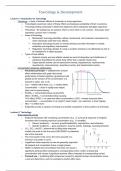
Lecture 1: Introduction to Toxicology
- Toxicology -> study of adverse effects of chemicals on living organisms.
o Toxicologists examines nature of these effects and assesses probability of their occurrence.
o Toxicology testing conducted to determine degree by which substance damages organisms.
o Paracelsus: “All substances are poisons; there is none which is not a poison. The proper dose
separates a poison from a remedy.”
o Areas of toxicology
Mechanistic toxicology identifies cellular, biochemical, and molecular mechanisms by
which chemicals exert their toxic effects.
Descriptive toxicology focuses on toxicity testing to provide information on safety
evaluation and regulatory requirements.
Regulatory toxicology decides if a drug or another chemical is of sufficiently low risk to
be marketed for a stated purpose.
o Types of toxic effects
Systemic toxicity are toxic effects caused as result of absorption and distribution of
substance that affects the whole body rather than a specific (local) area.
Organ-specific toxicity can be reproductive toxicity, hepatotoxicity, nephrotoxicity,
neurotoxicity, immunotoxicity, respiratory toxicity, and blood/cardiac toxicity.
- Concentration-response relationships
o Paracelsus principle -> establishment of dose-
effect relationships with graph that shows
performance of tested organism (growth/survival)
plotted as the function of the concentration of a
toxicant in water, soil, or air.
o LD50 = median lethal dose; LC50 = median lethal
concentration → dose in mg/kg body weight,
often oral or topical dosing.
o EC/ED50 = concentration/dose causing 50%
effect ; EC/ED10 = concentration/dose causing
10% effect; NOEC = no observed effect concentration; LOEC = lowest observed effect
concentration → concentration in air (mg/m3) water (mg/L), soil, sediment, or food (mg/kg).
o NEL = no effect level.
o Endpoints provide a measure of toxicity and enable comparison of toxic potency of chemicals.
Lecture 2: Toxicology
- Dose-response curves
o Endpoint decreases with increasing concentration (e.g., % survival) & response of endpoint
increases with increasing exposure concentration (e.g., % mortality).
Generic endpoints → survival, growth/metabolism, reproduction, and behaviour.
Specific endpoints → gene expression, enzyme activity, histology, neurotransmission.
o LC50, EC50, and EC10 determined by fitting dose-response
models (no point on the line) and LOEC/NOEC by statistical
test of the chemical.
o The more points in the curve, the more accurate it is;
minimum of 5 points in curve.
o Logarithmic dose-response curves are generally sigmoidal
(S-shaped) and monophasic (have a single phase).
o NOEC is highest test concentration that does not cause a
significant adverse effect compared to corresponding control. LOEC is lowest test
concentration that causes a significant adverse effect compared to corresponding control.
o Forward use -> predicting effect (response) caused by specific toxicant concentration (know
x-axis and determine y-axis for example to predict effect size).
, o Backward use -> estimate exposure concentration that triggers certain response; derive
chemical properties and trigger values (know y-axis and determine x-axis for example to derive
substance characteristics).
o Dose-response curves characterised by location (EC 50/potency), maximum response
(effectiveness), and steepness of the curve (slope).
Relative potency (REP) =
EC 50 of a standard
EC 50 of a sample -> only valid when
dose-response curves for sample and
standard are parallel and reach the same
maximum response (efficacy).
Increasing potency means a lower EC50.
Compounds could all have the same EC50, but
a different maximal response.
The steepness of the curve predicts how quickly an effect will happen.
- Therapeutic index -> measure of safety of a drug relating to blood
concentration at which a drug is toxic compared to concentration at
LD 50 toxic effect
which drug is effective = =
ED 50 therapeutic effect
o Hight TI → safe window & not very toxic (paracetamol).
o Low TI → very small window & toxic (lithium).
- Window of causality
o Optimal balance of essential metallic elements important for
sustaining normal functions in organism -> too little of it results in deficiency and poor quality of
life & too much can be toxic.
o Deficiencies associated with adverse pregnancy outcomes, including neural tube defects
(NTDs), congenital heart defects, preterm birth, miscarriage, and stillbirth.
o Non-essential metallic element exposure plays a role in the aetiology of NTDs.
- Toxicity tests in practice
o Organisation of Economic Co-operation and Development (OECD) prepares guidelines for
chemical regulation and toxicity testing (internationally agreed).
,o The OECD Guidelines for Testing of Chemicals is a collection of 150 testing methods used to
identify and characterise potential hazards of chemicals.
, - OECD – acute & sub-acute testing
o Testing effect of single dose on particular animal species: does it die or survive -> change dose
accordingly -> identify LC50, ED50, EC50, etc.
o Duration is from several days to weeks after single dose.
o Endpoints in acute studies are mortality, clinical pathology, gross necropsy, weight change,
and signs of toxicity.
o Endpoint of sub-acute studies are mortality, weight change, signs of toxicity, clinical pathology,
pathology, and histopathology.
- OECD – chronic & sub-chronic testing
o Establish NOEL and characterise dose-response relationships following repeated doses to
identify/ determine affected organs.
o Prediction of reasonable and appropriate dosing for chronic exposure studies -> evaluation of
cumulative toxicity of chemicals and assessing carcinogenic potential.
o Duration is from 28 days, through 90 days (sub-chronic) up to 6/12/24 months (chronic).
o Endpoints are mortality, weight change, signs of toxicity, clinical pathology, pathology, and
histopathology.
- OECD – reproduction & development testing
o Reproductive studies determine potential adverse effects of test item on fertility and
reproductive performance / sexual function, as well as developmental toxicity in offspring.
o Development studies (teratology) relate to adverse toxic effects to developing embryo or
foetus, respectively adverse effects induced during pregnancy.
o Duration varies depending upon endpoint.
o Endpoints are according to OECD guidelines.
- Acute to chronic ratio (ACR) -> toxicity increases with increasing exposure time.
o Uses acute toxicity data to measure the chronic toxicity of a chemical.
High ACR means that compounds bioaccumulate (not acute, so toxicity rises slowly
and there is a long exposure time).
Low ACR means a strong direct lethal effect (very acute, so already a high toxicity with
short exposure time).
- Multigenerational toxicity -> populations that do not go extinct and persist, may have developed
resistance / adaptation to substance(s).
o Remains unclear whether this lower sensitivity is due to genetic adaptation, epigenetics, or
phenotypic plasticity.
Lecture 3: ADME
- Toxicokinetics -> how the body handles a chemical, as a function of dose and time.
o The rate of chemical absorption from the site of application into the bloodstream (ADME).
- Absorption (A) -> process of taking toxins into the system (site of entry).
o Different absorption routes:
Oral intake -> absorption through passive (transcellular/paracellular) and active
(transcellular) carrier-mediated transport, or endocytosis (specialised).
Ingestion -> substance first absorbed in intestines and then moved to blood and lymph
through portal vein. In small
intestine, water and digested
nutrients are absorbed in blood
and lymph vessels & in large
intestine, absorption of water
occurs by osmosis.
Inhalation -> chemical exchange
with blood happens in alveoli &
different sizes of particles can
arrive in different part of the lungs.
Lecture 1: Introduction to Toxicology
- Toxicology -> study of adverse effects of chemicals on living organisms.
o Toxicologists examines nature of these effects and assesses probability of their occurrence.
o Toxicology testing conducted to determine degree by which substance damages organisms.
o Paracelsus: “All substances are poisons; there is none which is not a poison. The proper dose
separates a poison from a remedy.”
o Areas of toxicology
Mechanistic toxicology identifies cellular, biochemical, and molecular mechanisms by
which chemicals exert their toxic effects.
Descriptive toxicology focuses on toxicity testing to provide information on safety
evaluation and regulatory requirements.
Regulatory toxicology decides if a drug or another chemical is of sufficiently low risk to
be marketed for a stated purpose.
o Types of toxic effects
Systemic toxicity are toxic effects caused as result of absorption and distribution of
substance that affects the whole body rather than a specific (local) area.
Organ-specific toxicity can be reproductive toxicity, hepatotoxicity, nephrotoxicity,
neurotoxicity, immunotoxicity, respiratory toxicity, and blood/cardiac toxicity.
- Concentration-response relationships
o Paracelsus principle -> establishment of dose-
effect relationships with graph that shows
performance of tested organism (growth/survival)
plotted as the function of the concentration of a
toxicant in water, soil, or air.
o LD50 = median lethal dose; LC50 = median lethal
concentration → dose in mg/kg body weight,
often oral or topical dosing.
o EC/ED50 = concentration/dose causing 50%
effect ; EC/ED10 = concentration/dose causing
10% effect; NOEC = no observed effect concentration; LOEC = lowest observed effect
concentration → concentration in air (mg/m3) water (mg/L), soil, sediment, or food (mg/kg).
o NEL = no effect level.
o Endpoints provide a measure of toxicity and enable comparison of toxic potency of chemicals.
Lecture 2: Toxicology
- Dose-response curves
o Endpoint decreases with increasing concentration (e.g., % survival) & response of endpoint
increases with increasing exposure concentration (e.g., % mortality).
Generic endpoints → survival, growth/metabolism, reproduction, and behaviour.
Specific endpoints → gene expression, enzyme activity, histology, neurotransmission.
o LC50, EC50, and EC10 determined by fitting dose-response
models (no point on the line) and LOEC/NOEC by statistical
test of the chemical.
o The more points in the curve, the more accurate it is;
minimum of 5 points in curve.
o Logarithmic dose-response curves are generally sigmoidal
(S-shaped) and monophasic (have a single phase).
o NOEC is highest test concentration that does not cause a
significant adverse effect compared to corresponding control. LOEC is lowest test
concentration that causes a significant adverse effect compared to corresponding control.
o Forward use -> predicting effect (response) caused by specific toxicant concentration (know
x-axis and determine y-axis for example to predict effect size).
, o Backward use -> estimate exposure concentration that triggers certain response; derive
chemical properties and trigger values (know y-axis and determine x-axis for example to derive
substance characteristics).
o Dose-response curves characterised by location (EC 50/potency), maximum response
(effectiveness), and steepness of the curve (slope).
Relative potency (REP) =
EC 50 of a standard
EC 50 of a sample -> only valid when
dose-response curves for sample and
standard are parallel and reach the same
maximum response (efficacy).
Increasing potency means a lower EC50.
Compounds could all have the same EC50, but
a different maximal response.
The steepness of the curve predicts how quickly an effect will happen.
- Therapeutic index -> measure of safety of a drug relating to blood
concentration at which a drug is toxic compared to concentration at
LD 50 toxic effect
which drug is effective = =
ED 50 therapeutic effect
o Hight TI → safe window & not very toxic (paracetamol).
o Low TI → very small window & toxic (lithium).
- Window of causality
o Optimal balance of essential metallic elements important for
sustaining normal functions in organism -> too little of it results in deficiency and poor quality of
life & too much can be toxic.
o Deficiencies associated with adverse pregnancy outcomes, including neural tube defects
(NTDs), congenital heart defects, preterm birth, miscarriage, and stillbirth.
o Non-essential metallic element exposure plays a role in the aetiology of NTDs.
- Toxicity tests in practice
o Organisation of Economic Co-operation and Development (OECD) prepares guidelines for
chemical regulation and toxicity testing (internationally agreed).
,o The OECD Guidelines for Testing of Chemicals is a collection of 150 testing methods used to
identify and characterise potential hazards of chemicals.
, - OECD – acute & sub-acute testing
o Testing effect of single dose on particular animal species: does it die or survive -> change dose
accordingly -> identify LC50, ED50, EC50, etc.
o Duration is from several days to weeks after single dose.
o Endpoints in acute studies are mortality, clinical pathology, gross necropsy, weight change,
and signs of toxicity.
o Endpoint of sub-acute studies are mortality, weight change, signs of toxicity, clinical pathology,
pathology, and histopathology.
- OECD – chronic & sub-chronic testing
o Establish NOEL and characterise dose-response relationships following repeated doses to
identify/ determine affected organs.
o Prediction of reasonable and appropriate dosing for chronic exposure studies -> evaluation of
cumulative toxicity of chemicals and assessing carcinogenic potential.
o Duration is from 28 days, through 90 days (sub-chronic) up to 6/12/24 months (chronic).
o Endpoints are mortality, weight change, signs of toxicity, clinical pathology, pathology, and
histopathology.
- OECD – reproduction & development testing
o Reproductive studies determine potential adverse effects of test item on fertility and
reproductive performance / sexual function, as well as developmental toxicity in offspring.
o Development studies (teratology) relate to adverse toxic effects to developing embryo or
foetus, respectively adverse effects induced during pregnancy.
o Duration varies depending upon endpoint.
o Endpoints are according to OECD guidelines.
- Acute to chronic ratio (ACR) -> toxicity increases with increasing exposure time.
o Uses acute toxicity data to measure the chronic toxicity of a chemical.
High ACR means that compounds bioaccumulate (not acute, so toxicity rises slowly
and there is a long exposure time).
Low ACR means a strong direct lethal effect (very acute, so already a high toxicity with
short exposure time).
- Multigenerational toxicity -> populations that do not go extinct and persist, may have developed
resistance / adaptation to substance(s).
o Remains unclear whether this lower sensitivity is due to genetic adaptation, epigenetics, or
phenotypic plasticity.
Lecture 3: ADME
- Toxicokinetics -> how the body handles a chemical, as a function of dose and time.
o The rate of chemical absorption from the site of application into the bloodstream (ADME).
- Absorption (A) -> process of taking toxins into the system (site of entry).
o Different absorption routes:
Oral intake -> absorption through passive (transcellular/paracellular) and active
(transcellular) carrier-mediated transport, or endocytosis (specialised).
Ingestion -> substance first absorbed in intestines and then moved to blood and lymph
through portal vein. In small
intestine, water and digested
nutrients are absorbed in blood
and lymph vessels & in large
intestine, absorption of water
occurs by osmosis.
Inhalation -> chemical exchange
with blood happens in alveoli &
different sizes of particles can
arrive in different part of the lungs.