BIOC0001 Practicals
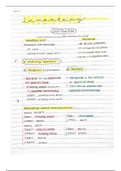
How many base pairs long is a typical gene? - ANS ~10^4bp. What is supercoiling? What is its purpose? - ANS The twisting of a DS DNA helix around itself allowing it to be packaged efficiently into a cell. Why might two sections of DNA which are the same length travel at different rates during gel electrophoresis? - ANS Some of the DNA, but not all, becomes relaxed during laboratory preparation (the state of a circular, non-supercoiled plasmid). Some of the DNA remains supercoiled and so is more compact meaning it migrates faster than its equally sized linear or relaxed counterpart. How are restriction endonucleases made? - ANS They are made naturally by bacteria as a defence against viral infection. What are all restriction sites recognised by restriction endonucleases known as? - ANS Palindromic. Why are all restriction sites palindromic? - ANS It allows the restriction endonuclease to cut both strands at the same point. What is the gel used in gel electrophoresis? Why? - ANS Agarose. What type of molecule is agarose? - ANS Polysaccharide. Describe the movement of DNA fragments in agarose gel electrophoresis. - ANS They move towards the anode (positive end) of the gel by moving through pores in the gel. The larger the fragment, the more drag it will experience whilst moving through the gel and so the slower it will move. What chemical is used to visualise DNA and how does it work? - ANS Ethidium bromide which intercalates (inserts) between bases and will fluoresce a pink-orange colour when illuminated with UV light (300nm). What wavelength is the UV light used to show the ethidium bromide? - ANS 300nm. What does a restriction map of a DNA fragment show? - ANS The positions of the different target sites for various restriction endonucleases. Draw the locations of three restriction sites P, Q and R on a 9kb plasmid given the following information: - Digestion with enzyme P gives a single 9kb piece of DNA. - Double digest with enzymes P and Q gives two fragments of 2kb and 7kb in length. - Double digest with enzymes P and R gives two fragments of 3kb and 6kb in length. - Double digest with enzymes Q and R gives two fragments of 1kb and 8kb in length. - ANS Describe how the lengths of DNA fragments on a gel electropheresis digest are estimated? How is a graph used here? - ANS The fragment migrations are compared against the migrations of fragments of known length. To do this, a standard curve of logbp (x) vs distance migrated/mm (y) must be plotted using the reference results. A line of best fit should then be drawn through the points and this then used to calculate the length of the DNA fragments of the practical digest by reading from the y-value representing the distance a specific DNA fragment migrated across to the LOB and then down to the relevant fragment length. Why do fragments of the same length migrate together in distinct bands? - ANS Because the agarose gel restricts random diffusion. What are agarose vs polyacrylamide gels used for? - ANS Agarose gel is used for a gel electrophoresis of larger DNA molecules between 200-20,000bp. Polyacrylamide gel on the other hand is used for gel electrophoresis of smaller DNA molecules between 10-2000bp.
Escuela, estudio y materia
- Institución
- UCL ECONS
- Grado
- UCL ECONS
Información del documento
- Subido en
- 11 de febrero de 2024
- Número de páginas
- 23
- Escrito en
- 2023/2024
- Tipo
- Examen
- Contiene
- Preguntas y respuestas
Temas

Documento también disponible en un lote