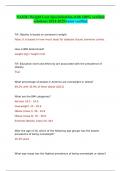
PRM (Personnel Readiness Management) Test Questions with 100% Complete Solutions, Rated A+
Personnel Readiness Management (PRM) - involves analyzing personnel strength data to determine current combat capabilities, projecting future requirements, and assessing conditions of individual readiness Goal of SRM - To create a constant state of readiness 3 stages of SRM - Prepare, Ready, Mission PRR - Personnel Readiness Report IDES - Integrated Disability Evaluation System MAR2 - MOS Administrative Retention Review SRP - Soldier Readiness Program ARFORGEN - Army Force Generation: rotational cycle, RESET, Train/Ready, Available. Two types of compassionate reassingnments - Deferment and Deletion USR - Unit Status Report- every month to review combat readiness What are the 6 processes of PRM? - 1. First obtain Commander's PRM intent and guidance 2. Analyze personnel strength to determine current combat capabilities 3. Compare strength against authorizations 4. Project future requirements 5. Assess conditions of individual readiness 6. Decide personnel / replacement allocation What systems can assist with the PRM Process? - eMILPO EDAS TOPMIS II DTAS TPS MEDPRO b. Physical Evaluation Board (PEB) - Which board is comprised of an informal board and a formal board presided over by a three member panel which makes a determination for the purpose of a Soldier's retention, separation, or retirement? a. Medical Evaluation Board (MEB) b. Physical Evaluation Board (PEB) c. Medical Assessment Board (MAB) d. MOS Administrative Retention Review (MAR2) a. Soldier Readiness Processing (SRP) - What is the Army's Program to ensure Soldiers meet readiness criteria for deployment? a. Soldier Readiness Processing (SRP) b. Personnel Accountability c. Strength Reporting d. Human Resources Command (HRC) d. All of the above - What can an S-1 do to minimize non-deployable personnel in a unit? a. Intensively manage physical profiles b. Cross-level personnel within the unit as necessary c. Intensively manage the MAR2/MEB/PEB process d. All of the above Urgent Forces, Rotational Units, and Essential Forces - What are the three categories within the FY 16-19 ACMG? Allows the Army to maintain a viable and credible deterrence capability while also meeting enduring requirements; Reduces the readiness "peaks and valleys" and enhance the Army's ability to preserve the readiness of the force and balance the Army's steady state missions and contingency response requirements - What is the goal of the Sustainable Readiness Model? b. Distribution Management Level (DML) - Which of the following distribution level is a two Star level Command? a. Distributive Management Level (DML) b. Distribution Management Level (DML) c. Distribution Management Sub-Level (DMSL) d. None of the above c. Distribution Management Sub-Level (DMSL) - Which of the following distribution level is a O6 level Command? a. Distributive Management Level (DML) b. Distribution Management Level (DML) c. Distribution Management Sub-Level (DMSL) d. None of the above
Escuela, estudio y materia
- Institución
- PRM
- Grado
- PRM
Información del documento
- Subido en
- 7 de febrero de 2024
- Número de páginas
- 10
- Escrito en
- 2023/2024
- Tipo
- Examen
- Contiene
- Preguntas y respuestas
Temas
-
prm personnel readiness management test
-
prm personnel readiness management