

MOVEMENT IN ANIMALS
- Movement is brought upon by muscles
- The skeletal muscles apply force to the bones and joints when they contract
Characteristics of skeletal muscle tissue:
- Forms the skeletal muscles that are attached to the bony skeleton
- Has stripes called striations
- Can be controlled voluntarily
Functions of skeletal muscle tissue
- When they contract and relax, it brings about the movement of the bones at joints
- Maintain posture and keep body stable. Muscles are always sitting in a state of slight
tension - a condition called muscles tone
- Joined together with ligaments - help to stabilise joints
- Generate heat when they contract
What makes us skeletal muscle
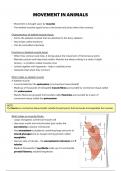
A skeletal muscle
- Is surrounded but the epimysium (a connective tissue sheath)
- Made up of thousands of elongated muscle ibres surrounded by connective tissue called
the endomysium
- Muscle ibres are grouped into bundles called fascicles, surrounded by a layer of
connective tissue called the perimysium
NOTE:
The fascia is a connective tissue sheath outside the epimysium that surrounds and separates the muscles
What makes up muscles ibres:
- Large, elongated, cylindrical muscle cell
- Has many nuclei and mitochondria (just under the
sarcolemma / plasma membrane)
- Has sarcoplasm (cytoplasm) containing large amounts of
stored glycogen and an oxygen-storing protein called
myoglobin
- Has two sets of tubules - the sarcoplasmic reticulum and T
tubules
- Made of thousands of myo ibrils made up of a contractile
protein ilament, stacked lengthwise
ff f f f
, How is a myo ibril made up:
Each myo ibril is made up of parallel ilaments forming a pattern of alternating
- dark A bands consisting of thick ilaments made up of the protein myosin
- Light I bands consisting of thin ilaments made up of the protein actin
- The dark A bands are bisected by the H zone, where there are no overlapping actin
ilaments
- The light I bands are bisected by the Z line, a dense area to which the actin ilaments are
attached
- All the ilaments between the Z lines form the sarcomere - the functional unit of a muscle
(part that usually contracts)
HOW ACTIN FILAMENTS LOOK VS HOW MYOSIN FILAMENTS LOOK:
- A myosin molecule has a stalk-like tail from which two ‘heads’ stick out. The heads are
called cross bridges because they link the thick and thin ilaments during contraction.
- Each thick ilament consists of many myosin molecules where the heads stick out at
opposite ends of the ilament, leaving the center of the sarcomeres with no heads, just tails
- Each thin ilament consists of actin
molecule, made up of two polypeptide
strands
twisted
together
f
f ff f f f ff f f f
- Movement is brought upon by muscles
- The skeletal muscles apply force to the bones and joints when they contract
Characteristics of skeletal muscle tissue:
- Forms the skeletal muscles that are attached to the bony skeleton
- Has stripes called striations
- Can be controlled voluntarily
Functions of skeletal muscle tissue
- When they contract and relax, it brings about the movement of the bones at joints
- Maintain posture and keep body stable. Muscles are always sitting in a state of slight
tension - a condition called muscles tone
- Joined together with ligaments - help to stabilise joints
- Generate heat when they contract
What makes us skeletal muscle
A skeletal muscle
- Is surrounded but the epimysium (a connective tissue sheath)
- Made up of thousands of elongated muscle ibres surrounded by connective tissue called
the endomysium
- Muscle ibres are grouped into bundles called fascicles, surrounded by a layer of
connective tissue called the perimysium
NOTE:
The fascia is a connective tissue sheath outside the epimysium that surrounds and separates the muscles
What makes up muscles ibres:
- Large, elongated, cylindrical muscle cell
- Has many nuclei and mitochondria (just under the
sarcolemma / plasma membrane)
- Has sarcoplasm (cytoplasm) containing large amounts of
stored glycogen and an oxygen-storing protein called
myoglobin
- Has two sets of tubules - the sarcoplasmic reticulum and T
tubules
- Made of thousands of myo ibrils made up of a contractile
protein ilament, stacked lengthwise
ff f f f
, How is a myo ibril made up:
Each myo ibril is made up of parallel ilaments forming a pattern of alternating
- dark A bands consisting of thick ilaments made up of the protein myosin
- Light I bands consisting of thin ilaments made up of the protein actin
- The dark A bands are bisected by the H zone, where there are no overlapping actin
ilaments
- The light I bands are bisected by the Z line, a dense area to which the actin ilaments are
attached
- All the ilaments between the Z lines form the sarcomere - the functional unit of a muscle
(part that usually contracts)
HOW ACTIN FILAMENTS LOOK VS HOW MYOSIN FILAMENTS LOOK:
- A myosin molecule has a stalk-like tail from which two ‘heads’ stick out. The heads are
called cross bridges because they link the thick and thin ilaments during contraction.
- Each thick ilament consists of many myosin molecules where the heads stick out at
opposite ends of the ilament, leaving the center of the sarcomeres with no heads, just tails
- Each thin ilament consists of actin
molecule, made up of two polypeptide
strands
twisted
together
f
f ff f f f ff f f f

