
Bio 420 – Lab View Microbiology Questions and Answers 2024 Approved Questions and Correct Answers Graded A+ Latest 2024 Update
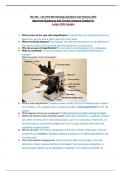
Bio 420 – Lab View Microbiology Questions and Answers 2024 Approved Questions and Correct Answers Graded A+ Latest 2024 Update 1. What occurs to the view with magnification? magnification you will be able to see tiny specimens, but you will be able to see them even closer 2. What is working distance? the distance from the front lens element of the objective to the closest surface of the coverslip when the specimen is in sharp focus 3. Why do we use oil magnification? to increase the resolving power of a microscope. 4. What is a parfocal? is a lens that stays in focus when magnification/focal length is changed - Name the parts of the microscope? 5. What is total magnification? eyepiece power (usually 10x) by the objective lens in place. For example, a 10x eyepiece and a 4x objective yields a total magnification of 40x (40 power). 6. What happens during the iris diagram? It alters the amount of light reaching the object 7. Difference between acidic and basic dyes? Acidic dye is defined as a negatively charged dye, which contains one or more acidic groups, such as a sulfo group. A basic dye, on the other hand, is a positively charged stain that is usually synthetic and reacts with negatively charged particles 8. Why do we stain? to enhance visualization of the cell or certain components. Cells are sometimes also stained to highlight metabolic processes or to differentiate between live and dead cells 9. Cocci and bacillus Arrangements: Cocci and bacilli differ in their shape. Cocci are spherical in shape: whereas bacilli are rod-shaped, Cocci are usually aflagellate, i.e. lacking flagella. Bacilli may be aflagellate or flagellate. The number and position of flagella differ in different bacillus forms. Both cocci and bacilli may occur singly or in aggregation of two or more and termed accordingly. 10. Why do we need an air vent in Bunsen Burner? changes the volume of gas flow; the more gas entering the burner, the larger the flame 11. Will charge + & + attract or repel? repel 12. Will charge + &- attract or repel? attract 13. Why do we stain bacteria? to view them easier and clearly, to have contrast to identify cell morphology of the bacteria 14. Does methylene blue have a + or – atmosphere? negatively charged (anionic) and combine with positively charged cellular components 15. What is the charge of a bacteria outer layer? Can be both positive and negative bc. Of color 16. During a simple stain using acidic dye instead of a basic dye will result? It will not stain 17. Simple stain, can’t focus on bacteria with oil lens. Why? Not heat fixing or air drying. Things used during staining: Prime dye: violet crystal. Mordant: iodine, d
Información del documento
- Subido en
- 3 de febrero de 2024
- Número de páginas
- 5
- Escrito en
- 2023/2024
- Tipo
- Examen
- Contiene
- Preguntas y respuestas

