

Ornamental and Turfgrass Pest Management Georgia Study Guide with Complete Solutions!
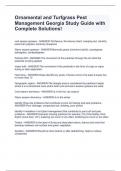
cool season grasses - ANSWER-Tall fescue, fine fescue (hard, creeping red, clemifs), perennial ryegrass, kentucky bluegrass Warm season grasses - ANSWER-Bermuda grass (common,hybrid), zoysiagrass, bahiagrass, centipedegrass Particle drift - ANSWER-The movement of fine particles through the air while the pesticide is being applied Vapor drift - ANSWER-The movement of the pesticide in the form of a gas or vapor during or after application Hand lens - ANSWER-Helps identify tiny pests. Choose a lens of at least 5 power but no more than 10 Geographic region - ANSWER-The triangle area is considered the piedmont region where it is a transitional zone where both cool and warm season grasses are used. Cool season dormancy - ANSWER-Is in the hot, dry season Warm season dormancy - ANSWER-Is in the winter Identify three site problems that contribute to poor turf stands and pest problems - ANSWER-Poor drainage, compacted soil, shading, poor airflow Identify 4 mistakes in turf plant management that contribute to poor turf and pest problems - ANSWER-Improper mowing practices for species (1/3 of the blade), thick thatch (more than 1/2"), watering too much or too often, fertilizing too much or too often Thatch - ANSWER-Is the layer of living and dead plant stems, leaves and roots that develops between soil surface and green vegetation Aeration - ANSWER-Should be done before or after dethatching, helps to relieve compaction Turf irrigation practices - ANSWER-Thoroughly water with 1" per week, new turf should be watered lightly and frequently, turf should be watered when you see signs of wilting such as footprints, leaf curling or discoloration, irrigate early in the morning Turf fertilization practices - ANSWER-Requirements and timing vary by cultivar, test the soil every two to three years and follow turfgrass manual recommendations Excess nitrogen on turf - ANSWER-Leads to thatch build up and lush plants that are more likely to get diseases such as leaf spot, brown patch, large patch and pythium blight Nitrogen deficiency in turf - ANSWER-Favors dollar spot. Can leave turf thin, bare and susceptible to weeds Insects that go through complete metamorphosis - ANSWER-Moths and beetles Insects that go through gradual metamorphosis - ANSWER-Chinch bug Chinch bug damage to turf - ANSWER-Appears as circular patches of yellowing turf that resembles drought. Resistant to most pesticides 4 pests that cause root damage to turf - ANSWER-White grubs, mole crickets, masked chafer grub, green june beetle grub How does frequent mowing impact fire ants? - ANSWER-Forces them to move to less disturbed areas 3 ways to find turf insects in soil - ANSWER-Inspect turf by pulling some up or spreading it out and inspecting it closely, soap and water flush, flotation What insects are detected using the soap and water flush? - ANSWER-Mole crickets, sod webworms, armyworms and other caterpillars What insects are detected using the flotation method? - ANSWER-Chinch bugs and others What insects are deteced by pulling up the turf? - ANSWER-Grubs and billbugs What are the types of traps used to monitor pests? - ANSWER-Light traps, pheremone traps a
Información del documento
- Subido en
- 1 de febrero de 2024
- Número de páginas
- 5
- Escrito en
- 2023/2024
- Tipo
- Examen
- Contiene
- Preguntas y respuestas


