PCN-100 Final Exam Study Guide Updated
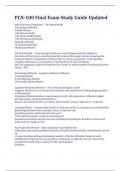
PCN-100 Final Exam Study Guide Updated Major theories of addiction - -The Moral Model -Psychological Models -Family Models -The Disease Model -The Public Health Model -The Developmental Model -Biological Models -Sociocultural Models -Multicausal Models The Moral Model - -do not accept that there is any biological basis for addiction; they believe that there is something morally wrong with people who use drugs heavily. -based on beliefs or judgments of what is right or wrong, acceptable or unacceptable. -explains addiction as a consequence of personal choice, and individuals who are engaging in addictive behaviors are viewed as being capable of making alternative choices. This Psychological Models - -Cognitive-Behavioral Models -Learning Models -Psychodynamic Models -Personality Theory Models Cognitive-Behavioral Models - -one of the psychological models -suggests that there are a variety of motivations and reinforcers for taking drugs (positive reinforcement) -Examples of the motivations: experiencing variety, self-exploration, religious insights, altering moods, escape from boredom or despair, and enhancement of creativity, performance, sensory experience, or pleasure Learning Models - -assumes that alcohol or drug use results in a decrease in uncomfortable psychological states such as anxiety, stress, or tension, thus providing positive reinforcement to the user. -This learned response continues until physical dependence develops and the aversion of withdrawal symptoms becomes a reason and motivation for continued use. Psychodynamic Models - -links addiction to ego deficiencies, inadequate parenting, attachment disorders, hostility, homosexuality, masturbation, and so on -A major problem with psychodynamic models is that the difficulties linked to early childhood development are not specific to alcoholism or addiction, but are reported by nonaddicted adults with a variety of other psychological problems -Explanation of addiction: Substance abuse can be viewed as symptomatic of more basic psychopathology. 2. Difficulty with an individual's regulation of affect can be seen as a core problem or difficulty. 3. Disturbed object relations may be central to the development of substance abuse. Personality Theory Models - -the assumption that certain personality traits predispose the individual to drug use -"alcoholic personality": dependent, immature, impulsive, highly emotional, having low frustration tolerance, unable to express anger, and confused about their sex role orientation Criticism -Not consistently supported -The consensus among those who work in the addictions counseling arena seems to be that personality traits are not of much importance in explaining addiction because an individual can become drug dependent irrespective of personality traits Family Models - -Behavioral Models -Family Systems -Family Disease Behavioral Models - -within the context of the family, there is a member (or members) who reinforces the behavior of the abusing family member. Family Systems - -model focuses on the way roles in families interrelate -Some family members may feel threatened if the person with the abuse problem shows signs of wanting to recover since caretaker roles, for example, would no longer be necessary within the family system if the member began behaving more responsibly Family Disease - -the entire family has a disorder or disease, and all must enter counseling or therapy for improvement to occur within the addicted family member -willing to work with whichever family members will come to the sessions, even though every family member is not present. The Disease Model - -The disease concept follows the medical model and posits addiction as an inherited disease that chemically alters the body in such a way that the individual is permanently ill at a genetic level -addiction is viewed as a primary disease rather than being secondary to another condition -addictive disease is chronic and incurable
Información del documento
- Subido en
- 26 de enero de 2024
- Número de páginas
- 6
- Escrito en
- 2023/2024
- Tipo
- Examen
- Contiene
- Preguntas y respuestas