ACRP CCRC Exam (Latest 2024/ 2025 Update) Questions and Verified Answers| 100% Correct| Grade A
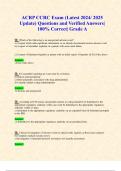
ACRP CCRC Exam (Latest 2024/ 2025 Update) Questions and Verified Answers| 100% Correct| Grade A Q: Which of the following is an unexpected adverse event? a) A report which adds significant information to an already documented serious adverse event b) A report of interstitial nephritis in a patient with acute renal failure c) A report of fulminant hepatitis in patient with an initial report of hepatitis d) All of the above Answer: d) All of the above Q: For expedited reporting an event must be a) Serious b) Serious and unexpected c) Only temporally associated with drug administration d) Causally related to drug administration Answer: b) Serious and unexpected Q: According to ICH serious unexpected reaction to a drug should be a) Submitted to the appropriate regulatory authority within one week b) Submitted to the appropriate regulatory authority within 15 days c) Submitted to the appropriate regulatory authority on an expedited basis d) Submitted promptly to the IRB Answer: c) Submitted to the appropriate regulatory authority on an expedited basis Q: Clinical investigation of adverse events in clinical trials requires a) Root cause analysis b) Complete medical records review c) Investigation of potential protocol deviations d) Causality assessment Answer: a) Root cause analysis Q: Adverse events of marketed drugs usually imply a) Multi-drug interactions b) Unreliable subjective measures c) Psychosomatic factors d) Causality Answer: d) Causality Q: Rapid communication of single case reports of serious adverse events is merited if the information a) Influences risk benefit assessment b) Implies a change need in drug administration c) A change in the conduct of the clinical investigation d) All of the above Answer: d) All of the above Q: Expedited reporting of serious adverse events may be considered if a) There is an increased rate of occurrence in the serious adverse drug reaction b) A lack of efficacy is evident in treating a life-threatening disease c) A new safety consideration is evident from a new animal study d) All of the above Answer: d) All of the above Q: Fatal or life threatening and unexpected adverse drug reactions in clinical investigations should be reported to the regulatory agencies (check all that apply) a) No later than 7 days after first knowledge of event b) No later than 15 days after first knowledge of event c) By filing a complete report within 8 additional days of the initial notification d) By filing a complete report within 15 additional days of the initial notifica- tion Answer: a) No later than 7 days after first knowledge of event c) By filing a complete report within 8 additional days of the initial notification Q: Serious adverse drug reactions must be filed with regulatory agencies a) As soon as possible, but not later than 8 days of first knowledge b) As soon as possible, but not later than 10 days of first knowledge c) As soon as possible, but not later than 15 days of first knowledge d) As soon as possible, but not later than 1 month of first knowledge Answer: c) As soon as possible, but not later than 15 days of first knowledge Q: In ascertaining the basis for a serious adverse drug reaction in a random- ized trial a) Care should be taken not to break the blind for the patient b) Care should be taken to break the blind only for the single patient involved c) The blind for the group of patients being treated at the site should be broken d) The blind for the single patient should be broken only if the sponsor approves Answer: b) Care should be taken to break the blind only for the single patient involved Q: Breaking the blind for a single patient in randomized clinical trial a) Has negative implications for data integrity at the site level b) Has little or no significant implication for the investigation or final data analysis c) May compromise drug approval because of implications for final data analysis d) Provides no significant information regarding the safety of the patient Answer: b) Has little or no significant implication for the investigation or final data analysis Q: Adverse drug reactions in the control group should be reported to a) The other manufacturer b) Appropriate regulatory agency c) a only d) a and b Answer: d) a and b
Escuela, estudio y materia
- Institución
- ACRP CCRC
- Grado
- ACRP CCRC
Información del documento
- Subido en
- 24 de enero de 2024
- Número de páginas
- 35
- Escrito en
- 2023/2024
- Tipo
- Examen
- Contiene
- Preguntas y respuestas
Temas
-
acrpccrccertified clinical research coordinator
-
acrp ccrccertified clinical research coordinator
-
acrp ccrc exam latest update question
-
adverse drug reactions in the control group shoul

Documento también disponible en un lote