

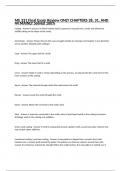
ME 331 Final Exam Review ONLY CHAPTERS 28, 31, AND 44 MAINLY Solved 100%
Casting - Answer A process in which molten metal is poured or injected into a cavity and allowed to solidify taking on the shape of the cavity. Anisotropic - Answer Means they [in this case wrought metals] are stronger and tougher in one direction versus another. [Dealing with castings] Cope - Answer The upper half of a mold Drag - Answer The lower half of a mold Cores - Answer Made of sand or metal, depending on the process, are placed into the cavity to form the inner surfaces of the casting. Sprue - Answer The channel through which the metal enters the mold. Runner - Answer Leads the metal through the mold. Gates - Answer Attach the runner(s) to the mold cavity. Riser - Answer A reservoir connected to the mold cavity to feed liquid metal to the casting to prevent shrinkage voids in the casting as it solidifies. Green-sand casting - Answer A mold is compacted around a pattern with a sand-clay-water mixture that may contain other additives. Investment casting / precision casting - Answer A wax pattern is dipped into a ceramic slurry that hardens into a ceramic shell around the patter. The pattern can then be coated a second time with coarser dry refractory material for strength When the mold hardens, the wax pattern is melted out. It typically produces porosity-free castings with superior dimensional accuracy and surface finish, however, with low productivity. Evaporative / lost foam casting - Answer Making metal castings by the use of expanded polystyrene foam patterns that eliminate the need for traditional mold cavities. It also eliminates the need for cores and core boxes. Permanent mold castings - Answer Which castings are produced by pouring molten metal, under pressure of a gravity head or a low-pressure feed system, into a static mold. Die casting - Answer Molten metal is forced under pressure into metal molds or dies. It is limited to use with low-milting-temperature alloys such as aluminum, zinc, and magnesium. The process is economical for producing castings with complex contours, thin cross-sections, and hols and contours that would be costly to produce by macing operations. Hot-chamber machine - Answer Is commonly used to produce zinc and some magnesium castings. Cold-chamber machines - Answer The pressure chamber is separate from the melting pot and is not heated. Therefore, the pressure chamber is not exposed directly to the erosive and thermal characteristics of molten metal. Extrusion blow molding - Answer An extruder creates a thick tube called a *parison*. A mold then closes on the parison, pinching the bottom shut. Injection blow molding - Answer A parison is created by injection molding. The biggest use for _____ is the creation of containers for carbonated soft drinks. Injection molding - Answer Generally makes use of the heat-softening characteristics of thermoplastics materials, which soften when heatened and reharden when cooled. The change is entirely physical, allowing the softening and rehardening cycle to be repeated several times. Shot size - Answer The maximum amount of material the machine [injection molding] can inject per cycle. The accepted standard for _____ is for the material polystyrene. Clamp tonnage - Answer The amount of force the machine can generate to squeeze a mold together. Reaction injection molding (RIM) - Answer A form of injection molding that brings temperature and ratio-controlled, liquid reactant streams together under high-pressure impingement mixing to form a polymer directly in the mold. Thermoforming - Answer Consists of heating a thermoplastic sheet to its processing temperature and forcing the hot, flexible material against the contours of a mold. Vacuum forming - Answer The most simple and common thermoforming process is _____. Sheet thinning - Answer The greatest problem in thermoforming is control of sheet thinning. Numerous techniques are used to reduce or control _____, including plug-assist forming, pressure bubble forming, and snap-back forming. Rotational molding - Answer A process for forming hollow plastic parts. Transparent acrylic sheet - Answer One of the common plastics materials in wide-scale use [casting] is _____. These _____ are called cell cast, because they are manufactured by pouring liquid plastic resin into a mold made with think glass plates.
Información del documento
- Subido en
- 19 de enero de 2024
- Número de páginas
- 6
- Escrito en
- 2023/2024
- Tipo
- Examen
- Contiene
- Preguntas y respuestas

