Health Insurance Florida 2-40 Practice Exam Questions #3 - Medical Expenses Already Passed
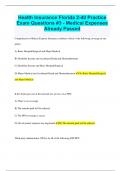
Health Insurance Florida 2-40 Practice Exam Questions #3 - Medical Expenses Already Passed Comprehensive Medical Expense Insurance combines which of the following coverage in one policy: A) Basic Hospital/Surgical and Major Medical B) Disability Income and Accidental Death and Dismemberment C) Disability Income and Basic Hospital/Surgical D) Major Medical and Accidental Death and Dismemberment A) Basic Hospital/Surgical and Major Medical If the client goes out of the network for services on a PPO: A) There is no coverage B) The amount paid will be reduced C) The PPO coverage is excess D) Out of pocket expenses are negotiated B) The amount paid will be reduced Third party administrator (TPAs) do all of the following EXCEPT: A) Marketing B) Underwriting C) Provide coverage D) Claims processing C) Provide coverage A (basic hospital) health insurance service plan: A) Pays hospital only for specific services stated in the policy B) Pays the hospital directly for claims incurred by low income persons C) Pays the hospital or doctor directly as provided by the service plan D) Pays the hospital or doctor directly as provided by the service plan D) Pays the hospital or doctor directly as provided by the service plan All of the following are true about HMOs Except: A) They offer a limited choice of doctors B) Covered individuals are known as subscribers C) Ambulatory services are covered on an out patient basis D) Treatment must always be pre-authorized by a primary care physician C) Ambulatory services are covered on an out patient basis Major Medical Expense plans do not contain a: A) Deductible B) Co-insurance requirement C) Schedule of benefits D) High limit of coverage C) Schedule of benefits All of the following statements about Major Medical benefits are true, EXCEPT: A) The deductible can be expressed as a fixed dollar amount B) The benefit period begins only after a specified amount of expenses have been accrued within the accumulation period C) Benefits are generally expressed as a percentage of eligible expenses D) Benefits have no maximum limit D) Benefits have no maximum limit A Major Medical Expense policy has a $100 per family, per year deductible and 80/20 co-insurance. Three claims occur during the year as follows: The first claim was for $200, the second claim was for $400 and the third claim was for $500. How much will the insurer pay: A) $300 B) $640 C) $800 D) $1,000 C) $800 Which type of insurance policy combines several types of benefits and provides more coverage than any of the others? A) Hospital Expense B) Comprehensive Medical Expense C) Major Medical D) Surgical Expense B) Comprehensive Medical Expense All are true about Preferred Provider Organizations (PPOs), EXCEPT: A) They may only be started by hospitals B) Coverage may be reduced for out-of-network services C) They may be started by insurance companies in order to compete with HMOs D) Clients are known as subscribers A) They may only be started by hospitals HMOs generally provide preventative care in all of the following areas EXCEPT: A) Well baby care B) Hearing loss exams for adults C) Physical exams D) Wellness clinics B) Hearing loss exams for adults Which of the following statements is true about the deductibility of premiums and the taxation of benefits on a non-contributory Group medical expense purchased by an employer for employees: A) Premiums are tax deductible for the employer but benefits are not taxed to the employee B) Premiums are not tax deductible for the employer but benefits are taxed to the employee C) Premiums are tax deductible for the employer, but benefits are taxed to the employee A) Premiums are tax deductible for the employer but benefits are not taxed to the employee If an insured with a major medical policy with no deductible and 80/20 co-insurance has a $1,000 claim, the insured must pay: A) $800 B) $200 C) $1000 B) $200 If an insured with a major medical policy with a $100 deductible and 80/20 co-insurance has a $1,100 claim, how much will the insurer pay: A) $800 B) $880 C) $200 D) $220 C) $800
Escuela, estudio y materia
- Institución
- Health Insurance Florida 2-40
- Grado
- Health Insurance Florida 2-40
Información del documento
- Subido en
- 18 de enero de 2024
- Número de páginas
- 6
- Escrito en
- 2023/2024
- Tipo
- Examen
- Contiene
- Preguntas y respuestas
Temas
-
health insurance florida 2 40 practice exam questi

Documento también disponible en un lote