AICE Psychology AS review Questions with 100% Complete Solutions
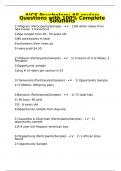
1) Milgram (Participants/Sample) - 1)All white males from new haven, Connecticut 2)Age ranged from 20 - 50 years old 3)40 participants in total 4)volunteers from news ad 5) were paid $4.50 2) Pilliavin (Participants/Sample) - 1) 4 teams of 4 (2 Males, 2 Females) 2)Opportunity sample 3)avg # of riders per section is 43 3) Yamamoto (Participants/Sample) - 1) Opportunity Sample 2) 5 Mother- Offspring pairs 4)Bandura (Participants/Sample) - 1) 72 total kids 2) 36 boys; 36 girls 3)3 - 6 years old 4)Opportunity sample from daycare 5) Saavedra & Silverman (Participants/Sample) - 1) opportunity sample 2)A 9 year old Hispanic-american boy 6) Pepperburg (Participants/Sample) - 1) 1 African Grey Parrot 2) Opportunity Sample 7) Canli (Participants/Sample) - 1)Volunteer sample 2) 10 right handed females 3) chose women because more emotional 8) Schacter & Singer(Participants/Sample) - 1) 18 white males 2)students offered 2 pts extra credit on final exam per hour 3)Volunteer sample 9) Dement & klietman (Participants/Sample) - 1)7 males and 2 females 2)5 intensely investigated for 6-17 nights and 4 to confirm findings for 1-2 nights 3)electrodes placed next to eyes and scalp 4) told to avoid caffeine and drinking 10) Andrade (Participants/Sample) - 1)Ages 18-55 Mostly Females 2)20 Control (2 males); 20 Experimental (doodlers/3 males) 3)Sampling Technique Volunteer- Original study (deception) Opportunity- Since they were already there from a previous experiment 11) Baron-Cohen (Participants/Sample) - 1) Group 1 (AS/HFA) Experimental group - 15 male adults with AS/HFA -Self-selecting from U.K. National Autistic Society magazine ad -Normal IQ range (x=115) and mix of socioeconomics and education 2)Group 2 (general population controls) -122 adults (as controls) from adult community & education classes from Exeter or from public library at Cambridge -55 males & 67 females -Broad mix of occupations and education 3)Group 3 (students from Cambridge) Control group -103 undergraduate students (71 in science and 32 in other majors) -53 males and 50 females -Assumed to have higher IQ than other Ps (though not specified) 4)Group 4 (IQ-matched controls) -14 randomly selected adults who were IQ- matched with Group 1 -IQ x=116 -No mention of gender (assuming male though) -No mention of how selected/recruited -Sampling Technique- Volunteer/Opportunity 12) laney (Participants/Sample) - -Experiment 1 1)Volunteers from University of California 2)128 Undergrads, received course credit 3)99 Females; 29 Males 4) Mean age 20.8 -Experiment 2 1)103 undergrads from university of Washington 2) 64 Females; 39 Males 3)Volunteer 1) Milgram (Results) - AIM: To investigate what level of obedience would be shown by P's when told by an authority figure to shock another person. 1)All participants went to 300 volts 2)65% went to 450 volts 3) The amount of stress and tension clearly observed in P's (laughing,sweating, seizures,biting nails etc) 2) Pilliavin (Results) - AIM: To investigate whether diffusion of responsibility applies in all situations and what other factors might influence helping behavior. 1)Slight "same race effect" 2) Men were significantly more likely to help (90% of first helpers) 3)Cane Victim - 100% help w/o model -avg of 5 sec to help 4) drunk victim- 86% help w/o the model -75% help w/model 3)Yamamoto (Results) - AIM: to investigate whether chimpanzees have the ability and flexibility to help another chimpanzees depending on its specific needs. -Can see condition 1) 4 of the chimps offered the straw or stick first significantly more -Cannot see condition 1)71.7% came to help after request 2)ayumu only chimp to look through hole 3) straw or stick was 50/50 4) Bandura (Results) - AIM: to demonstrate that learning can occur through mere observation of a model and that imitation can occur in the absence of a model. 1)Children shown aggressive model will be more aggressive 2)children shown non-aggressive model will be less aggressive 3)children will imitate the actions of same sex model 4)boys were more aggressive than girls 5) Saavedra & Silverman (Results) - AIM: to use exposure therapy to treat a specific phobia in a child with emotions of fear and disgust related to buttons. 1) Had two follow-ups (6 and 12 month checkups) 2)minimal distress about buttons and more willing to approach buttons was found 6) Pepperburg (Results) - AIM: could a parrot use vocalizations to demonstrate an understanding of the concepts "same" and "different" 1)Familiar objects - 69 out of 99 correct responses, first trial only (69.7%) 2)Novel Objects- 79 out of 96 correct response, first trial only 96 out of 113 correct responses, overall
Información del documento
- Subido en
- 18 de enero de 2024
- Número de páginas
- 23
- Escrito en
- 2023/2024
- Tipo
- Examen
- Contiene
- Preguntas y respuestas