

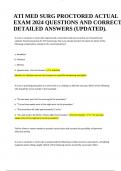
ATI MED SURG PROCTORED ACTUAL EXAM 2024 QUESTIONS AND CORRECT DETAILED ANSWERS (UPDATED).
ATI MED SURG PROCTORED ACTUAL EXAM 2024 QUESTIONS AND CORRECT DETAILED ANSWERS (UPDATED). A nurse is caring for a client who experienced a traumatic head injury and has an intraventricular catheter (Ventriculostomy) for ICP monitoring. The nurse should monitor the client for which of the following complications related to the ventriculostomy?: a. Headache b. Infection c. Aphasia d. Hypertension (Correct Answer) - b. Infection Monitor for infection and use strict asepsis to avoid life-threatening meningitis. A nurse is providing education to a client who is to undergo an EEG the next day. Which of the following info should the nurse include in the teaching? a. "Do not wash your hair the morning of the procedure." b. "Try and stay awake most of the night prior to the procedure." c. "The procedure will take approximately 15 mins." d. "You will need to lie flat for 4 hours after the procedure." (Correct Answer) - b. "Try and stay awake most of the night prior to the procedure." Tell the client to remain awake to provide cranial stress and increase the possibility of abnormal electrical activity A nurse is caring for a client who is postprocedural following a lumbar puncture and reports a throbbing headache when sitting upright. Which of the following actions should the nurse take? SATA. lOMoARcPSD| ATI MED SURG PROCTORED ACTUAL EXAM 2024 QUESTIONS AND CORRECT DETAILED ANSWERS (UPDATED). lOMoAR cPSD| a. Use the GCS scale to assess the client b. Assist the client into a supine position c. Administer an opioid analgesic d. Encourage the client to increase PO fluid intake e. Instruct the client to perform coughing and deep breathing (Correct Answer) - B, D A nurse is caring for a client who has continuous bladder irrigation following a transurethral resection of the prostate (TURP). Which of the following findings should the nurse report to the provider? a Output equal to the instilled irrigate b. Client reports bladder spasms c. Viscous urinary output with clots d. Reports of strong urge to urinate (Correct Answer) - c. Viscous urinary output with clots Urine that is bright red with clots is an indication of arterial bleeding. A nurse is monitoring the ECG of a client who has hypocalcemia. Which of the following findings should the nurse expect? a. Flattened T waves b. Prolonged QT intervals c. Shortened QT intervals d Widened QRS complexes (Correct Answer) - b. Prolonged QT intervals Manifestations of hypocalcemia include tingling, numbness, tetany, seizures, prolonged QT intervals, and laryngospasm. lOMoARcPSD| lOMoAR cPSD| A nurse is preparing a client who has a brain tumor for a CT scan. Which of the following factors affects the manner in which the nurse will prepare the client for the scan? a. No food or fluids consumed for 4 hours b. Difficulty recalling recent events c. Development of hives while eating shrimp d. e. Paresthesia in both hands (Correct Answer) - c. Development of hives while eating shrimp Shellfish allergy is contraindication of use of contrast media during a CT scan. A nurse is preparing an in-service program about the stages of acute kidney injury. Which of the following pieces of info should the nurse include about prerenal azotemia? a. Prerenal azotemia begins prior to the onset of symptoms b. Interference with renal perfusion causes renal azotemia c. Prerenal azotemia is irreversible, even in early stages d. Infections and tumors cause prerenal azotemia (Correct Answer) - b. Interference with renal perfusion causes prerenal azotemia. Prerenal = interference with renal perfusion, such as from heart failure or hypovolemic shock. A nurse is teaching a client who has CAD about the difference between angina pectoris and MI. Which of the following should the nurse identify as indications of MI? SATA. a. N/V b. Diaphoresis and dizziness c. Chest and left arm pain that subsides with rest d. Anxiety and feelings of doom lOMoARcPSD| lOMoAR cPSD| e. Bounding pulse and bradypnea (Correct Answer) - A, B, D .
Información del documento
- Subido en
- 18 de enero de 2024
- Número de páginas
- 28
- Escrito en
- 2023/2024
- Tipo
- Examen
- Contiene
- Preguntas y respuestas

