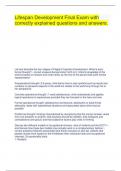
Lifespan Development Final Exam with correctly explained questions and answers.
Lifespan Development Final Exam with correctly explained questions and answers. List and describe the four stages of Piaget's Cognitive Development. What is post-formal thought? - correct answers.Sensorimotor: birth to 2, infant's knowledge of the world is based on senses and motor skills, by the end of the period child uses mental representation Preoperational thought: 2-6 years, child learns how to use symbols such as words and numbers to represent aspects of the world but relates to the world only through his or her perspective Concrete operational thought: 7- early adolescence, child understands and applies logical operations to experiences provided they are focused on the here and now Formal operational thought: adolescence and beyond, adolescent or adult thinks abstractly, deals with hypothetical situations and speculates about what may be possible Postformal thought: thinking characterized by recognizing that the correct answer varies from one situation to another, that solutions should be realistic, that ambiguity and contradictions are typical, and that subjective factors play roles in thinking Discuss two different models of occupational choices—that of Holland and the SCCT—and discuss how these two models may actually work in a complementary fashion. - correct answers.Holland's personality type theory focuses on skill-set. Asserts that people choose work based on the fit between their individual traits and occupational interests. Six personality traits: 1. Realistic 2. Investigative (thought, analytical approaches, explore, knowledge, ideas, not social) = biologist, chemist, dentist, vegetarian, programmer 3. Artistic (literary, musical, artistic, emotional, creative, open) = artist, musician, poet, interior designer, writer 4. Social (train, inform, educate, help, supportive, avoid technical skills, empathy, relationships) = social work, counseling, police officer, LPN 5. Enterprising (verbally skilled, persuasive, direct, leader, dominant) = lawyer, business executive, politician, TV producer 6. Conventional (rules and routines, provide order or direct structure, self control, respect power and status, punctual, orderly) = bank teller, clerk typist, cashier, data entry Albert Bandura's social cognitive career theory (SCCT): focuses on self-efficacy with respect to occupation. By means of the self system, individuals exercise control over their thoughts, feelings, and actions. Among the beliefs with which an individual evaluates the control over his/her actions and environment, self-efficacy beliefs are the most influential predictor of human behavior. The level and strength of self-efficacy will determine: whether coping behavior will be initiated, how much effort will result, and how long the effort will be sustained in the face of obstacles. Self efficacy is derived from 4 most influential sources: 1. Personal performance (Accomplishments - previous successes or failures) - Most influential 2. Vicarious experience (watching others, modeling, mentoring 3. Verbal persuasion (verbal encouragement or discouragement 4. Physiological and emotional factors (perceptions of stress react List and describe Erikson's eight stages of Psychosocial Development. - correct answers.1. Trust vs. Mistrust (Infancy): When parents consistently respond to the newborns needs, results in HOPE. 2. Autonomy vs. Shame and Doubt (1-3yrs): Understanding that the child can control his/her actions counteracts with doubt and shame, results in WILL. 3. Initiative vs. Guilt (3-6yrs): Ones initiative may clash with goals of others, results in PURPOSE. 4. Industry vs. Inferiority (school age 5-12): Mastery comes from success and recognition, accepting of the course of ones life, results in COMPETENCY. 5. Ego Identity vs. Role confusion (adolescence): Exploration of different paths to attain a healthy identity, results in FIDELITY. 6. Intimacy vs. Isolation (young adult 18-40): Form positive, close relationships with others, results in LOVE.
Escuela, estudio y materia
- Institución
- Lifespan Development
- Grado
- Lifespan Development
Información del documento
- Subido en
- 16 de enero de 2024
- Número de páginas
- 14
- Escrito en
- 2023/2024
- Tipo
- Examen
- Contiene
- Preguntas y respuestas
Temas
-
lifespan development final exam

Documento también disponible en un lote