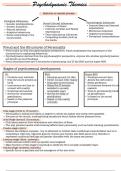
Psychodynamic Theories
Beahvior or mental process
Biological In uences:
Social-Cultural In uences: Pyschological In uences:
• Genetic predispositions
• Presence of others • Learned fears and learned
• Genetic mutations
• Cultural, societal, and family expectations
• Natural selection
expectations • Emotional responses
• Adaptive behaviours
• Peer/other group in uences • Cognitive processing
• Genes responding to the
• Compelling models (such as • Perceptual interpretations
environment
the media
Freud and the Structures of Personality
• Freud came up with the psychoanalytic perspective, which emphasizes the importance of the
unconscious in explaining behaviour.
• Psychodynamic derives from the psychoanalytic perspective. Anyone who studies psychodynamics
are known as neo-Freudians.
• Freud theorizes there are 3 structures of personality, the ID the EGO and the super-EGO.
Stages of psychosexual development:
ID: EGO: Super-EGO
• Contains only instincts • Develops around 13-15m • Develops around 4yrs
• Only structure present at • Direct contact with reality • Allows foe self-control
birth • Evaluates environment • Seeks perfection
• unconscious and has no • Helps the ID become • Is irrational because it's not
contact with reality satis ed in socially realistic
• Irrational and amoral acceptable ways • Tries to permanently block
• Strives for immediate • strives for delay of all grati cation
grati cation grati cation • Is based on the moral
• based on the pleasure • Based on the reality principle
principal. principle
Oral stage (birth to 15 month):
• Personality is in uenced based on degree in which the babies oral needs were grati ed.
• Focuses on the mouth, sucking/biting sensations which babies derive pleasure from.
Anal stage (around 18 months):
• Child gets pleasure from elimination and retention of feces.
• The way parents handle toilet training affects later personality such as toilet training punishments.
Phallic stage (4yrs):
• Follows the Oedipus complex - boy is attracted to mother, feels con ictual towards father and is in
competition with him. Opposite goes for women and women also feels penis envy. Results in
repressed con ictual feelings and gender identi es with the same sex parent.
Latency stage (5yrs - puberty):
• Little internal con ict with no speci c zone targeted.
• Main function of this stage to learning to satify the ID in socially acceptable ways.
Genital stage (puberty onwards):
• Speci c focus on genitals and the emergence of the sex drive.
fl flfl
Beahvior or mental process
Biological In uences:
Social-Cultural In uences: Pyschological In uences:
• Genetic predispositions
• Presence of others • Learned fears and learned
• Genetic mutations
• Cultural, societal, and family expectations
• Natural selection
expectations • Emotional responses
• Adaptive behaviours
• Peer/other group in uences • Cognitive processing
• Genes responding to the
• Compelling models (such as • Perceptual interpretations
environment
the media
Freud and the Structures of Personality
• Freud came up with the psychoanalytic perspective, which emphasizes the importance of the
unconscious in explaining behaviour.
• Psychodynamic derives from the psychoanalytic perspective. Anyone who studies psychodynamics
are known as neo-Freudians.
• Freud theorizes there are 3 structures of personality, the ID the EGO and the super-EGO.
Stages of psychosexual development:
ID: EGO: Super-EGO
• Contains only instincts • Develops around 13-15m • Develops around 4yrs
• Only structure present at • Direct contact with reality • Allows foe self-control
birth • Evaluates environment • Seeks perfection
• unconscious and has no • Helps the ID become • Is irrational because it's not
contact with reality satis ed in socially realistic
• Irrational and amoral acceptable ways • Tries to permanently block
• Strives for immediate • strives for delay of all grati cation
grati cation grati cation • Is based on the moral
• based on the pleasure • Based on the reality principle
principal. principle
Oral stage (birth to 15 month):
• Personality is in uenced based on degree in which the babies oral needs were grati ed.
• Focuses on the mouth, sucking/biting sensations which babies derive pleasure from.
Anal stage (around 18 months):
• Child gets pleasure from elimination and retention of feces.
• The way parents handle toilet training affects later personality such as toilet training punishments.
Phallic stage (4yrs):
• Follows the Oedipus complex - boy is attracted to mother, feels con ictual towards father and is in
competition with him. Opposite goes for women and women also feels penis envy. Results in
repressed con ictual feelings and gender identi es with the same sex parent.
Latency stage (5yrs - puberty):
• Little internal con ict with no speci c zone targeted.
• Main function of this stage to learning to satify the ID in socially acceptable ways.
Genital stage (puberty onwards):
• Speci c focus on genitals and the emergence of the sex drive.
fl flfl