

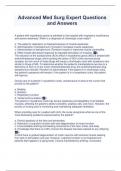
Advanced Med Surg Expert Questions and Answers
A patient with myasthenia gravis is admitted to the hospital with respiratory insufficiency and severe weakness. When is a diagnosis of cholinergic crisis made? a. The patient's respiration is impaired because of muscle weakness. b. Administration of edrophonium (Tensilon) increases muscle weakness. c. Administration of edrophonium (Tensilon) results in improved muscle contractility. d. EMG reveals decreased response to repeated stimulation of muscles. b. The reduction of the acetylcholine (ACh) effect in myasthenia gravis (MG) is treated with anticholinesterase drugs, which prolong the action of ACh at the neuromuscular synapse, but too much of these drugs will cause a cholinergic crisis with symptoms very similar to those of MG. To determine whether the patient's manifestations are due to a deficiency of ACh or to too much anticholinesterase drug, the anticholinesterase drug edrophonium chloride (Tensilon) is administered. If the patient is in cholinergic crisis, the patient's symptoms will worsen; if the patient is in a myasthenic crisis, the patient will improve. During care of a patient in myasthenic crisis, maintenance of what is the nurse's first priority for the patient? a. Mobility b. Nutrition c. Respiratory function d. Verbal communication c. The patient in myasthenic crisis has severe weakness and fatigability of all skeletal muscles, affecting the patient's ability to breathe, swallow, talk, and move. However, the priority of nursing care is monitoring and maintaining adequate ventilation. When providing care for a patient with ALS, the nurse recognizes what as one of the most distressing problems experienced by the patient? a. Painful spasticity of the face and extremities b. Retention of cognitive function with total degeneration of motor function c. Uncontrollable writhing and twisting movements of the face, limbs, and body d. Knowledge that there is a 50% chance the disease has been passed to any offspring b. In ALS there is gradual degeneration of motor neurons with extreme muscle wasting from lack of stimulation and use. However, cognitive function is not impaired and patients feel trapped in a dying body. Chorea manifested by writhing, involuntary movements is characteristic of HD. As an autosomal dominant genetic disease, HD also has a 50% chance of being passed to each offspring. In providing care for patients with chronic, progressive neurologic disease, what is the major goal of treatment that the nurse works toward? a. Meet the patient's personal care needs. b. Return the patient to normal neurologic function. c. Maximize neurologic functioning for as long as possible. d. Prevent the development of additional chronic diseases. c. Many chronic neurologic diseases involve progressive deterioration in physical or mental capabilities and have no cure, with devastating results for patients and families. Health care providers can only attempt to alleviate physical symptoms, prevent complications, and assist patients in maximizing function and self-care abilities for as long as possible.
Document information
- Uploaded on
- January 6, 2024
- Number of pages
- 191
- Written in
- 2023/2024
- Type
- Exam (elaborations)
- Contains
- Questions & answers


