
8
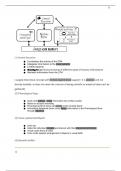
(1) Central Executive:
● Coordinates the activity of the STM
● Delegates information to the slave systems
● Limited capacity
● Modality free (general processing of different types of sensory information)
● Retrieves information from the LTM
[ Largely theoretical concept with limited experimental support= it is abstract and not
directly testable, so does not meet the criterion of being scientific as empirical data can’t be
gathered]
(2) Phonological loop:
● Deals with auditory, verbal information (inc written words)
● Relies on acoustic encoding
● Phonological Store (inner ear) stores words recently heard
● Articulatory Rehearsal (inner voice) keeps information in the Phonological Store
through repetition
(3) Visuo-spatial sketchpad:
● Inner eye
● Helps the individual navigate and interact with their physical environment.
● Visual cache (form & color)
● Inner scribe (spatial, arrangement of objects in visual field)
(4) Episodic buffer:
8
, 9
● Component added to the model in 2000
● Integrates information from Central Executive, Phonological Loop and Visuo-Spatial
Sketchpad
● Retrieves information from LTM
Strengths
Neuroimaging evidence :PET scans show different brain areas are used while undertaking
visual and verbal tasks, providing objective and scientific support and increasing credibility
of WMM as an accurate representation of memory.
Paulesu (1993) different brain regions activated during tasks using phonological store +
articulatory loop. Through PET scan :
- Broca’s area activated during a subvocal rehearsal task
- Supramarginal gyrus activated when phonological store used
However exact location of CE difficult to find (thought to diffuse across cortex)
Case study of KF : suffered STM impairment after a motorcycle accident, His short-term
forgetting of auditory information was greater than for visual information, suggesting that
his memory damage was restricted to the phonological loop.
Case study of HM : suffered gross impairment in his spatial memory with unaffected
memory for verbal information.
9

