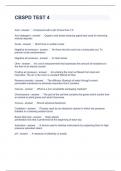
WSU Biology 106 Exam 3 Questions Marking Scheme
WSU Biology 106 Exam 3 Questions Marking Scheme Spongocoel - ANSWER- the large central cavity of sponges. water enters the spongocoel through tiny pores called ostia and it exits through the large opening called the osculum. spongocoel is lined with choanocytes which help to create a current in the water. Spicule - ANSWER- structural elements found in most sponges. They provide structural support and deter predators. Large ones are called megascleres while microscopic ones are called microscleres. Parenchyma - ANSWER- thin-walled cells that make up the inside of many non-woody plant structures including stems, roots, and leaves. form the mesophyll and are responsible for photosynthesis and gas exchange. Medusa - ANSWER- a free-swimming form of cnidarian in which the body is shaped like an umbrella. found in the aquatic invertebrate plum cnidaria. Corals, sea anemones and jellyfish belong to a group of animals called cnidarians. Tube Feet - ANSWER- One of the numerous external, fluid-filled muscular tubes of echinoderms, such as the starfish or sea urchin used for locomotion, respiration, and grasping food or prey. Mantle & Mantle Cavity - ANSWER- in mollusks, the mantle is the dorsal body wall which covers the visceral mass and usually protrudes in the form of flaps the mantle cavity is highly muscular. functions as a respiratory chamber mantle cavity is formed by a double fold of mantle which encloses a water space. Chelicerae - ANSWER- the pair of apendages/mouthparts of the "chelicerata", an arthropod group that includes arachnids (spiders), horseshoe crabs, and sea spiders. Pentaradial body plan - ANSWER- example includes echinoderms (starfish) body symmetry having 5 compartments (arms) branching out from central focus Notochord - ANSWER- a flexible, skeletal rod supporting the body in all embryonic and some adult chordate animals made of material similar to cartilage Osculum - ANSWER- a large aperture in a sponge through which water exits Cnidocyte - ANSWER- an specialized, explosive cell containing one giant secretory organelle or cnida that defines the phylum cnidaria examples include corals, sea anemones, jellyfish, etc.) cnidae are used for prey capture and defense from predators Gastrovascular Cavity - ANSWER- is a structure found in primitive animal phyla. responsible for both the digestion of food and the transport of nutrients thru the body only one opening. food goes in and waste comes out the same opening (=2-way digestive tract) Polyp - ANSWER- One of the two body forms of cnidarians (the other being medusa) cnidarian in its sedentary stage. The polyp body form is tube-shaped, sessile, elongated, and hollow with a central mouth on top surrounded by tentacles. corals and sea anemones only exist as polyps. Parapodia - ANSWER- refers to two different organs. In annelids, parapodia are paired, un-jointed lateral outgrowths that bear the chateau. In sea snails and slugs, refers to fleshy protrusions Visceral Mass - ANSWER- viscera refers to the internal organs of the body, specifically those within the chest (as the heart or lungs) or abdomen (liver, pancreas, intestines) Mandibles - ANSWER- the lower jawbone in vertebrates the pair of appendages near mouth in insects. function is to grasp, chew, crush the food or to defend against predators. Water-vascular system - ANSWER- is a hydraulic system used by echinoderms (starfish, sea urchins) for locomotion, food and waste transportation, and respiration. system composed of canals connecting numerous tube feet Pharyngeal gill arches - ANSWER- structures seen in the embryonic development of vertebrates that are recognizable precursors for many structures. In fish, these arches are known as branchial or gill arches. A series of externally visible anterior tissue bands lying under the early brain that give rise to the structures of the hand and neck Choanocyte - ANSWER- any of the flagellated cells in sponges that maintain the flow (current) of water through the body of the sponge. Make up the choanoderm, a type of cell layer found in sponges. Nematocyst - ANSWER- produced by a special cell called a cnidoblast and contains a coiled, hollow, barbed thread. Quickly turns outward from the capsule upon stimulation. Often contains poison. Serves to ward of enemies or to capture/immobilize prey. Uncharged nematocyst housed within a nematoc
Escuela, estudio y materia
- Institución
- WSU Biology 106 E
- Grado
- WSU Biology 106 E
Información del documento
- Subido en
- 19 de diciembre de 2023
- Número de páginas
- 18
- Escrito en
- 2023/2024
- Tipo
- Examen
- Contiene
- Preguntas y respuestas
Temas
-
wsu biology 106 exam 3 questions marking sch
-
wsu biology 106 exam 3 questions marking scheme

Documento también disponible en un lote