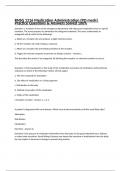
RNSG 1216 Medication Administration (PO meds) Practice Questions & Answers Solved 100%
Question 1: A patient arrives at the emergency department with depressed respirations from an opioid overdose. The nurse prepares to administer the antagonist naloxone. The nurse understands an antagonist will do which of the following? a. Attach at a receptor site and produce a slight chemical action. b. Fit the receptor site well creating a response. c. Attach at a receptor site preventing activation of the receptor. d. Trigger the immune response to prevent an allergic reaction. - Answer c; This describes the action of an antagonist. By blocking the receptor, no chemical reaction can occur. Question 1: Pharmacokinetics is the study of the metabolism and action of medications with particular emphasis on which of the following? (Select all that apply.) a. The time required for absorption b. The effect of medication on a living organism c. Distribution in the body d. Method of excretion of the medication e. Origin of the medication f. Duration of action - Answer a, c, d, f; A patient is diagnosed with renal disease. Which area of pharmacokinetics will this most likely alter? Absorption Distribution Metabolism Excretion - Answer d; Excretion is the process of medication elimination from the body via the gastrointestinal tract, kidneys, or other body secretions. Renal (kidney) disease may impair the excretion of medications from the body. He may require a decrease in dosage to prevent drug toxicity. You have orders to administer a pain medication by the intravenous (IV) route because the patient will receive quicker pain relief. Which area of pharmacokinetics does the route of administration influence? Absorption Distribution Metabolism Excretion - Answer a; You are preparing to administer medications to a group of patients on a medical unit. Which of the following patients should you pay particular attention to because they are at an increased risk of having an adverse medication reaction? (Select all that apply.) a. A 99-year-old patient who receives 10 medications daily b. A 40-year-old patient with a fractured clavicle and ribs c. A patient who has a history of alcohol abuse and is diagnosed with hepatitis d. A 35-year-old patient who is 90 pounds over her ideal body weight e. A 52-year-old patient recuperating from multiple lobe pneumonia f. A 17-year-old patient receiving sulfa for the first time - Answer a, c, d, f **slide 14, lesson 1, module 5 idiosyncratic reaction - Answer An abnormal and unexpected response to a medication, other than an allergic reaction, that is peculiar to an individual patient. Patient A who developed hives after taking oral amoxicillin (an antibiotic). Patient B, a child with croup, who was given an oral antihistamine. The medication usually makes people sleepy, but this patient is unable to sit still and/or sleep. Patient C who has been taking an oral iron supplement for anemia. In a follow-up lab report, her hemoglobin was within normal limits. Patient D who states that when she does not take her calcium supplement with food it makes her nauseated. Patient E with renal failure who has been receiving morphine sulfate 5 mg IV to relieve his back pain. His respiratory rate has fallen from 22 to 8 in the last hour. - Answer 1.Allergic reactiom 2.Idiosyncratic effect 3.Therapeutic effect 4.Side effect 5.Toxic effect A patient with a history of alcohol abuse. He requires a large amount of pain medication to relieve his postoperative pain. A patient whose dosage of pain medication increased over the last 3 months to treat his cancer pain. A patient who knows he must decrease his prednisone (Deltasone) dosage (a steroid) gradually rather than discontinuing the medication abruptly. A patient who was in a motor vehicle accident and was unconscious for 3 days. As she recovers, she requests a cigarette or to ask the health care provider for a nicotine patch, stating, "I am too nervous without it." - Answer 1. The patient who was unconscious for 3 days. 2. The patient who has to stop a medication gradually. 3. The patient with cancer pain. 4. The patient with a history of alcoholism. 1.Psychological dependence 2.Physical dependence 3.Tolerance 4.Cross-tolerance Onset of medication action - Answer Period of time it takes after you administer a medication for it to produce a therapeutic effect Peak action - Answer occurs when the drug reaches its highest blood or plasma concentration
Escuela, estudio y materia
- Institución
- RNSG 1216
- Grado
- RNSG 1216
Información del documento
- Subido en
- 11 de diciembre de 2023
- Número de páginas
- 6
- Escrito en
- 2023/2024
- Tipo
- Examen
- Contiene
- Preguntas y respuestas
Temas
- rnsg 1216 stuvia
-
rnsg 1216 medication administration po meds prac
-
question 1 a patient arrives at the emergency dep
-
question 1 pharmacokinetics is the study of the m

Documento también disponible en un lote